Schmitz Florian, Wilhelm Oliver
Institute of Psychology, Ulm University, Albert-Einstein Allee 47, 89081 Ulm, Germany.
J Intell. 2019 Jul 9;7(3):16. doi: 10.3390/jintelligence7030016.
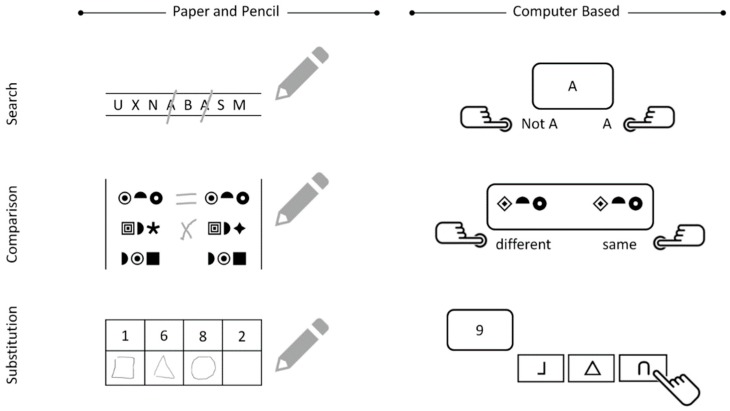
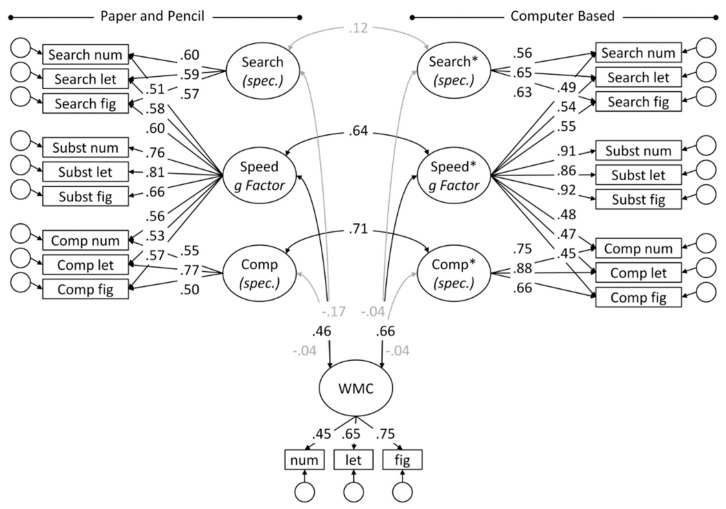
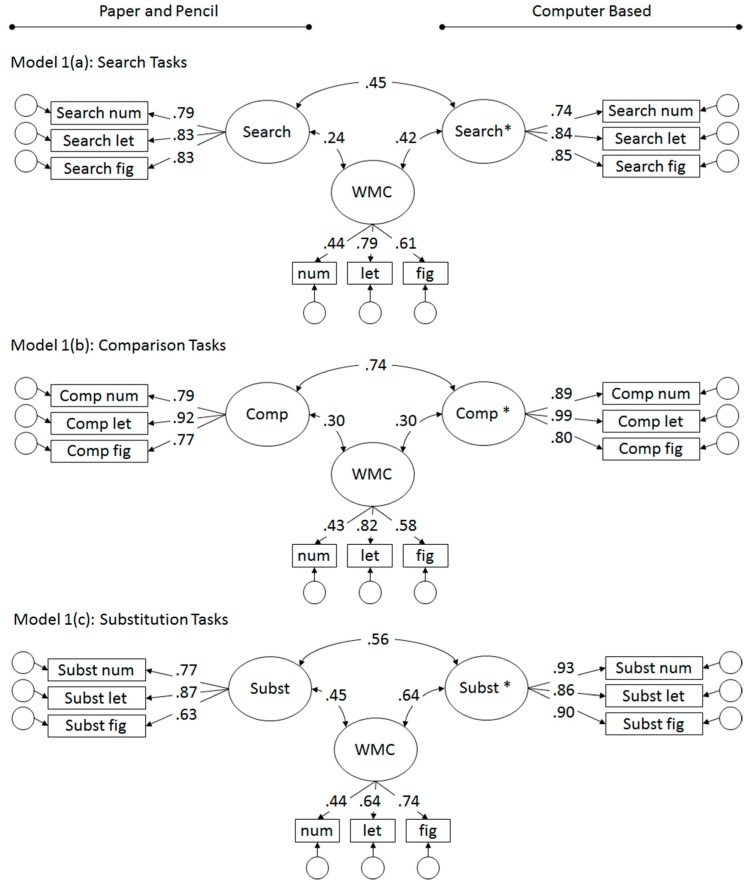
Current taxonomies of intelligence comprise two factors of mental speed, clerical speed (Gs), and elementary cognitive speed (Gt). Both originated from different research traditions and are conceptualized as dissociable constructs in current taxonomies. However, previous research suggests that tasks of one category can be transferred into the other category by simply changing the mode of administration, i.e., in form of a paper-and-pencil test or in from of a computer-based elementary cognitive task. However, cross-mode correlations for specific tasks are usually only moderate. In the present study, mental speed was assessed as a broad construct across different tasks and stimulus materials. This allowed modeling mental speed as a hierarchical construct for paper-and-pencil as well as for computer-based tests. Cross-mode correlations of the respective general factors were moderate ( = 0.64), while the cross-mode correlations of task-specific components depended on task type ( = 0.12 to = 0.71). Only the g factors of mental speed, but not the task-specific components, were found to be related with working memory capacity as a marker of cognitive ability. The speed general factor modeled across computer-based tests was more highly correlated with working memory capacity ( = 0.66) than the general factor modeled across paper-and-pencil tests ( = 0.46). These findings corroborate a crucial role of the assessment method and imply that validity of speed tests is affected by the choice of the test format.
当前的智力分类法包含心理速度的两个因素,即文书速度(Gs)和基本认知速度(Gt)。这两个因素都源自不同的研究传统,在当前的分类法中被概念化为可分离的结构。然而,先前的研究表明,通过简单地改变施测方式,即纸笔测试形式或基于计算机的基本认知任务形式,一类任务可以转换为另一类任务。然而,特定任务的跨模式相关性通常仅为中等程度。在本研究中,心理速度被评估为一个跨越不同任务和刺激材料的宽泛结构。这使得能够将心理速度建模为纸笔测试以及基于计算机测试的层次结构。各个一般因素的跨模式相关性为中等(= 0.64),而特定任务成分的跨模式相关性则取决于任务类型(= 0.12至 = 0.71)。研究发现,只有心理速度的g因素与作为认知能力指标的工作记忆容量相关,而特定任务成分则不然。基于计算机测试建模的速度一般因素与工作记忆容量的相关性(= 0.66)高于基于纸笔测试建模的一般因素(= 0.46)。这些发现证实了评估方法的关键作用,并暗示速度测试的有效性受测试形式选择的影响。