Pasini Luigi, Ulivi Paola
Biosciences Laboratory, Istituto Scientifico Romagnolo per lo Studio e la Cura dei Tumori (IRST) IRCCS, 47014 Meldola, Italy.
J Clin Med. 2019 Jul 9;8(7):998. doi: 10.3390/jcm8070998.
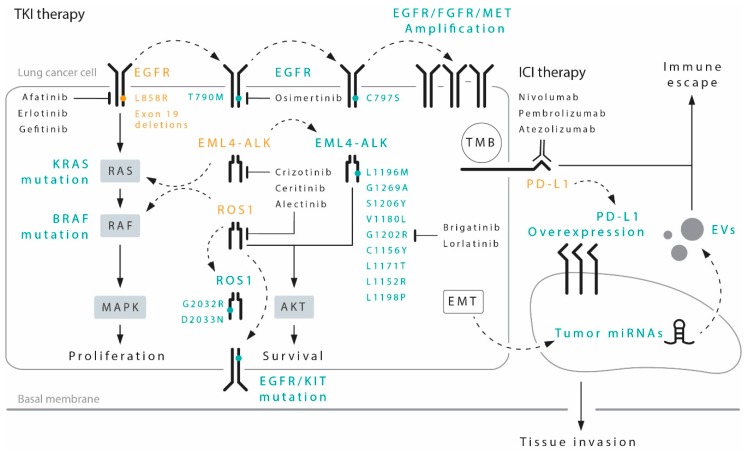
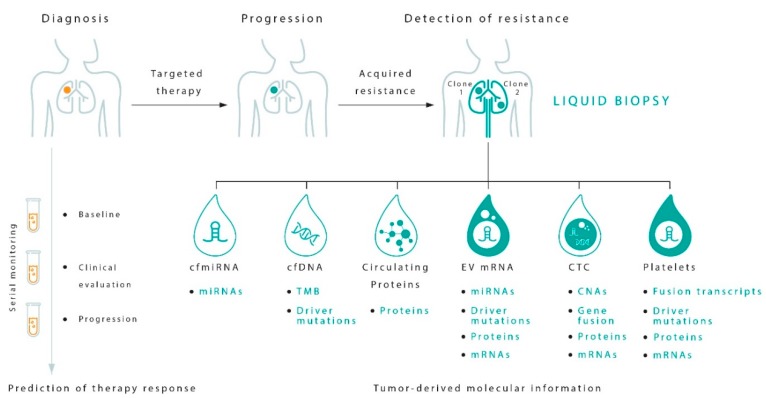
The use of targeted agents and immunotherapy for the treatment of advanced non-small-cell lung cancer (NSCLC) has made it mandatory to characterize tumor tissue for patient selection. Moreover, the development of agents that are active against specific resistance mechanisms arising during treatment make it equally important to characterize the tumor tissue at progression by performing tissue re-biopsy. Given that tumor tissue is not always available for molecular characterization due to the paucity of diagnostic specimens or problems relating to the carrying out of invasive procedures, the use of liquid biopsy represents a valid approach to overcoming these difficulties. The most common material used for liquid biopsy in this setting is plasma-derived cell free DNA (cfDNA), which originates from cells undergoing apoptosis or necrosis. However, other sources of tumor material can be considered, such as extracellular vesicle (EV)-derived nucleic acids, which are actively secreted from living cells and closely correspond to tumor dynamics. In this review, we discuss the role of liquid biopsy in the therapeutic management of NSCLC with particular regard to targeted therapy and immunotherapy, and analyze the pros and cons of the different types of samples used in this context.
使用靶向药物和免疫疗法治疗晚期非小细胞肺癌(NSCLC)使得为患者选择进行肿瘤组织特征分析成为必要。此外,针对治疗期间出现的特定耐药机制具有活性的药物的研发,使得通过进行组织重新活检来在疾病进展时对肿瘤组织进行特征分析同样重要。鉴于由于诊断标本匮乏或与实施侵入性操作相关的问题,并非总能获得肿瘤组织进行分子特征分析,液体活检的应用是克服这些困难的有效方法。在这种情况下,用于液体活检最常见的材料是血浆来源的游离DNA(cfDNA),其源自经历凋亡或坏死的细胞。然而,也可以考虑其他肿瘤材料来源,例如细胞外囊泡(EV)衍生的核酸,其由活细胞主动分泌且与肿瘤动态密切相关。在本综述中,我们讨论液体活检在NSCLC治疗管理中的作用,特别关注靶向治疗和免疫疗法,并分析在此背景下使用的不同类型样本的优缺点。