Respiratory Department of Chinese PLA General Hospital, Beijing, China.
Cancer Med. 2019 Mar;8(3):910-919. doi: 10.1002/cam4.1935. Epub 2019 Feb 14.
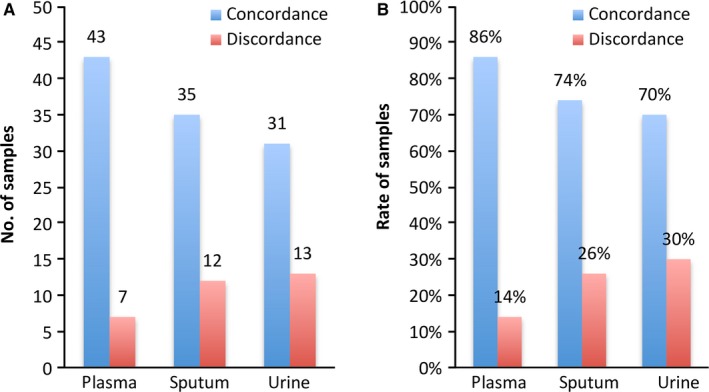
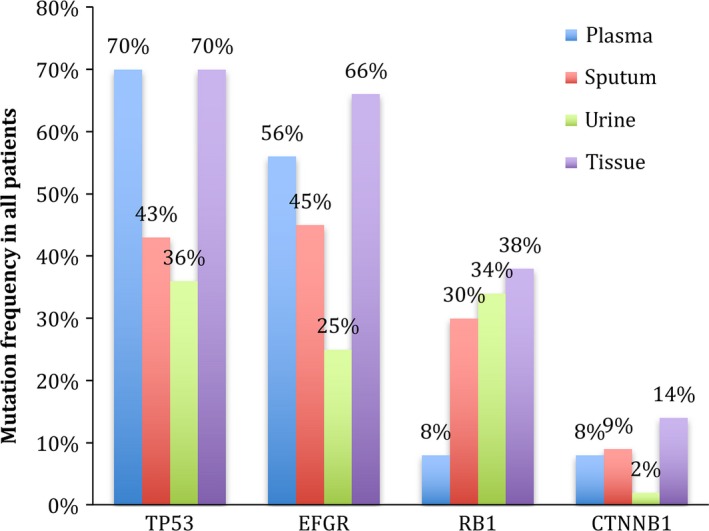
Liquid biopsy has provided an efficient way for detection of gene alterations in advanced non-small-cell lung cancer (NSCLC). However, the correlation between systematic determination of somatic genomic alterations in liquid biopsy and tumor biopsy still remained unclear, and the concordance rate between cell-free DNA (cfDNA) and matched tumor tissue DNA needs to be increased. A prospective study was performed to detect differences in genetic profiles of cfDNA in sputum, plasma, urine, and tumor tissue from 50 advanced NSCLC patients in parallel by the same next-generation sequencing (NGS) platform. Driver genes alterations were identified in cfDNA sample and matched tumor sample, with an overall concordance rate of 86% in plasma cfDNA, 74% in sputum cfDNA, 70% in urine cfDNA, and 90% in cfDNA of combination of plasma, sputum, and urine. And the concordant rate of cfDNA in sputum in patients with smoking history was higher than that in patients without history of smoking (89% vs. 66%, P = 0.033) and equal to that in plasma cfDNA of the smoking patients (89% vs. 89%). In conclusion, sputum cfDNA can be considered as an alternative medium to liquid biopsy, while the complementarity of genomic profiles in cfDNA among plasma, sputum, and urine was beneficial to detect more diver genes alterations and improve the utility of liquid biopsy in advanced NSCLC (Liquid Biopsy for Detection of Driver Mutation in NSCLC; NCT02778854).
液体活检为检测晚期非小细胞肺癌(NSCLC)中的基因改变提供了一种有效的方法。然而,液体活检中系统确定体细胞基因组改变与肿瘤活检之间的相关性仍不清楚,需要提高游离 DNA(cfDNA)与匹配的肿瘤组织 DNA 的一致性。一项前瞻性研究通过相同的下一代测序(NGS)平台,同时平行检测 50 例晚期 NSCLC 患者的痰液、血浆、尿液和肿瘤组织中 cfDNA 的遗传特征差异。在 cfDNA 样本和匹配的肿瘤样本中鉴定出驱动基因改变,血浆 cfDNA 的总一致性率为 86%,痰液 cfDNA 为 74%,尿液 cfDNA 为 70%,血浆、痰液和尿液 cfDNA 的组合为 90%。有吸烟史的患者的痰液 cfDNA 的一致性率高于无吸烟史的患者(89%比 66%,P=0.033),与吸烟患者的血浆 cfDNA 一致率相同(89%比 89%)。总之,痰液 cfDNA 可以被认为是液体活检的替代介质,而血浆、痰液和尿液中 cfDNA 的基因组特征互补性有利于检测更多的差异基因改变,提高液体活检在晚期 NSCLC 中的应用(非小细胞肺癌驱动突变的液体活检;NCT02778854)。