Department of Materials Science and Engineering, 2800 Plymouth Rd, Building 28, Room 3044W, Ann Arbor, MI, 48109, USA.
Department of Computational Mathematics, Science, and Engineering, Michigan State University, East Lansing, MI, 48823, USA.
J Immunother Cancer. 2019 Jul 19;7(1):190. doi: 10.1186/s40425-019-0666-1.
Innate immune cells such as macrophages are abundantly present within malignant ascites, where they share the microenvironment with ovarian cancer stem cells (CSC).
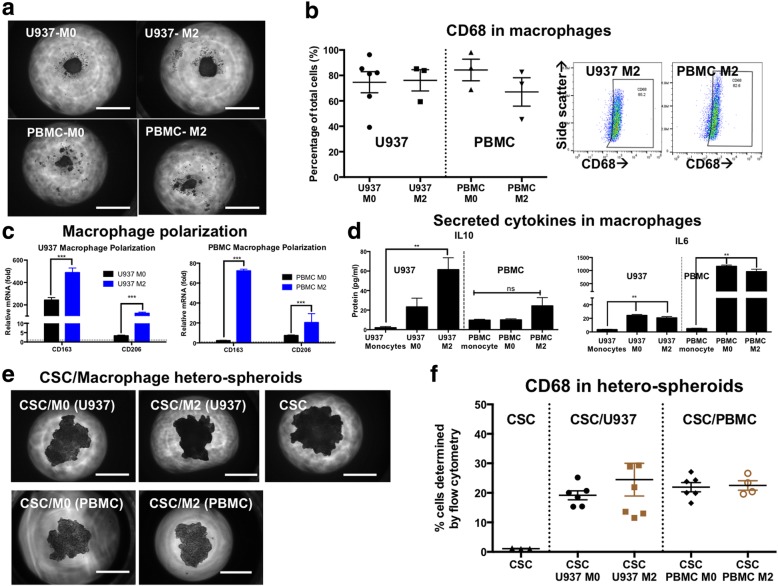
To mimic this malignant ascites microenvironment, we created a hanging-drop hetero-spheroid model to bring CSCs and macrophages in close association. Within these hetero-spheroids, CD68 macrophages (derived from U937 or peripheral blood monocytes) make up ~ 20% of the population, while the rest are ovarian cancer cells and ovarian cancer stem cells (derived from the high grade serous ovarian cancer cell line, OVCAR3).
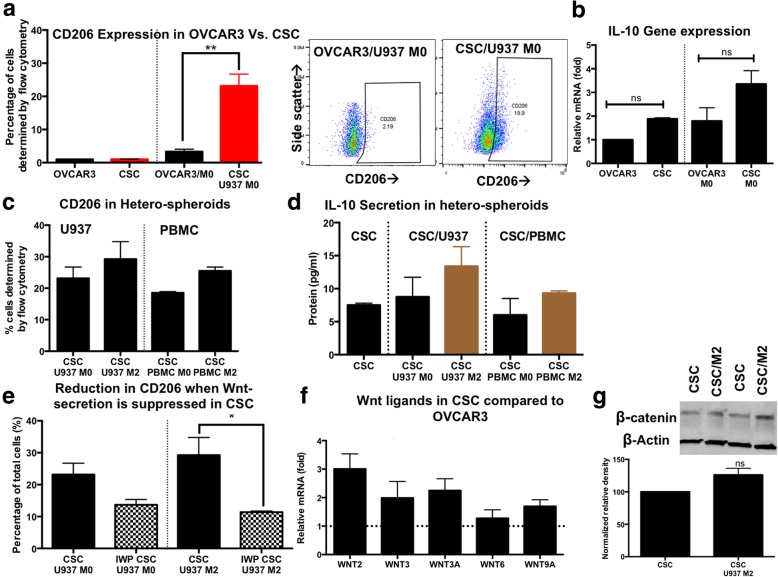
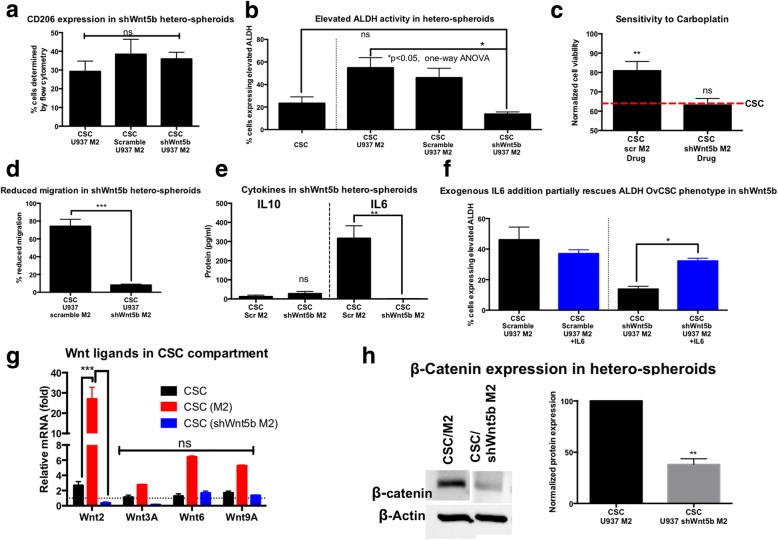
Our results indicate that CSCs drive the upregulation of M2 macrophage marker CD206 within hetero-spheroids, compared to bulk ovarian cancer cells, implying an inherently more immuno-suppressive program. Moreover, an increased maintenance of elevated aldehyde dehydrogenase (ALDH) activity is noted within hetero-spheroids that include pre-polarized CD206 M2 macrophages, implying a reciprocal interaction that drives pro-tumoral activation as well as CSC self-renewal. Consistent with enriched CSCs, we also observe increased levels of pro-tumoral IL-10 and IL-6 cytokines in the CSC/M2-macrophage hetero-spheroids. CSC/M2-macrophage hetero-spheroids are also less sensitive to the chemotherapeutic agent carboplatin and are subsequently more invasive in transwell assays. Using inhibitors of WNT secretion in both CSCs and macrophages, we found that CSC-derived WNT ligands drove CD206 M2 macrophage activation, and that, conversely, macrophage-derived WNT ligands enriched ALDH cells within the CSC compartment of hetero-spheroids. Upon examination of specific WNT ligand expression within the monocyte-derived macrophage system, we observed a significant elevation in gene expression for WNT5B. In CSCs co-cultured with macrophages within hetero-spheroids, increases in several WNT ligands were observed, and this increase was significantly inhibited when WNT5B was knocked down in macrophages.
Our data implies that macrophage- initiated WNT signaling could play a significant role in the maintenance of stemness, and the resulting phenotypes of chemoresistance and invasiveness. Our results indicate paracrine WNT activation during CSC/M2 macrophages interaction constitutes a positive feedback loop that likely contributes to the more aggressive phenotype, which makes the WNT pathway a potential target to reduce the CSC and M2 macrophage compartments in the tumor microenvironment.
先天免疫细胞(如巨噬细胞)在恶性腹水中大量存在,在那里它们与卵巢癌干细胞(CSC)共享微环境。
为了模拟这种恶性腹水微环境,我们创建了一个悬滴异质球体模型,使 CSC 和巨噬细胞紧密相关。在这些异质球体中,CD68 巨噬细胞(来自 U937 或外周血单核细胞)占人口的~20%,其余为卵巢癌细胞和卵巢癌干细胞(来自高级别浆液性卵巢癌细胞系 OVCAR3)。
我们的结果表明,与 bulk 卵巢癌细胞相比,CSC 驱动异质球体中 M2 巨噬细胞标志物 CD206 的上调,这表明其具有内在的更免疫抑制的程序。此外,在包含预极化 CD206 M2 巨噬细胞的异质球体中,醛脱氢酶(ALDH)活性的维持增加,这暗示了一种互惠的相互作用,既驱动了促肿瘤激活,也驱动了 CSC 自我更新。与富集的 CSC 一致,我们还观察到 CSC/M2-巨噬细胞异质球体中促肿瘤的 IL-10 和 IL-6 细胞因子水平升高。CSC/M2-巨噬细胞异质球体对化疗药物卡铂的敏感性也较低,并且在 Transwell 测定中侵袭性更强。使用 CSC 和巨噬细胞中 WNT 分泌的抑制剂,我们发现 CSC 衍生的 WNT 配体驱动 CD206 M2 巨噬细胞活化,并且相反,巨噬细胞衍生的 WNT 配体在异质球体的 CSC 隔室中富集 ALDH 细胞。在单核细胞衍生的巨噬细胞系统中检查特定的 WNT 配体表达时,我们观察到 WNT5B 的基因表达显著升高。在 CSC 与巨噬细胞共培养于异质球体中时,观察到几种 WNT 配体增加,并且当巨噬细胞中的 WNT5B 被敲低时,这种增加显著受到抑制。
我们的数据表明,巨噬细胞启动的 WNT 信号可能在维持干性和由此产生的耐药性和侵袭性表型中发挥重要作用。我们的结果表明,CSC/M2 巨噬细胞相互作用过程中的旁分泌 WNT 激活构成了一个正反馈回路,可能有助于更具侵袭性的表型,这使得 WNT 途径成为减少肿瘤微环境中 CSC 和 M2 巨噬细胞的潜在靶标。