Flores-Holguín Norma, Frau Juan, Glossman-Mitnik Daniel
Laboratorio Virtual NANOCOSMOS, Departamento de Medio Ambiente y Energía, Centro de Investigación en Materiales Avanzados, Miguel de Cervantes 120, Complejo Industrial Chihuahua, 31136, Chihuahua, Mexico.
Departament de Química, Universitat de les Illes Balears, 07122, Palma, Spain.
BMC Res Notes. 2019 Jul 19;12(1):442. doi: 10.1186/s13104-019-4478-7.
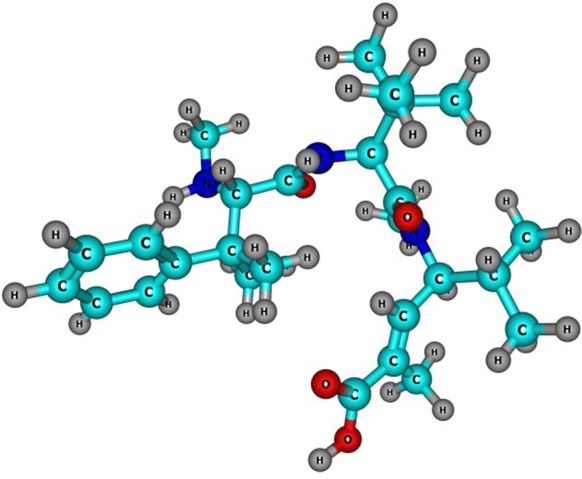
A well-behaved model chemistry previously validated for the study of the chemical reactivity of peptides was considered for the calculation of the molecular properties and structure of the Taltobulin anticancer peptide. A methodology based on Conceptual Density Functional Theory (CDFT) was chosen for the determination of the reactivity descriptors.
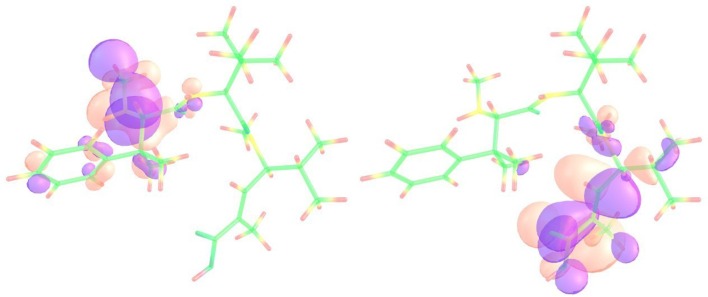
The molecular active sites were associated with the active regions of the molecule were associated with the nucleophilic and electrophilic Fukui functions. Finally, the bioactivity scores for the Taltobulin peptide are predicted through a homology methodology relating them with the calculated reactivity descriptors.
考虑使用一种先前已验证适用于肽化学反应性研究的性能良好的模型化学方法,来计算塔尔托布林抗癌肽的分子性质和结构。选择了一种基于概念密度泛函理论(CDFT)的方法来确定反应性描述符。
分子活性位点与分子的活性区域相关,这些区域与亲核和亲电福井函数相关。最后,通过一种同源性方法预测塔尔托布林肽的生物活性分数,该方法将它们与计算出的反应性描述符相关联。