Laboratory of Molecular Neuropharmacology, Graduate School of Pharmaceutical Sciences, Osaka University, Suita, Osaka, Japan.
Laboratory of Biopharmaceutics, Graduate School of Pharmaceutical Sciences, Osaka University, Suita, Osaka, Japan.
Int J Neuropsychopharmacol. 2019 Oct 1;22(10):665-674. doi: 10.1093/ijnp/pyz041.
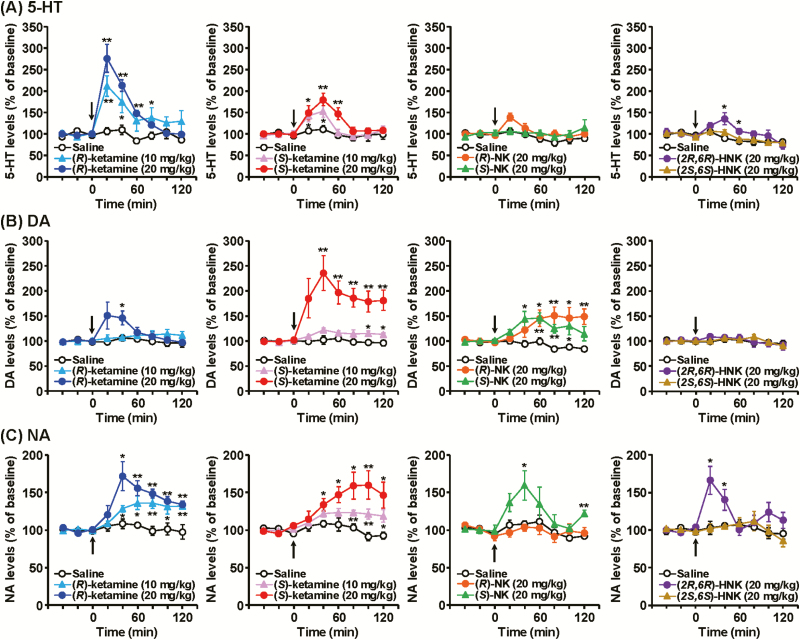
Although recent studies provide insight into the molecular mechanisms of the effects of ketamine, the antidepressant mechanism of ketamine enantiomers and their metabolites is not fully understood. In view of the involvement of mechanisms other than the N-methyl-D-aspartate receptor in ketamine's action, we investigated the effects of (R)-ketamine, (S)-ketamine, (R)-norketamine [(R)-NK], (S)-NK, (2R,6R)-hydroxynorketamine [(2R,6R)-HNK], and (2S,6S)-HNK on monoaminergic neurotransmission in the prefrontal cortex of mice.
The extracellular monoamine levels in the prefrontal cortex were measured by in vivo microdialysis.
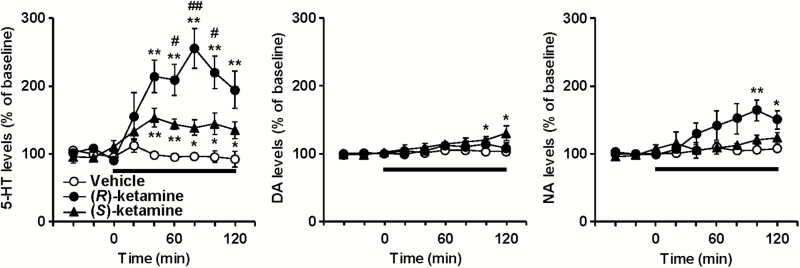
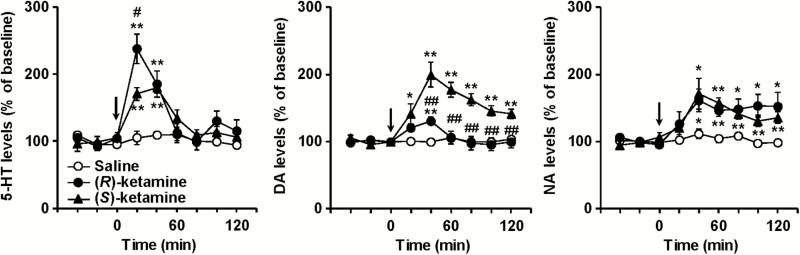
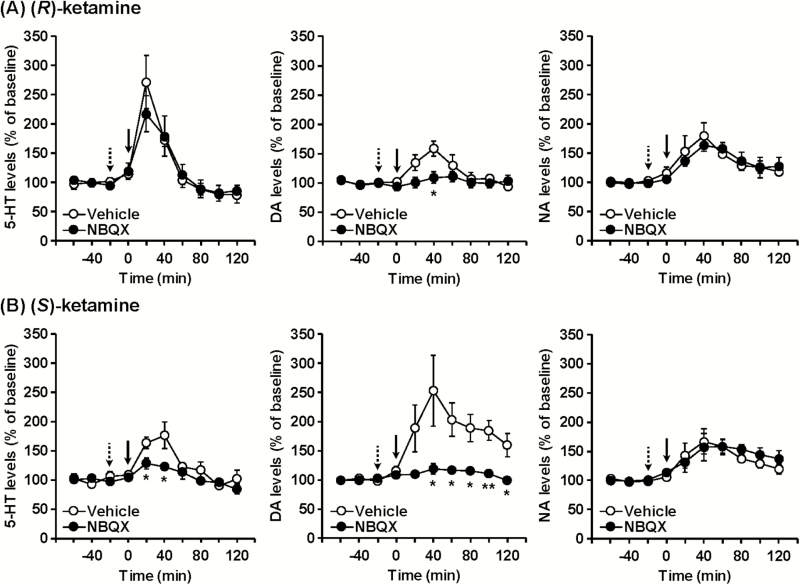
(R)-Ketamine and (S)-ketamine acutely increased serotonin release in a dose-dependent manner, and the effect of (R)-ketamine was greater than that of (S)-ketamine. In contrast, (S)-ketamine caused a robust increase in dopamine release compared with (R)-ketamine. Both ketamine enantiomers increased noradrenaline release, but these effects did not differ. (2R,6R)-HNK caused a slight but significant increase in serotonin and noradrenaline but not dopamine release. (S)-NK increased dopamine and noradrenaline but not serotonin release. Differential effects between (R)-ketamine and (S)-ketamine were also observed in a lipopolysaccharide-induced model of depression. An α-amino-3-hydroxy-5-methyl-4-isoxazole-propionic acid (AMPA) receptor antagonist, 2,3-dioxo-6-nitro-1,2,3,4- tetrahydrobenzo[f]quinoxaline-7-sulfonamide (NBQX), attenuated (S)-ketamine-induced, but not (R)-ketamine-induced serotonin release, whereas NBQX blocked dopamine release induced by both enantiomers. Local application of (R)-ketamine into the prefrontal cortex caused a greater increase in prefrontal serotonin release than that of (S)-ketamine.
(R)-Ketamine strongly activates the prefrontal serotonergic system through an AMPA receptor-independent mechanism. (S)-Ketamine-induced serotonin and dopamine release was AMPA receptor-dependent. These findings provide a neurochemical basis for the underlying pharmacological differences between ketamine enantiomers and their metabolites.
尽管最近的研究提供了对氯胺酮作用的分子机制的深入了解,但氯胺酮对映异构体及其代谢物的抗抑郁机制仍未完全阐明。鉴于氯胺酮作用涉及 NMDA 受体以外的其他机制,我们研究了(R)-氯胺酮、(S)-氯胺酮、(R)-去甲氯胺酮[(R)-NK]、(S)-去甲氯胺酮[(S)-NK]、(2R,6R)-羟基去甲氯胺酮[(2R,6R)-HNK]和(2S,6S)-HNK 对小鼠前额叶中单胺能神经传递的影响。
通过体内微透析测量前额叶皮质中的细胞外单胺水平。
(R)-氯胺酮和(S)-氯胺酮急性剂量依赖性增加 5-羟色胺释放,(R)-氯胺酮的作用大于(S)-氯胺酮。相比之下,(S)-氯胺酮引起多巴胺释放的强烈增加,而(R)-氯胺酮则没有。两种氯胺酮对映异构体均增加去甲肾上腺素释放,但这些作用没有差异。(2R,6R)-HNK 引起 5-羟色胺和去甲肾上腺素的轻微但显著增加,但不引起多巴胺释放。(S)-NK 增加多巴胺和去甲肾上腺素,但不增加 5-羟色胺释放。在脂多糖诱导的抑郁模型中也观察到(R)-氯胺酮和(S)-氯胺酮之间的差异效应。α-氨基-3-羟基-5-甲基-4-异恶唑丙酸(AMPA)受体拮抗剂 2,3-二氧代-6-硝基-1,2,3,4-四氢苯并[f]喹喔啉-7-磺酰胺(NBQX)减弱了(S)-氯胺酮诱导的但不(R)-氯胺酮诱导的 5-羟色胺释放,而 NBQX 阻断了两种对映异构体诱导的多巴胺释放。(R)-氯胺酮局部应用于前额叶皮质引起的前额叶 5-羟色胺释放增加大于(S)-氯胺酮。
(R)-氯胺酮通过非 AMPA 受体依赖机制强烈激活前额叶 5-羟色胺能系统。(S)-氯胺酮诱导的 5-羟色胺和多巴胺释放依赖于 AMPA 受体。这些发现为氯胺酮对映异构体及其代谢物之间潜在药理学差异提供了神经化学基础。