Division of Psychiatry, University College London, London, UK.
BMJ Open. 2019 Jul 19;9(7):e027925. doi: 10.1136/bmjopen-2018-027925.
Inflammation has been implicated in the aetiology of mental illness. We conducted the first systematic review and meta-analysis of the association between peripheral markers of inflammation and generalised anxiety disorder (GAD).
Systematic review and meta-analysis of studies measuring peripheral cytokine levels in people with GAD compared with controls.
MEDLINE (1950-), EMBASE (1947-), PsycINFO (1872-) and Web of Science (1945-) databases up until January 2018.
Primary, quantitative research studies of people with a diagnosis of GAD assessed using a standardised clinical interview that measured peripheral inflammatory markers.
Two independent reviewers extracted data and assessed study quality. Meta-analysis using a random-effects model was conducted for individual cytokines where data from three or more studies were available.
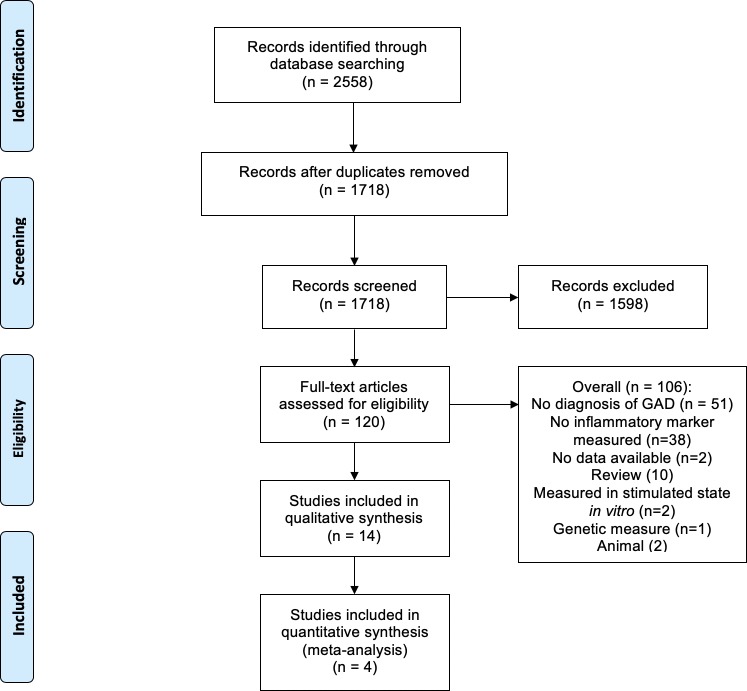
14 of 1718 identified studies met the inclusion criteria, comprising 1188 patients with GAD and 10 623 controls. In total 16 cytokines were evaluated. Significantly raised levels of C reactive protein (CRP), interferon-γ and tumour necrosis factor-α were reported in patients with GAD compared with controls in two or more studies. Ten further proinflammatory cytokines were reported to be significantly raised in GAD in at least one study. However, 5 of 14 studies found no difference in the levels of at least one cytokine. Only CRP studies reported sufficient data for meta-analysis. CRP was significantly higher in people with GAD compared with controls, with a small effect size (Cohen's d=0.38, 0.06-0.69), comparable with that reported in schizophrenia. However, heterogeneity was high (I=75%), in keeping with meta-analyses of inflammation in other psychiatric conditions and reflecting differences in participant medication use, comorbid depression and cytokine sampling methodology.
There is preliminary evidence to suggest an inflammatory response in GAD, but it remains unclear whether inflammatory cytokines play a role in the aetiology. GAD remains a poorly studied area of neuroinflammation compared with other mental disorders, and further longitudinal studies are required.
炎症与精神疾病的病因有关。我们进行了首次系统综述和荟萃分析,以评估外周炎症标志物与广泛性焦虑障碍(GAD)之间的关系。
对 GAD 患者与对照组外周细胞因子水平进行测量的研究进行系统综述和荟萃分析。
截至 2018 年 1 月,MEDLINE(1950 年起)、EMBASE(1947 年起)、PsycINFO(1872 年起)和 Web of Science(1945 年起)数据库。
使用标准临床访谈对 GAD 进行诊断的原发性、定量研究,该访谈可测量外周炎症标志物。
两名独立审查员提取数据并评估研究质量。当有 3 项或更多研究提供数据时,采用随机效应模型对个别细胞因子进行荟萃分析。
在 1718 项已确定的研究中,有 14 项符合纳入标准,包括 1188 例 GAD 患者和 10623 例对照。共评估了 16 种细胞因子。有 2 项或更多研究报告,GAD 患者的 C 反应蛋白(CRP)、干扰素-γ和肿瘤坏死因子-α水平显著升高,而对照组没有。有 10 项进一步的促炎细胞因子在至少一项研究中被报道显著升高。然而,有 5 项研究报告了至少一种细胞因子水平没有差异。只有 CRP 研究报告了足够的数据进行荟萃分析。与对照组相比,GAD 患者的 CRP 显著升高,效应量较小(Cohen's d=0.38,0.06-0.69),与精神分裂症的报道相似。然而,异质性很高(I=75%),这与其他精神疾病的炎症荟萃分析一致,反映了参与者用药、共病抑郁和细胞因子采样方法的差异。
有初步证据表明 GAD 存在炎症反应,但尚不清楚炎症细胞因子是否在发病机制中发挥作用。与其他精神障碍相比,GAD 仍然是神经炎症研究较少的领域,需要进一步的纵向研究。