Department of Anatomy, Faculty of Medicine, University of Helsinki, Haartmaninkatu 8 00290 Helsinki, Finland; Minerva Foundation Institute for Medical Research, Tukholmankatu 8, 00290 Helsinki, Finland.
Orphazyme A/S, Ole Maaløes Vej 3, DK-2200 Copenhagen N, Denmark.
Mol Metab. 2019 Oct;28:135-143. doi: 10.1016/j.molmet.2019.07.005. Epub 2019 Jul 6.
Heat Shock Proteins (HSPs) maintain cellular homeostasis under stress. HSP70 represents a major stress-inducible family member and has been identified as a druggable target in inherited cholesterol-sphingolipid storage diseases. We investigated if HSP70 modulates cholesterol accumulation in more common conditions related to atherogenesis.
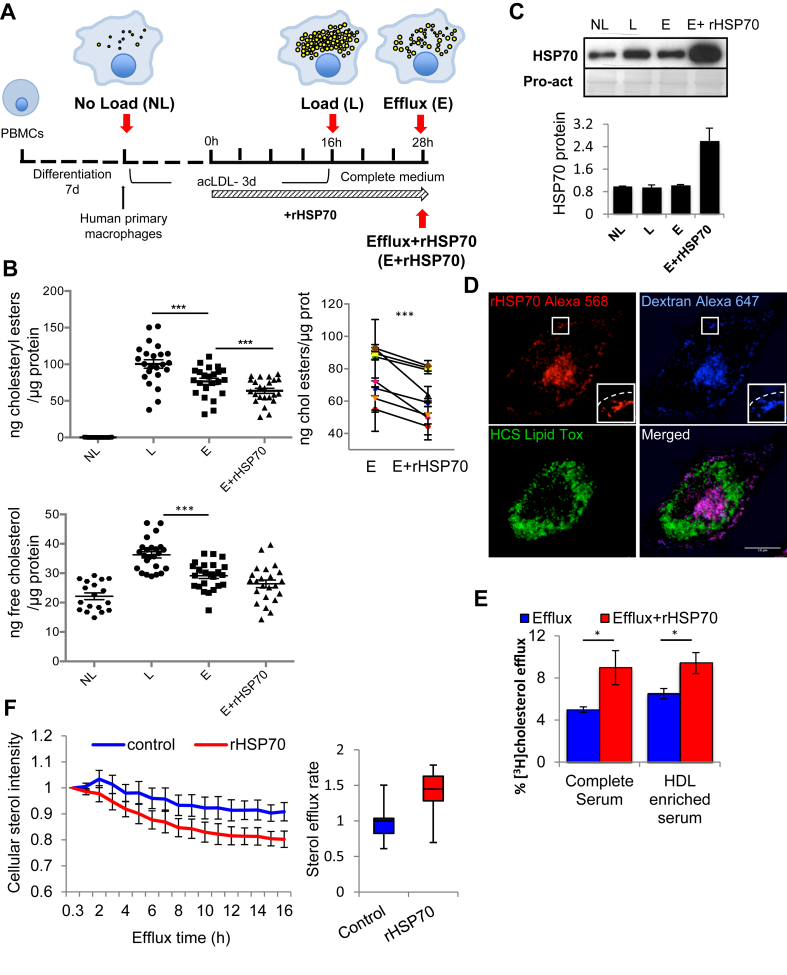
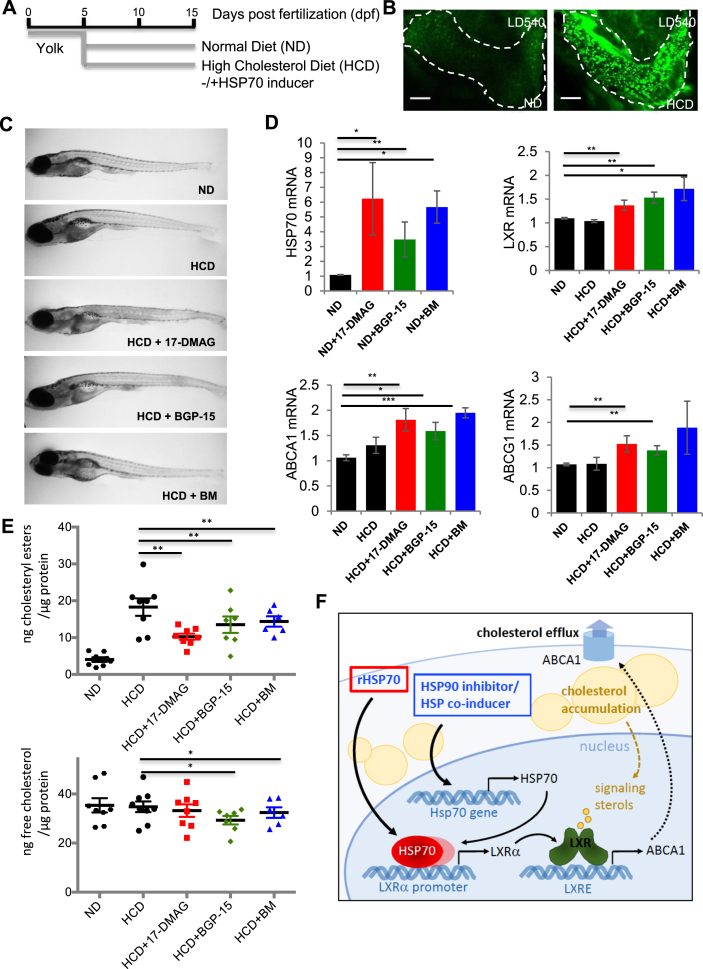
We studied the effects of recombinant HSP70 in cholesterol-laden primary macrophages from human blood donors and pharmacological HSP70 upregulation in high-cholesterol diet fed zebrafish.
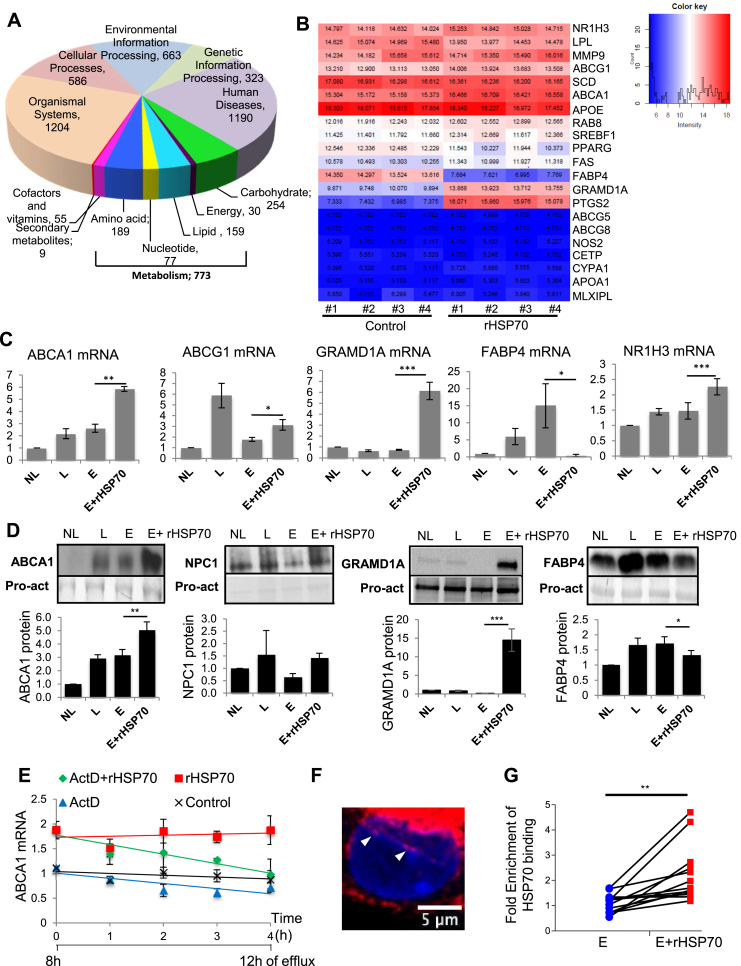
Recombinant HSP70 facilitated cholesterol removal from primary human macrophage foam cells. RNA sequencing revealed that HSP70 induced a robust transcriptional re-programming, including upregulation of key targets of liver X receptors (LXR), master regulators of whole-body cholesterol removal. Mechanistically, HSP70 interacted with the macrophage LXRalpha promoter, increased LXRalpha and its target mRNAs, and led to elevated levels of key proteins facilitating cholesterol efflux, including ATP-binding cassette transporters A1 and G1. Pharmacological augmentation of endogenous HSP70 in high-cholesterol diet fed zebrafish activated LXR and its target mRNAs and reduced cholesterol storage at the whole organism level.
These data demonstrate that HSP70 exerts a cholesterol lowering effect in primary human cells and animals and uncover a nuclear action of HSP70 in mediating cross-talk between HSP and LXR transcriptional regulation.
热休克蛋白 (HSPs) 在应激下维持细胞内稳态。HSP70 是主要的应激诱导家族成员,已被确定为遗传性胆固醇 - 神经鞘脂贮积病的可用药靶标。我们研究了 HSP70 是否调节与动脉粥样硬化相关的更常见情况下的胆固醇积累。
我们研究了重组 HSP70 在载脂蛋白胆固醇的人血供体原代巨噬细胞中的作用,以及高胆固醇饮食喂养的斑马鱼中药物诱导 HSP70 上调的作用。
重组 HSP70 促进了原代人巨噬细胞泡沫细胞中胆固醇的清除。RNA 测序显示,HSP70 诱导了强大的转录重编程,包括肝脏 X 受体 (LXR) 的关键靶标上调,这是全身胆固醇清除的主要调节因子。从机制上讲,HSP70 与巨噬细胞 LXRα 启动子相互作用,增加了 LXRα及其靶基因 mRNAs 的表达,并导致促进胆固醇外排的关键蛋白水平升高,包括 ABC 转运蛋白 A1 和 G1。在高胆固醇饮食喂养的斑马鱼中,内源性 HSP70 的药理学增强激活了 LXR 及其靶基因 mRNAs,并降低了整个机体水平的胆固醇储存。
这些数据表明,HSP70 在原代人细胞和动物中发挥降低胆固醇的作用,并揭示了 HSP70 在介导 HSP 和 LXR 转录调控之间相互作用中的核作用。