Research Division, Cleft and Facial Deformity Foundation (CFDF), International Craniofacial Academy, Gwarinpa, Abuja, Federal Capital Territory, Nigeria.
Department of Oral and Maxillofacial Surgery, University of Port Harcourt Teaching Hospital, Rivers State, Nigeria.
PLoS Negl Trop Dis. 2019 Jul 22;13(7):e0007574. doi: 10.1371/journal.pntd.0007574. eCollection 2019 Jul.
Noma is a spreading and fulminant disease believed to be native to Sub-Saharan Africa over the last decade and associated with low socioeconomic status of citizens of the region. Within this noma belt, most epidemiological reports regarding the disease have emanated from the north western region of Nigeria. However, our indigenous surgical mission encountered a substantial number of cases of noma and post-noma defects noteworthy of epidemiological representation across north central Nigeria.
All noma cases encountered within the 8-year study period were included and divided based on clinical signs into acute and sequelae groups. Incidence estimation was based on acute/recently active cases and was calculated using the statistical method proposed by the WHO Oral Health Unit (1994). Period prevalence of noma was calculated considering the population at risk in the zone.
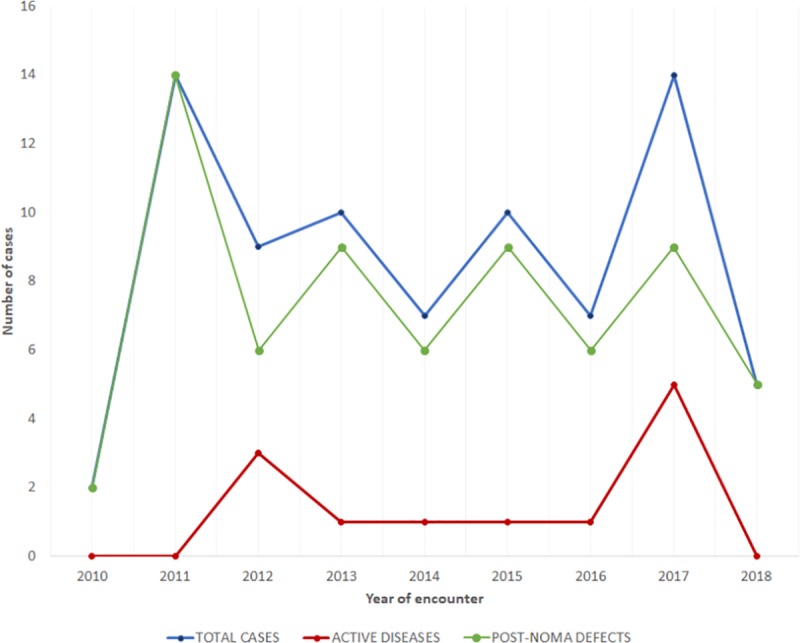
A total of 78 subjects were included in the study with age ranging from 2-75 years. Twelve subjects (15.4%) presented with acute disease while 66 (84.6%) had various forms of post-noma defects. The estimated incidence of noma in the north central zone was 8.3 per 100000 with a range of 4.1-17.9 per 100000 across various states. Period prevalence of noma which incorporated all cases seen within the study period was 1.6 per 100000 population at risk.
Although noma may be more prevalent in the north western region of Nigeria, substantial number of cases occurs within the north central zone which calls for deliberate public awareness campaign on disease risk factors and prevention, and education of primary health-care providers.
在过去十年中,坏疽性口炎被认为是一种流行于撒哈拉以南非洲的扩散性和暴发性疾病,与该地区公民的低社会经济地位有关。在这个坏疽性口炎带内,大多数关于该疾病的流行病学报告都来自尼日利亚西北部。然而,我们的本土外科任务在尼日利亚中北部遇到了大量的坏疽性口炎和坏疽性口炎后缺损病例,这些病例值得进行流行病学描述。
在 8 年的研究期间,我们纳入了所有遇到的坏疽性口炎病例,并根据临床特征将其分为急性和后遗症组。发病率估计是基于急性/最近活跃病例,使用世界卫生组织口腔健康部门(1994 年)提出的统计方法计算。在该区域内,考虑到风险人群,计算了坏疽性口炎的期间患病率。
本研究共纳入了 78 名患者,年龄在 2-75 岁之间。12 名患者(15.4%)表现为急性疾病,而 66 名患者(84.6%)有各种形式的坏疽性口炎后缺损。在尼日利亚中北部地区,坏疽性口炎的估计发病率为 8.3/100000,在不同的州发病率范围为 4.1-17.9/100000。纳入研究期间所有病例的坏疽性口炎期间患病率为 1.6/100000 风险人群。
尽管坏疽性口炎在尼日利亚西北部可能更为普遍,但在中北部地区也有大量病例发生,这需要对疾病的危险因素和预防进行有针对性的公众宣传活动,并对初级卫生保健提供者进行教育。