Museum of Comparative Zoology, Department of Organismic and Evolutionary Biology, Harvard University, Cambridge, MA, United States of America.
ETHZ Entomological Collection, Department of Environmental Systems Science, ETH Zürich, Zürich, Switzerland.
PLoS One. 2019 Jul 22;14(7):e0219070. doi: 10.1371/journal.pone.0219070. eCollection 2019.
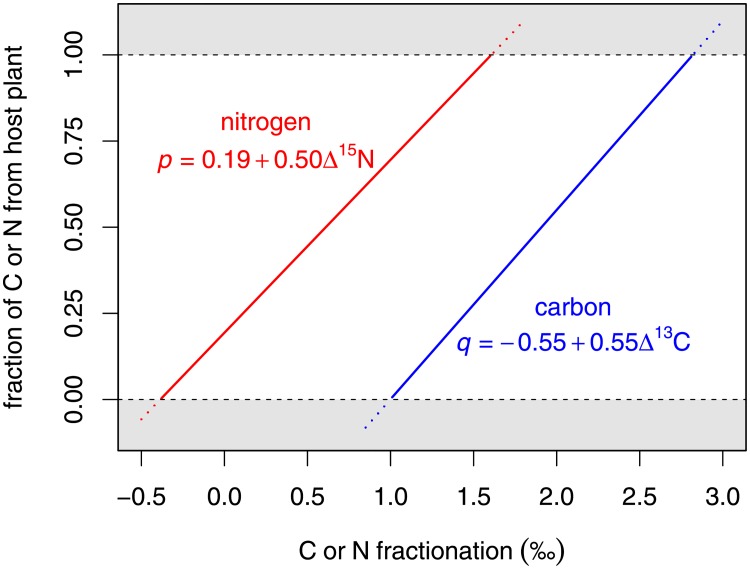
Knowing what animals eat is fundamental to our ability to understand and manage biodiversity and ecosystems, but researchers often must rely on indirect methods to infer trophic position and food intake. Using an approach that combines evidence from stable isotope analysis and DNA metabarcoding, we assessed the diet and trophic position of Anthene usamba butterflies, for which there are no known direct observations of larval feeding. An earlier study that analyzed adults rather than caterpillars of A. usamba inferred that this butterfly was aphytophagous, but we found that the larval guts of A. usamba and two known herbivorous lycaenid species contain chloroplast 16S sequences. Moreover, chloroplast barcoding revealed high sequence similarity between chloroplasts found in A. usamba guts and the chloroplasts of the Vachellia drepanolobium trees on which the caterpillars live. Stable isotope analysis provided further evidence that A. usamba caterpillars feed on V. drepanolobium, and the possibilities of strict herbivory versus limited omnivory in this species are discussed. These results highlight the importance of combining multiple approaches and considering ontogeny when using stable isotopes to infer trophic ecology where direct observations are difficult or impossible.
了解动物的食性是我们理解和管理生物多样性和生态系统的基础,但研究人员通常必须依赖间接方法来推断营养位和食物摄入量。本研究结合稳定同位素分析和 DNA 代谢组学的证据,评估了 Anthene usamba 蝴蝶的饮食和营养位,因为目前尚无已知的幼虫取食的直接观察结果。之前一项分析 Anthene usamba 成虫而非幼虫的研究推断这种蝴蝶是植食性的,但我们发现 Anthene usamba 幼虫的肠道以及两种已知的食草蛱蝶科物种的肠道中都含有叶绿体 16S 序列。此外,叶绿体条形码揭示了在 A. usamba 肠道中发现的叶绿体与幼虫生活的 Vachellia drepanolobium 树上的叶绿体之间存在高度相似性。稳定同位素分析进一步证明 A. usamba 幼虫以 V. drepanolobium 为食,讨论了该物种中严格的植食性与有限的杂食性的可能性。这些结果强调了在直接观察困难或不可能的情况下,使用稳定同位素推断营养生态学时,结合多种方法和考虑个体发育的重要性。