Wang Zhipeng, Ban Lijun, Meng Pingfan, Li Haitao, Zhao Yongxiang
Engineering Research Center of Ministry of Education for Fine Chemicals, School of Chemistry and Chemical Engineering, Shanxi University, Taiyuan 030006, China.
Nanomaterials (Basel). 2019 Jul 20;9(7):1038. doi: 10.3390/nano9071038.
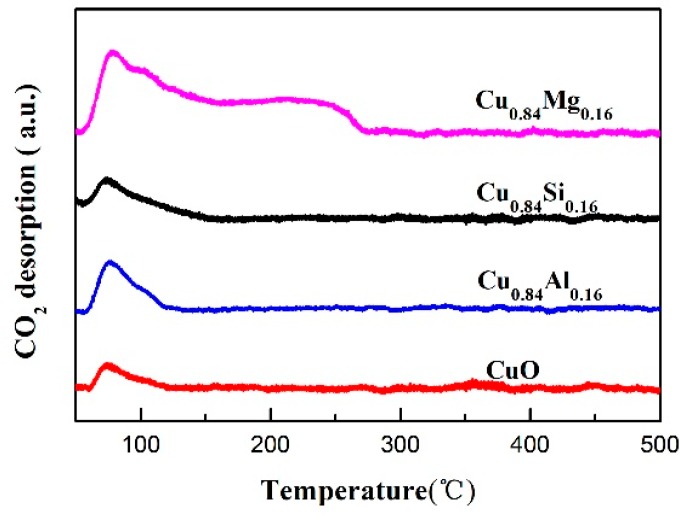
Most studies on the Cu-based catalysts in the ethynylation of formaldehyde are merely focused on the tuning of electronic configuration and dispersion of the Cu species. So far, little attention has been paid to the synergy between Cu species and promoters. Herein, binary nano-CuO-MO catalysts (M = Si, Al, and Mg) were synthesized and the effects of the promoter on the surface basicity/acidity were systematically studied as well as the ethynylation performance of the nano-CuO-based catalysts. The results show that the introduction of MgO provided a large number of basic sites, which could coordinate with the active Cu species and facilitate the dissociation of acetylene as HC ≡ C and H. The strongly nucleophilic acetylenic carbon (HC≡C) is favorable to the attack at the electropositive carbonyl C of formaldehyde. The MgO-promoted CuO catalyst showed the highest yield of BD (94%) and the highest stability (the BD yield decreased only from 94% to 82% after eight reaction cycles). SiO effectively dispersed Cu species, which improved catalytic activity and stability. However, the introduction of AlO resulted in a large number of acidic sites on the catalyst's surface. This led to the polymerization of acetylene, which covered the active sites and decreased the catalyst's activity.
大多数关于铜基催化剂用于甲醛乙炔化反应的研究仅聚焦于铜物种的电子构型调控和分散情况。到目前为止,很少有人关注铜物种与助剂之间的协同作用。在此,合成了二元纳米CuO-MO催化剂(M = Si、Al和Mg),并系统研究了助剂对表面碱/酸度的影响以及纳米CuO基催化剂的乙炔化性能。结果表明,MgO的引入提供了大量碱性位点,其可与活性铜物种配位并促进乙炔解离为HC≡C和H。强亲核性的炔碳(HC≡C)有利于进攻甲醛中带正电的羰基碳。MgO促进的CuO催化剂表现出最高的1,4-丁炔二醇(BD)产率(94%)和最高的稳定性(经过八个反应循环后,BD产率仅从94%降至82%)。SiO有效地分散了铜物种,提高了催化活性和稳定性。然而,AlO的引入导致催化剂表面出现大量酸性位点。这导致乙炔聚合,覆盖了活性位点并降低了催化剂活性。