Department of Physiology, Ribeirão Preto Medical School, University of São Paulo, Ribeirão Preto, São Paulo, Brazil; Department of Biochemistry/Immunology, Ribeirão Preto Medical School/University of São Paulo, Ribeirão Preto, São Paulo, Brazil; Institute for Diabetes and Cancer (IDC), Helmholtz Center Munich, 85764, Neuherberg, Germany; Joint Heidelberg-IDC Translational Diabetes Program, Inner Medicine I, Heidelberg University Hospital, 69120, Heidelberg, Germany.
Department of Physiology, Ribeirão Preto Medical School, University of São Paulo, Ribeirão Preto, São Paulo, Brazil.
Mol Metab. 2019 Oct;28:91-106. doi: 10.1016/j.molmet.2019.06.024. Epub 2019 Jul 3.
Although it is well established that a-calcitonin gene-related peptide (CGRP) stabilizes muscle-type cholinergic receptors nicotinic subunits (AChR), the underlying mechanism by which this neuropeptide regulates muscle protein metabolism and neuromuscular junction (NMJ) morphology is unclear.
To elucidate the mechanisms how CGRP controls NMJ stability in denervated mice skeletal muscles, we carried out physiological, pharmacological, and molecular analyses of atrophic muscles induced by sciatic nerve transection.
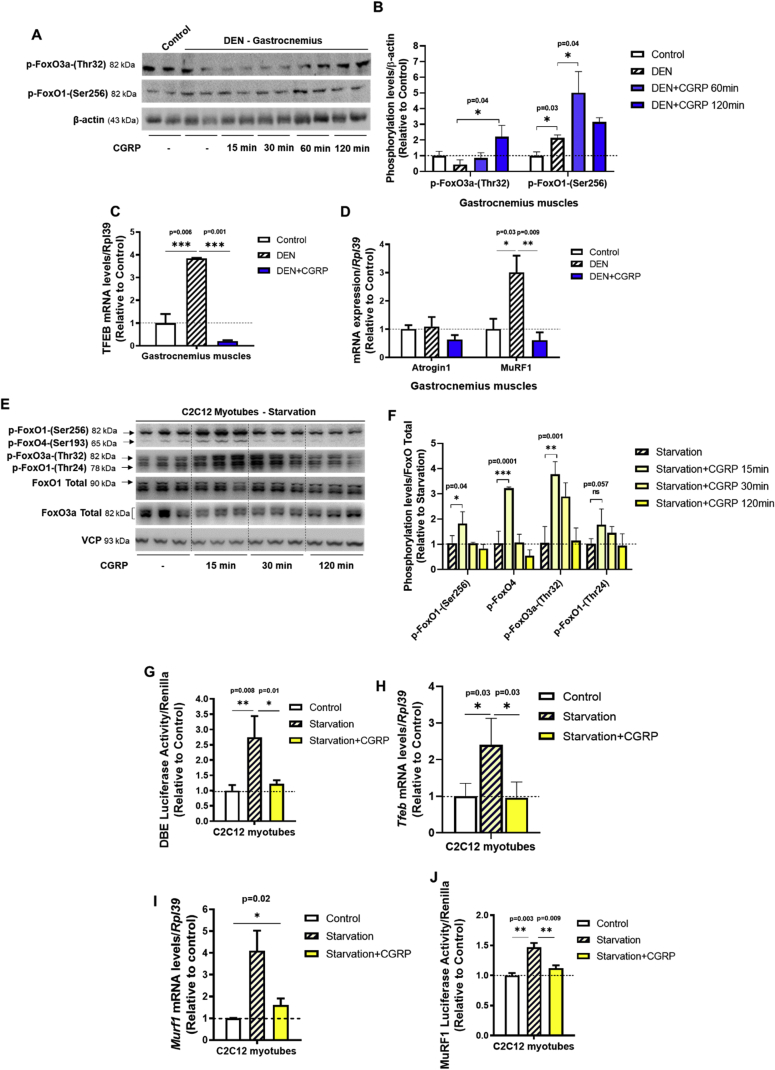
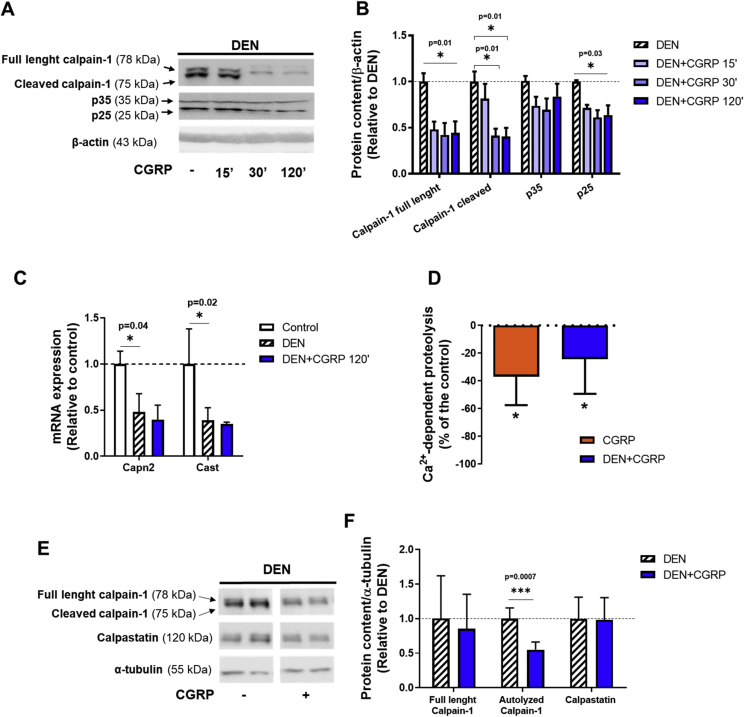
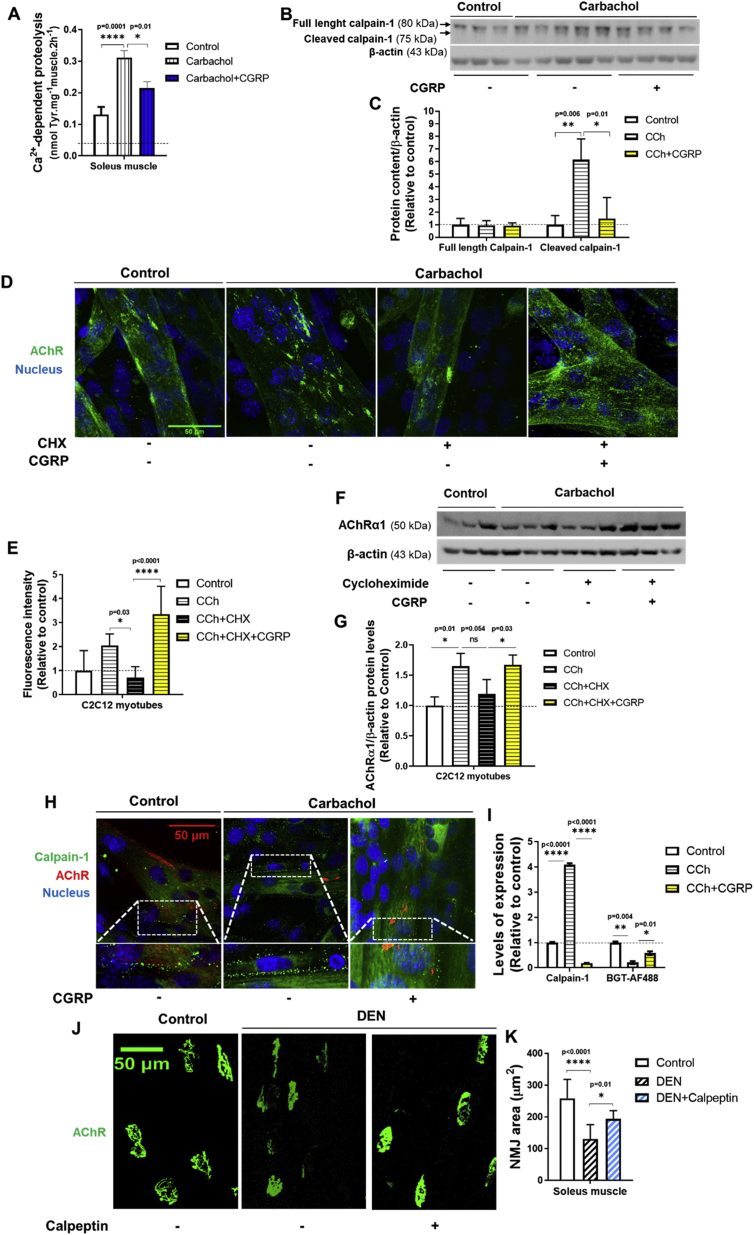
Here, we report that CGRP treatment in vivo abrogated the deleterious effects on NMJ upon denervation (DEN), an effect that was associated with suppression of skeletal muscle proteolysis, but not stimulation of protein synthesis. CGRP also blocked the DEN-induced increase in endocytic AChR vesicles and the elevation of autophagosomes per NMJ area. The treatment of denervated animals with rapamycin blocked the stimulatory effects of CGRP on mTORC1 and its inhibitory actions on autophagic flux and NMJ degeneration. Furthermore, CGRP inhibited the DEN-induced hyperactivation of Ca-dependent proteolysis, a degradative system that has been shown to destabilize NMJ. Consistently, calpain was found to be activated by cholinergic stimulation in myotubes leading to the dispersal of AChR clusters, an effect that was abolished by CGRP.
Taken together, these data suggest that the inhibitory effect of CGRP on autophagy and calpain may represent an important mechanism for the preservation of synapse morphology when degradative machinery is exacerbated upon denervation conditions.
尽管已经证实 a-降钙素基因相关肽(CGRP)稳定肌肉型烟碱型乙酰胆碱受体(AChR)的 nicotinic 亚单位,但这种神经肽调节肌肉蛋白代谢和神经肌肉接头(NMJ)形态的潜在机制尚不清楚。
为了阐明 CGRP 控制去神经支配小鼠骨骼肌 NMJ 稳定性的机制,我们对坐骨神经横断诱导的萎缩肌肉进行了生理、药理学和分子分析。
在这里,我们报告 CGRP 治疗体内可消除去神经支配(DEN)对 NMJ 的有害影响,这种作用与抑制骨骼肌蛋白水解有关,但不刺激蛋白质合成。CGRP 还阻断了 DEN 诱导的内吞 AChR 囊泡增加和每个 NMJ 区域的自噬体升高。用雷帕霉素处理去神经支配的动物阻断了 CGRP 对 mTORC1 的刺激作用及其对自噬流和 NMJ 退化的抑制作用。此外,CGRP 抑制了 DEN 诱导的钙依赖性蛋白水解的过度激活,这种降解系统已被证明会使 NMJ 不稳定。一致地,发现钙蛋白酶在肌管中被胆碱能刺激激活,导致 AChR 簇分散,这种作用被 CGRP 消除。
总之,这些数据表明,CGRP 对自噬和钙蛋白酶的抑制作用可能代表一种重要的机制,可在去神经支配条件下降解机制加剧时保持突触形态。