Mahoney Emily R, Dumitrescu Logan, Moore Annah M, Cambronero Francis E, De Jager Philip L, Koran Mary Ellen I, Petyuk Vladislav A, Robinson Renã A S, Goyal Sandeep, Schneider Julie A, Bennett David A, Jefferson Angela L, Hohman Timothy J
Vanderbilt Memory and Alzheimer's Center, Vanderbilt University Medical Center, Nashville, TN, USA.
Vanderbilt Genetics Institute, Vanderbilt University Medical Center, Nashville, TN, USA.
Mol Psychiatry. 2021 Mar;26(3):888-896. doi: 10.1038/s41380-019-0458-5. Epub 2019 Jul 22.
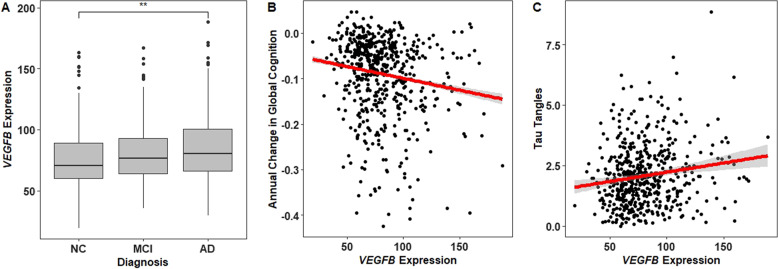
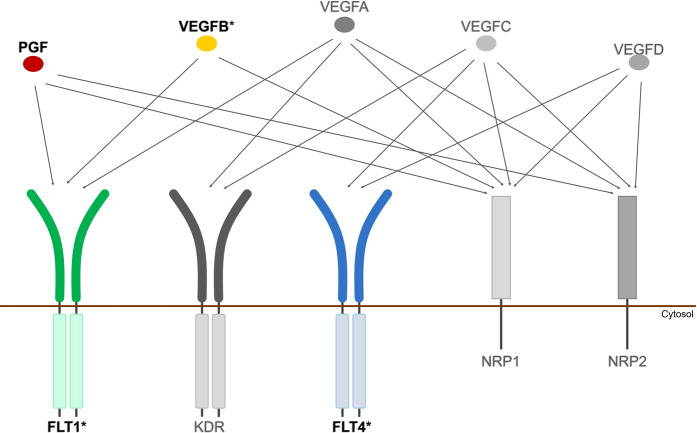
Vascular endothelial growth factor (VEGF) is associated with the clinical manifestation of Alzheimer's disease (AD). However, the role of the VEGF gene family in neuroprotection is complex due to the number of biological pathways they regulate. This study explored associations between brain expression of VEGF genes with cognitive performance and AD pathology. Genetic, cognitive, and neuropathology data were acquired from the Religious Orders Study and Rush Memory and Aging Project. Expression of ten VEGF ligand and receptor genes was quantified using RNA sequencing of prefrontal cortex tissue. Global cognitive composite scores were calculated from 17 neuropsychological tests. β-amyloid and tau burden were measured at autopsy. Participants (n = 531) included individuals with normal cognition (n = 180), mild cognitive impairment (n = 148), or AD dementia (n = 203). Mean age at death was 89 years and 37% were male. Higher prefrontal cortex expression of VEGFB, FLT4, FLT1, and PGF was associated with worse cognitive trajectories (p ≤ 0.01). Increased expression of VEGFB and FLT4 was also associated with lower cognition scores at the last visit before death (p ≤ 0.01). VEGFB, FLT4, and FLT1 were upregulated among AD dementia compared with normal cognition participants (p ≤ 0.03). All four genes associated with cognition related to elevated β-amyloid (p ≤ 0.01) and/or tau burden (p ≤ 0.03). VEGF ligand and receptor genes, specifically genes relevant to FLT4 and FLT1 receptor signaling, are associated with cognition, longitudinal cognitive decline, and AD neuropathology. Future work should confirm these observations at the protein level to better understand how changes in VEGF transcription and translation relate to neurodegenerative disease.
血管内皮生长因子(VEGF)与阿尔茨海默病(AD)的临床表现相关。然而,由于VEGF基因家族调控的生物学通路数量众多,它们在神经保护中的作用较为复杂。本研究探讨了VEGF基因的脑内表达与认知表现及AD病理之间的关联。遗传、认知和神经病理学数据取自宗教团体研究及拉什记忆与衰老项目。使用前额叶皮质组织的RNA测序对10种VEGF配体和受体基因的表达进行定量。从17项神经心理学测试中计算出整体认知综合评分。尸检时测量β-淀粉样蛋白和tau蛋白负荷。参与者(n = 531)包括认知正常者(n = 180)、轻度认知障碍者(n = 148)或AD痴呆患者(n = 203)。平均死亡年龄为89岁,男性占37%。VEGFB、FLT4、FLT1和PGF在前额叶皮质的较高表达与较差的认知轨迹相关(p≤0.01)。VEGFB和FLT4表达的增加也与死亡前最后一次访视时较低的认知评分相关(p≤0.01)。与认知正常的参与者相比,AD痴呆患者中VEGFB、FLT4和FLT1上调(p≤0.03)。所有这四个与认知相关的基因都与β-淀粉样蛋白升高(p≤0.01)和/或tau蛋白负荷增加(p≤0.03)有关。VEGF配体和受体基因,特别是与FLT4和FLT1受体信号传导相关的基因,与认知、纵向认知衰退和AD神经病理学相关。未来的工作应在蛋白质水平上证实这些观察结果,以更好地了解VEGF转录和翻译的变化与神经退行性疾病的关系。