Griffiths Kristi R, Yang Jenny, Touyz Stephen W, Hay Phillipa J, Clarke Simon D, Korgaonkar Mayuresh S, Gomes Linette, Anderson Gail, Foster Sheryl, Kohn Michael R
1The Brain Dynamics Centre, Westmead Institute for Medical Research, The University of Sydney, 176 Hawkesbury Road, Westmead, NSW 2145 Australia.
2School of Psychology, The University of Sydney, Camperdown, NSW 2050 Australia.
J Eat Disord. 2019 Jul 11;7:23. doi: 10.1186/s40337-019-0253-3. eCollection 2019.
The efficacy and safety of Lisdexamfetamine dimesylate (LDX) in the treatment of moderate to severe binge eating disorder (BED) has been demonstrated in multiple randomised clinical trials. Despite this, little is known about how LDX acts to improve binge eating symptoms. This study aims to provide a comprehensive understanding of the neural mechanisms by which LDX improves symptoms of BED. We hypothesise that LDX will act by normalising connectivity within neural circuits responsible for reward and impulse control, and that this normalisation will correlate with reduced binge eating episodes.
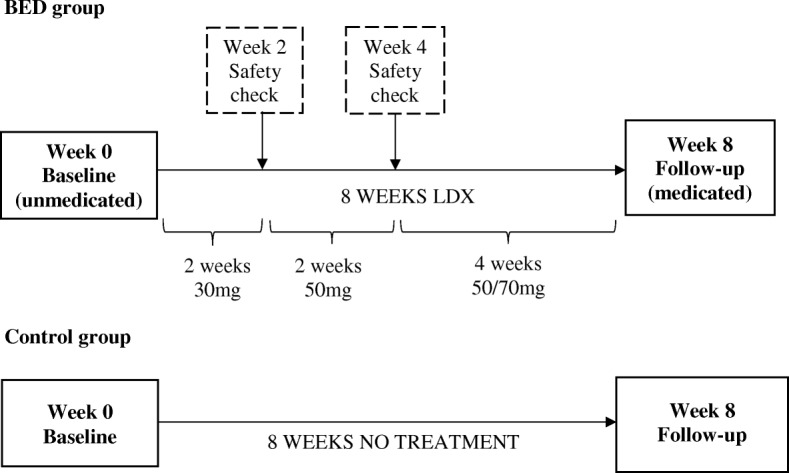
This is an open-label Phase 4 clinical trial of LDX in adults with moderate to severe BED. Enrolment will include 40 adults with moderate to severe BED aged 18-40 years and Body Mass Index (BMI) of 20-45 kg/m, and 22 healthy controls matched for age, gender and BMI. Clinical interview and validated scales are used to confirm diagnosis and screen for exclusion criteria, which include comorbid anorexia nervosa or bulimia nervosa, use of psychostimulants within the past 6 months, and current use of antipsychotics or noradrenaline reuptake inhibitors. Baseline assessments include clinical symptoms, multimodal neuroimaging, cognitive assessment of reward sensitivity and behavioural inhibition, and an (optional) genetic sample. A subset of these assessments are repeated after eight weeks of treatment with LDX titrated to either 50 or 70 mg. The primary outcome measures are resting-state intrinsic connectivity and the number of binge eating episodes. Analyses will be applied to resting-state fMRI data to characterise pharmacological effects across the functional connectome, and assess correlations with symptom measure changes. Comparison of neural measures between controls and those with BED post-treatment will also be performed to determine whether LDX normalises brain function.
First enrolment was in May 2018, and is ongoing. This study is the first comprehensive investigation of the neurobiological changes that occur with LDX treatment in adults with moderate to severe BED.
ACTRN12618000623291, Australian and New Zealand Clinical Trials Registry URL: https://www.anzctr.org.au/Trial/Registration/TrialReview.aspx?id=374913&isReview=true. Date of Registration: 20 April 2018.
多项随机临床试验已证明,二甲磺酸赖右苯丙胺(LDX)治疗中度至重度暴饮暴食症(BED)的疗效和安全性。尽管如此,对于LDX改善暴饮暴食症状的作用机制仍知之甚少。本研究旨在全面了解LDX改善BED症状的神经机制。我们假设,LDX将通过使负责奖励和冲动控制的神经回路内的连接正常化来发挥作用,并且这种正常化将与暴饮暴食发作次数的减少相关。
这是一项针对中度至重度BED成人的LDX开放标签4期临床试验。入组将包括40名年龄在18至40岁、体重指数(BMI)为20至45kg/m²的中度至重度BED成人,以及22名年龄、性别和BMI相匹配的健康对照者。通过临床访谈和经过验证的量表来确认诊断并筛查排除标准,这些标准包括共病神经性厌食症或神经性贪食症、在过去6个月内使用过精神兴奋剂,以及目前正在使用抗精神病药物或去甲肾上腺素再摄取抑制剂。基线评估包括临床症状、多模态神经影像学、奖励敏感性和行为抑制的认知评估,以及(可选的)基因样本。在使用滴定至50或70mg的LDX治疗八周后,重复进行这些评估中的一部分。主要结局指标是静息态内在连接性和暴饮暴食发作次数。将对静息态功能磁共振成像(fMRI)数据进行分析,以表征整个功能连接组的药理作用,并评估与症状测量变化的相关性。还将对对照组和治疗后患有BED的患者的神经测量结果进行比较,以确定LDX是否使脑功能正常化。
首次入组时间为2018年5月,研究仍在进行中。本研究是对中度至重度BED成人接受LDX治疗时发生的神经生物学变化的首次全面调查。
ACTRN12618000623291,澳大利亚和新西兰临床试验注册中心网址:https://www.anzctr.org.au/Trial/Registration/TrialReview.aspx?id=374913&isReview=true。注册日期:2018年4月20日。