Lim Kim H, Itinteang Tinte, Davis Paul F, Tan Swee T
Gillies McIndoe Research Institute, Wellington, New Zealand.
Wellington Regional Plastic, Maxillofacial & Burns Unit, Hutt Hospital, Wellington, New Zealand.
Plast Reconstr Surg Glob Open. 2019 May 16;7(5):e2228. doi: 10.1097/GOX.0000000000002228. eCollection 2019 May.
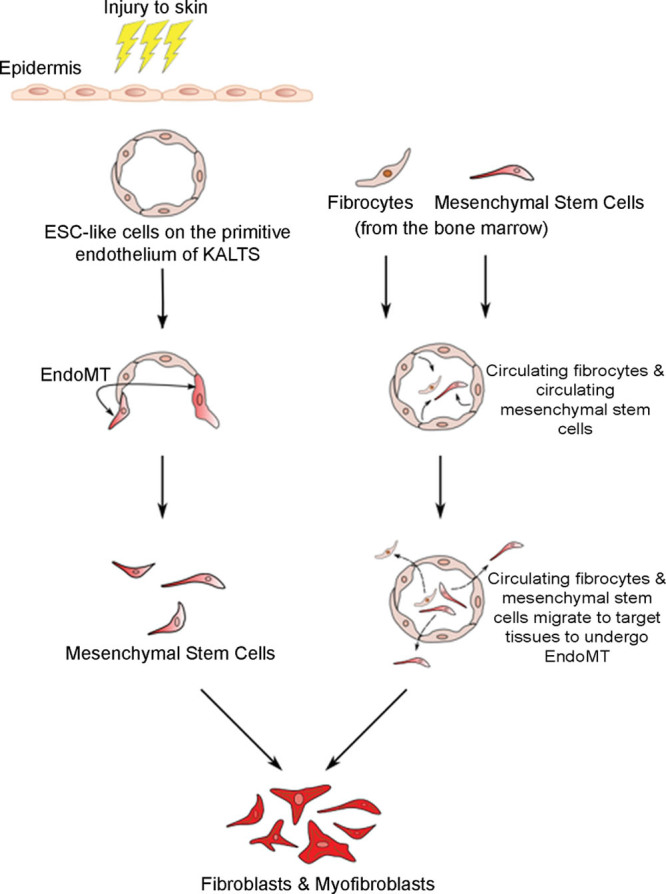
Keloid disorder (KD) is a fibroproliferative condition caused by dysregulated wound healing following wounding of the skin. The pathogenesis of KD has not been fully elucidated and current treatment is unsatisfactory. There is increasing evidence of the role of stem cells in KD. This review discusses the role of embryonic stem (ESC)-like cells and mesenchymal stem cells in the pathogenesis of KD. It is proposed that dysfunction of the ESC-like population localized to the endothelium of the microvessels and perivascular cells within the keloid-associated lymphoid tissues may give rise to the aberrant fibroblasts and myofibroblasts via a mesenchymal stem cell intermediate in keloid lesions, by undergoing an endothelial-to-mesenchymal transition. We also discuss the role of the renin-angiotensin system (RAS), the immune system, and the inflammatory response, on stem cell proliferation and differentiation. The understanding of the precise roles of these stem cells and interplay of the associated regulatory pathways could lead to the development of targeted therapy for this enigmatic and challenging condition. The demonstration of the expression of components of the RAS and cathepsins B, D, and G that constitute bypass loops of the RAS, by the ESC-like population, suggests that the primitive population may be a therapeutic target by modulation of the RAS, using existing medications.
瘢痕疙瘩疾病(KD)是一种皮肤受伤后伤口愈合失调引起的纤维增生性病症。KD的发病机制尚未完全阐明,目前的治疗并不令人满意。越来越多的证据表明干细胞在KD中发挥作用。本综述讨论了胚胎干细胞样细胞和间充质干细胞在KD发病机制中的作用。有人提出,瘢痕疙瘩相关淋巴组织内微血管内皮和血管周细胞中的胚胎干细胞样群体功能障碍,可能通过瘢痕疙瘩病变中的间充质干细胞中间体,经内皮向间充质转化产生异常成纤维细胞和平滑肌成纤维细胞。我们还讨论了肾素-血管紧张素系统(RAS)、免疫系统和炎症反应对干细胞增殖和分化的作用。对这些干细胞的确切作用以及相关调节途径相互作用的理解,可能会为这种神秘且具有挑战性的病症带来靶向治疗方法。胚胎干细胞样群体对构成RAS旁路环的RAS成分以及组织蛋白酶B、D和G的表达证明,通过使用现有药物调节RAS,原始群体可能成为治疗靶点。