Dev Sharad, Singh Anup
Department of Gastroenterology, Institute of Medical Sciences, Banaras Hindu University, Varanasi, Uttar Pradesh, India.
Department of Geriatric Medicine, Institute of Medical Sciences, Banaras Hindu University, Varanasi, Uttar Pradesh, India.
J Family Med Prim Care. 2019 Jun;8(6):2129-2133. doi: 10.4103/jfmpc.jfmpc_339_19.
Role of serum amyloid A (SAA) protein as a biomarker for the disease activity in juvenile idiopathic arthritis (JIA) has not been explored. This study was done to find its role as marker of disease activity in JIA.
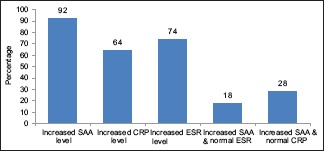
A case-control study with 50 newly diagnosed cases of JIA of all subtypes and 40 healthy controls was done. Serum amyloid A (SAA), erythrocyte sedimentation rate (ESR), and C-reactive protein (CRP) were measured in both patients and healthy controls. Quantitative measurement of SAA level was measured by using standard human SAA enzyme-linked immunosorbent assay (ELISA). Disease activity was assessed clinically and by ultrasonography (USG) score determined by examining eight large joints (bilateral elbow, wrist, knee, ankle). Serum SAA levels were found significantly higher in JIA patients as compared with healthy controls ( < 0.001). Significant positive correlations were found between SAA with presence of active joints ( = 0.64, < 0.001), ESR ( = 0.39, < 0.05), and CRP ( = 0.36, < 0.05). However, significant correlations was not found between ESR and the presence of active joints ( = 0.21, = 0.225) and between CRP and the presence of active joints ( = 0.034, = 0.855). The mean USG score of patients with increased SAA level was significantly higher than that of patients with normal SAA level ( < 0.05).
A significant increase in SAA levels was found in JIA patients with strong positive correlation between SAA level and JIA disease activity. The study discerned SAA to be a more sensitive laboratory marker than ESR and CRP for evaluating the presence of active joints.
血清淀粉样蛋白A(SAA)蛋白作为幼年特发性关节炎(JIA)疾病活动生物标志物的作用尚未得到研究。本研究旨在探讨其作为JIA疾病活动标志物的作用。
进行了一项病例对照研究,纳入50例新诊断的各亚型JIA病例和40例健康对照。对患者和健康对照均检测了血清淀粉样蛋白A(SAA)、红细胞沉降率(ESR)和C反应蛋白(CRP)。采用标准人SAA酶联免疫吸附测定(ELISA)对SAA水平进行定量检测。通过临床评估和超声检查(USG)评分评估疾病活动,USG评分通过检查八个大关节(双侧肘部、腕部、膝部、踝部)来确定。发现JIA患者的血清SAA水平显著高于健康对照(<0.001)。SAA与活动关节的存在(=0.64,<0.001)、ESR(=0.39,<0.05)和CRP(=0.36,<0.05)之间存在显著正相关。然而,ESR与活动关节的存在之间(=0.21,=0.225)以及CRP与活动关节的存在之间(=0.034,=0.855)未发现显著相关性。SAA水平升高的患者的平均USG评分显著高于SAA水平正常的患者(<0.05)。
JIA患者的SAA水平显著升高,且SAA水平与JIA疾病活动之间存在强正相关。该研究发现SAA是比ESR和CRP更敏感的实验室标志物,可用于评估活动关节的存在。