Bath Natalie M, Fahl William E, Redfield Robert R
Division of Transplant Surgery, Department of Surgery, University of Wisconsin-Madison, Madison, WI.
Wisconsin Institutes for Medical Research, University of Wisconsin-Madison, Madison, WI.
Transplant Direct. 2019 Jun 27;5(7):e469. doi: 10.1097/TXD.0000000000000909. eCollection 2019 Jul.
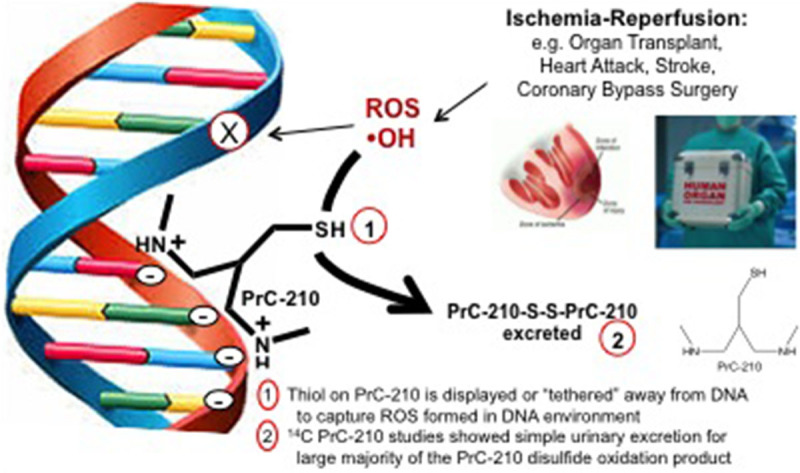
Ischemia-reperfusion (IR) injury remains a significant problem for all solid organ transplants; thus, an important unmet need in transplantation is the prevention of IR injury. PrC-210 has demonstrated superior prevention of reactive oxygen species damage in several preclinical studies as a free radical scavenger. Here, we describe its profound efficacy in suppressing IR injury in a murine model of kidney IR injury.
C57/B6 mice underwent laparotomy with the left renal pedicle occluded for 30 minutes to induce IR injury. Right nephrectomy was performed at the time of surgery. Mice received a single systemic dose of the PrC-210, PrC-211, or PrC-252 aminothiols 20 minutes before IR injury. Twenty-four hours following IR injury, blood and kidney tissue were collected for analysis. Kidney caspase-3 level (a marker of cell death), direct histological analysis of kidneys, and serum blood urea nitrogen (BUN) were measured in animals to assess reactive oxygen species scavenger protective efficacies.
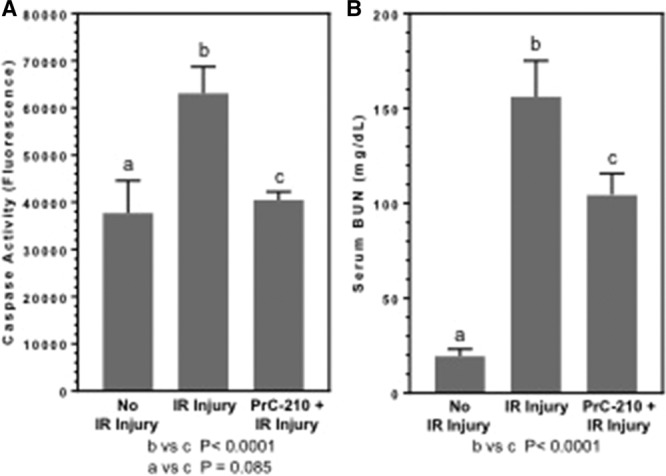
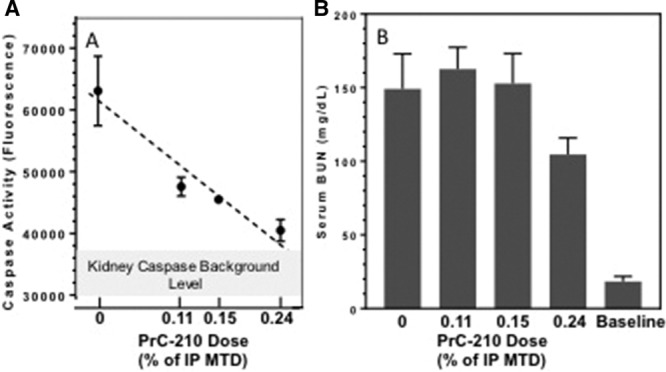
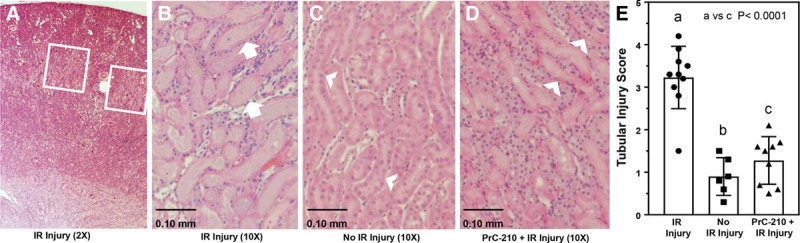
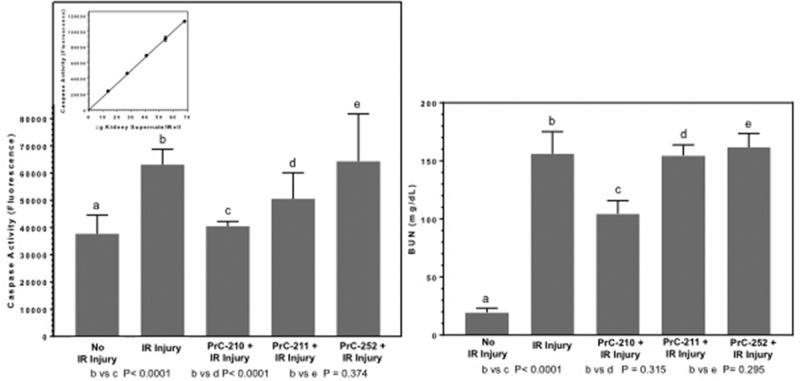
A single systemic PrC-210 dose 20 minutes before IR injury resulted in significant reductions in (1) IR-induced kidney caspase level ( < 0.0001); caspase was reduced to levels not significantly different than control caspase levels seen in unperturbed kidneys, (2) IR-induced renal tubular injury scores ( < 0.0001); brush border loss and tubular dilation were markedly reduced, and (3) serum BUN compared with control IR injury kidneys ( < 0.0001). The ranked protective efficacies of PrC-210 > PrC-211 >> PrC-252 paralleled previous radioprotection studies of the molecules.
A single PrC-210 dose, minutes before the IR insult, profoundly reduced caspase, renal tubular injury, and serum BUN in mice exposed to standard kidney IR injury. These findings support further development of the PrC-210 molecule to suppress or prevent IR injury in organ transplant and other IR injury settings.
缺血再灌注(IR)损伤仍然是所有实体器官移植面临的一个重大问题;因此,移植领域一个重要的未满足需求是预防IR损伤。在多项临床前研究中,PrC-210作为一种自由基清除剂,已证明在预防活性氧损伤方面具有卓越效果。在此,我们描述了其在小鼠肾脏IR损伤模型中抑制IR损伤的显著疗效。
C57/B6小鼠接受剖腹手术,左肾蒂阻断30分钟以诱导IR损伤。手术时进行右肾切除术。小鼠在IR损伤前20分钟接受单次全身剂量的PrC-210、PrC-211或PrC-252氨基硫醇。IR损伤后24小时,收集血液和肾脏组织进行分析。测量动物的肾脏半胱天冬酶-3水平(细胞死亡标志物)、肾脏的直接组织学分析以及血清血尿素氮(BUN),以评估活性氧清除剂的保护效果。
在IR损伤前20分钟给予单次全身剂量的PrC-210,导致以下指标显著降低:(1)IR诱导的肾脏半胱天冬酶水平(<0.0001);半胱天冬酶降低至与未受干扰的肾脏中所见的对照半胱天冬酶水平无显著差异的水平,(2)IR诱导的肾小管损伤评分(<0.0001);刷状缘丧失和肾小管扩张明显减少,(3)与对照IR损伤肾脏相比,血清BUN(<0.0001)。PrC-210>PrC-211>>PrC-252的保护效果排名与先前对这些分子的辐射防护研究结果一致。
在IR损伤前几分钟给予单次PrC-210剂量,可显著降低暴露于标准肾脏IR损伤的小鼠体内的半胱天冬酶、肾小管损伤和血清BUN水平。这些发现支持进一步开发PrC-210分子,以抑制或预防器官移植及其他IR损伤情况下的IR损伤。