Chammout Ghazi, Kelly-Pettersson Paula, Hedbeck Carl-Johan, Stark André, Mukka Sebastian, Sköldenberg Olof
Department of Clinical Sciences at Danderyd Hospital, Karolinska Institutet, Stockholm, Sweden.
Department of Surgical and Perioperative Sciences, Umeå University, Umeå, Sweden.
JB JS Open Access. 2019 May 1;4(2):e0059. doi: 10.2106/JBJS.OA.18.00059. eCollection 2019 Apr-Jun.
The choice of primary hemiarthroplasty or total hip arthroplasty in patients ≥80 years of age with a displaced femoral neck fracture has not been adequately studied. As the number of healthy, elderly patients ≥80 years of age is continually increasing, optimizing treatments for improving outcomes and reducing the need for secondary surgery is an important consideration. The aim of the present study was to compare the results of hemiarthroplasty with those of total hip arthroplasty in patients ≥80 years of age.
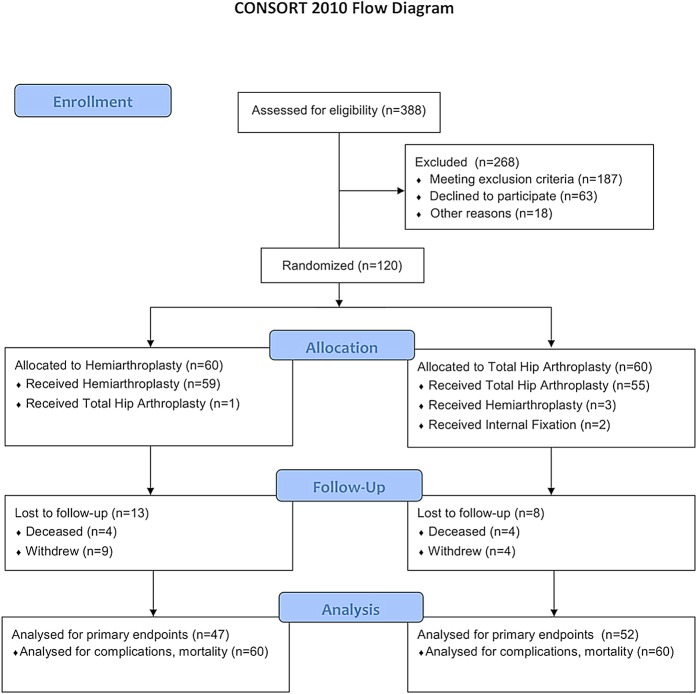
This prospective, randomized, single-blinded trial included 120 patients with a mean age of 86 years (range, 80 to 94 years) who had sustained an acute displaced femoral neck fracture <36 hours previously. The patients were randomized to treatment with hemiarthroplasty (n = 60) or total hip arthroplasty (n = 60). The primary end points were hip function and health-related quality of life at 2 years. Secondary end points included hip-related complications and reoperations, mortality, pain in the involved hip, activities of daily living, surgical time, blood loss, and general complications. The patients were reviewed at 3 months and 1 and 2 years.
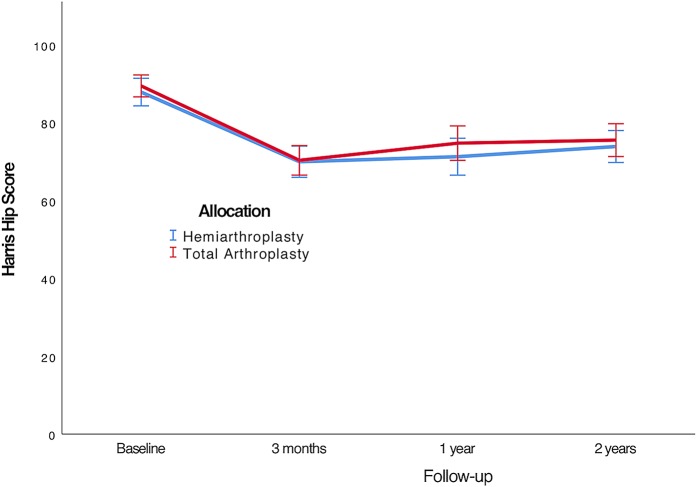
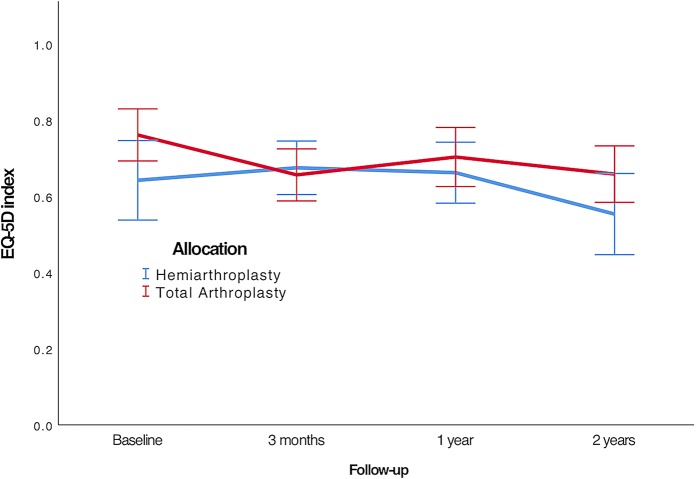
We found no differences between the groups in terms of hip function, health-related quality of life, hip-related complications and reoperations, activities of daily living, or pain in the involved hip. Hip function, activities of daily living, and pain in the involved hip deteriorated in both groups compared with pre-fracture values. The ability to regain previous walking function was similar in both groups.
We found no difference in outcomes after treatment with either hemiarthroplasty or total hip arthroplasty in active octogenarians and nonagenarians with a displaced femoral neck fracture up to 2 years after surgery. Hemiarthroplasty is a suitable procedure in the short term for this group of patients.
Therapeutic Level I. See Instructions for Authors for a complete description of levels of evidence.
对于年龄≥80岁的移位型股骨颈骨折患者,选择一期半髋关节置换术还是全髋关节置换术尚未得到充分研究。随着年龄≥80岁的健康老年患者数量持续增加,优化治疗以改善预后并减少二次手术需求是一个重要的考虑因素。本研究的目的是比较年龄≥80岁患者半髋关节置换术与全髋关节置换术的结果。
这项前瞻性、随机、单盲试验纳入了120例平均年龄86岁(范围80至94岁)的患者,这些患者在36小时内发生急性移位型股骨颈骨折。患者被随机分为半髋关节置换术治疗组(n = 60)或全髋关节置换术治疗组(n = 60)。主要终点是术后2年时的髋关节功能和健康相关生活质量。次要终点包括髋关节相关并发症和再次手术、死亡率、患髋疼痛、日常生活活动能力、手术时间、失血量和一般并发症。在术后3个月、1年和2年对患者进行复查。
我们发现两组在髋关节功能、健康相关生活质量、髋关节相关并发症和再次手术、日常生活活动能力或患髋疼痛方面没有差异。与骨折前值相比,两组的髋关节功能、日常生活活动能力和患髋疼痛均有所恶化。两组恢复先前行走功能的能力相似。
我们发现,对于年龄≥80岁且有移位型股骨颈骨折的活跃老年人和非agenarians,在术后2年内,半髋关节置换术或全髋关节置换术治疗后的结果没有差异。半髋关节置换术在短期内是适合该组患者的手术。
治疗水平I。有关证据水平的完整描述,请参阅作者指南。