National Tuberculosis, Leprosy and Lung Disease Program, Ministry of Health, Nairobi, Kenya.
International Union Against Tuberculosis and Lung Diseases, Paris, France.
Trans R Soc Trop Med Hyg. 2019 Dec 1;113(12):740-748. doi: 10.1093/trstmh/trz062.
Large numbers of tuberculosis (TB) patients seek care from private for-profit providers. This study aimed to assess and compare TB control activities in the private for-profit and public sectors in Kenya between 2013 and 2017.
We conducted a retrospective cross-sectional study using routinely collected data from the National Tuberculosis, Leprosy and Lung Disease Program.
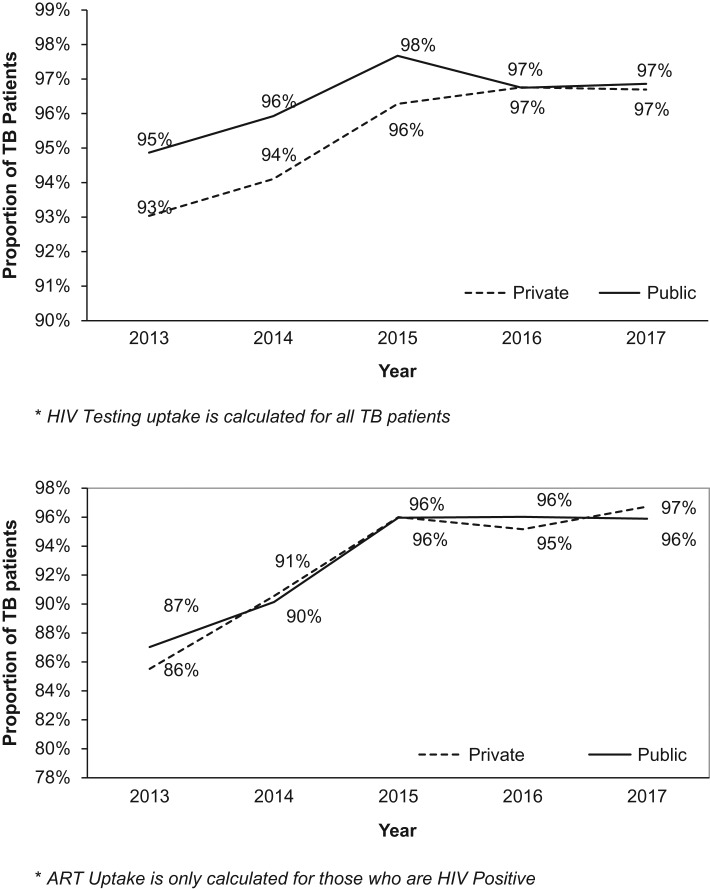
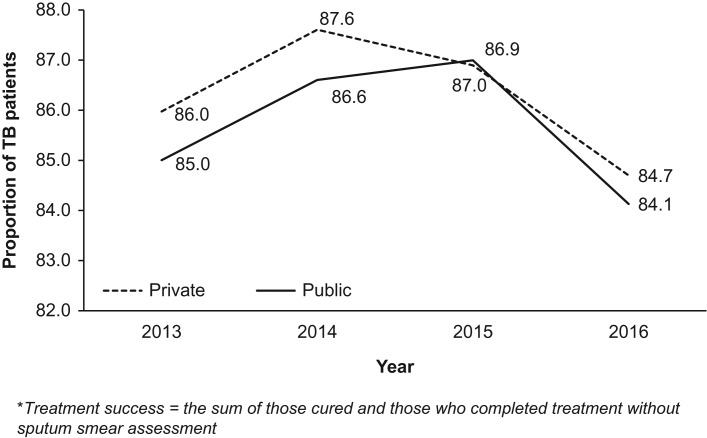
Of 421 409 patients registered and treated between 2013 and 2017, 86 894 (21%) were from the private sector. Data collection was less complete in the private sector for nutritional assessment and follow-up sputum smear examinations (p<0.001). The private sector notified less bacteriologically confirmed TB (43.1% vs 52.6%; p<0.001) and had less malnutrition (body mass index <18.5 kg/m2; 36.4% vs 43.3%; p<0.001) than the public sector. Rates of human immunodeficiency virus (HIV) testing and antiretroviral therapy initiation were >95% and >90%, respectively, in both sectors, but more patients were HIV positive in the private sector (39.6% vs 31.6%; p<0.001). For bacteriologically confirmed pulmonary TB, cure rates were lower in the private sector, especially for HIV-negative patients (p<0.001). The private sector had an overall treatment success of 86.3% as compared with the public sector at 85.7% (p<0.001).
The private sector is performing well in Kenya although there are programmatic challenges that need to be addressed.
大量结核病(TB)患者寻求私立营利性医疗机构的治疗。本研究旨在评估和比较肯尼亚 2013 年至 2017 年私营营利性部门和公共部门的结核病控制活动。
我们使用国家结核病、麻风病和肺部疾病规划常规收集的数据进行了回顾性横断面研究。
在 2013 年至 2017 年间登记和治疗的 421409 名患者中,有 86894 名(21%)来自私营部门。私营部门在营养评估和随访痰涂片检查方面的数据收集不够完整(p<0.001)。私营部门报告的细菌学确诊结核病病例较少(43.1% vs 52.6%;p<0.001),营养不良病例也较少(体重指数<18.5 kg/m2;36.4% vs 43.3%;p<0.001)。两个部门的人类免疫缺陷病毒(HIV)检测和抗逆转录病毒治疗启动率均>95%和>90%,但私营部门的 HIV 阳性患者更多(39.6% vs 31.6%;p<0.001)。对于细菌学确诊的肺结核,私营部门的治愈率较低,尤其是对于 HIV 阴性患者(p<0.001)。私营部门的总体治疗成功率为 86.3%,而公共部门为 85.7%(p<0.001)。
尽管肯尼亚私营部门存在一些需要解决的方案挑战,但表现良好。