Department of Pharmaceutical Sciences, Nova Southeastern University, 3200 South University Drive, Fort Lauderdale, FL 33328.
South University Drive, AutoNation Institute for Breast Cancer Research, 3321, Fort Lauderdale, FL 33328.
Mil Med. 2020 Feb 13;185(1-2):e47-e52. doi: 10.1093/milmed/usz177.
Veterans of the 1991 Gulf War were potentially exposed to a mixture of stress, chemicals and radiation that may have contributed to the persistent symptoms of Gulf War Illness (GWI). The genotoxic effects of some of these exposures are mediated by the DNA nucleotide excision repair (NER) pathway. We hypothesized that individuals with relatively low DNA repair capacity would suffer greater damage from cumulative genotoxic exposures, some of which would persist, causing ongoing problems.
Blood samples were obtained from symptomatic Gulf War veterans and age-matched controls. The unscheduled DNA synthesis assay, a functional measurement of NER capacity, was performed on cultured lymphocytes, and lymphocyte mRNA was extracted and analyzed by sequencing.
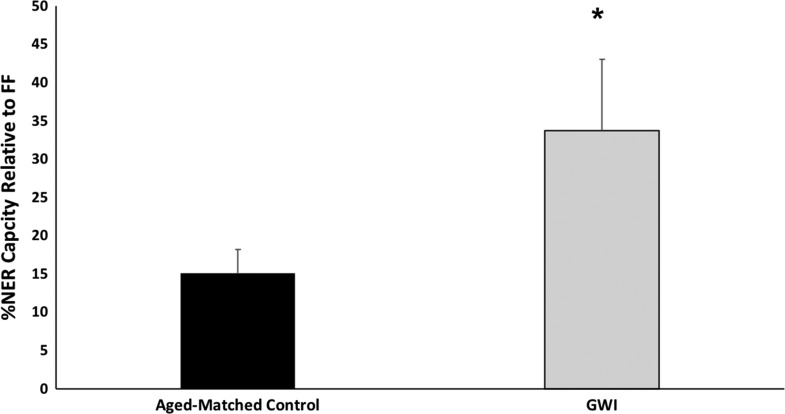
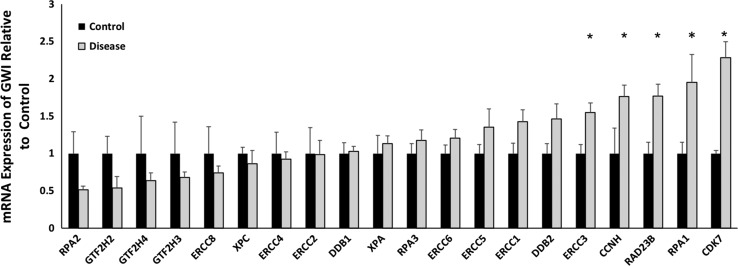
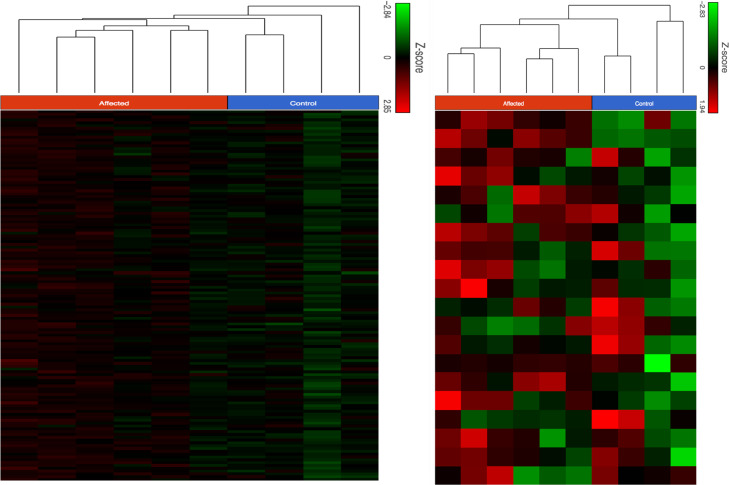
Despite our hypothesis that GWI would be associated with DNA repair deficiency, NER capacity in lymphocytes from affected GWI veterans actually exhibited a significantly elevated level of DNA repair (p = 0.016). Both total gene expression and NER gene expression successfully differentiated individuals with GWI from unaffected controls. The observed functional increase in DNA repair capacity was accompanied by an overexpression of genes in the NER pathway, as determined by RNA sequencing analysis.
We suggest that the observed elevations in DNA repair capacity and NER gene expression are indicative of a "hormetic," i.e., induced or adaptive protective response to battlefield exposures. Normally such effects are short-term, but in these individuals this response has resulted in a long-term metabolic shift that may also be responsible for the persistent symptoms of GWI.
1991 年海湾战争的退伍军人可能接触到压力、化学物质和辐射的混合物,这些可能导致海湾战争综合征(GWI)的持续症状。这些暴露物中的一些遗传毒性效应是由 DNA 核苷酸切除修复(NER)途径介导的。我们假设,具有相对较低 DNA 修复能力的个体将从累积的遗传毒性暴露中遭受更大的损害,其中一些损害将持续存在,导致持续存在的问题。
从有症状的海湾战争退伍军人和年龄匹配的对照组中采集血液样本。在培养的淋巴细胞上进行非计划 DNA 合成测定,这是 NER 能力的功能测量,提取淋巴细胞 mRNA 并通过测序进行分析。
尽管我们假设 GWI 与 DNA 修复缺陷有关,但受影响的 GWI 退伍军人淋巴细胞中的 NER 能力实际上表现出明显更高水平的 DNA 修复(p = 0.016)。总基因表达和 NER 基因表达都成功地区分了患有 GWI 的个体和未受影响的对照组。观察到的 DNA 修复能力的功能性增加伴随着 NER 途径中基因的过度表达,这是通过 RNA 测序分析确定的。
我们认为观察到的 DNA 修复能力和 NER 基因表达的升高表明存在“应激”,即对战场暴露的诱导或适应性保护反应。通常这种影响是短期的,但在这些个体中,这种反应导致了长期的代谢转变,这也可能是 GWI 持续症状的原因。