Liu Jing-Bo, Yan Yong-Ji, Shi Jing, Wu Ya-Bing, Li Yan-Feng, Dai Lin-Feng, Ma Xue-Tao
Department of Urology, Dongzhimen Hospital, Beijing University of Chinese Medicine, Beijing, China.
Medicine (Baltimore). 2019 Jul;98(29):e16193. doi: 10.1097/MD.0000000000016193.
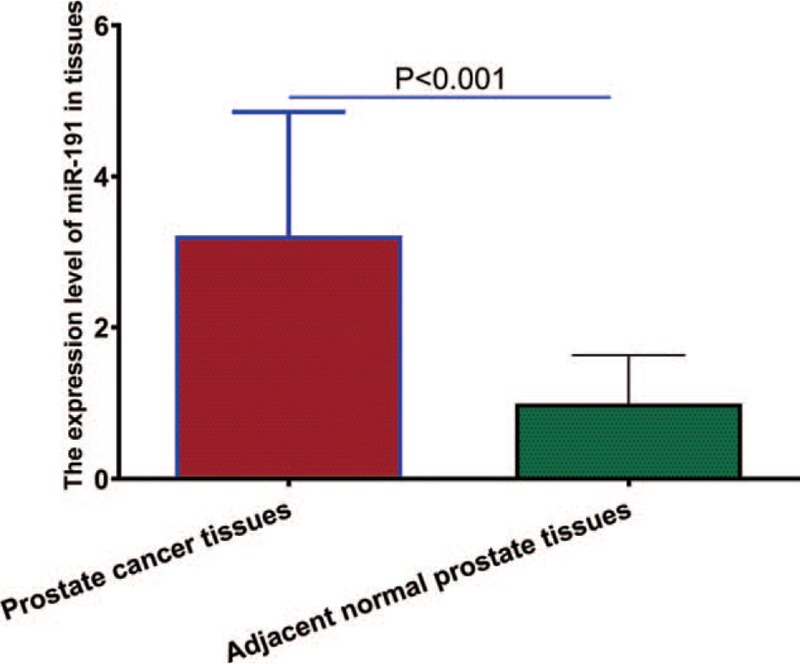
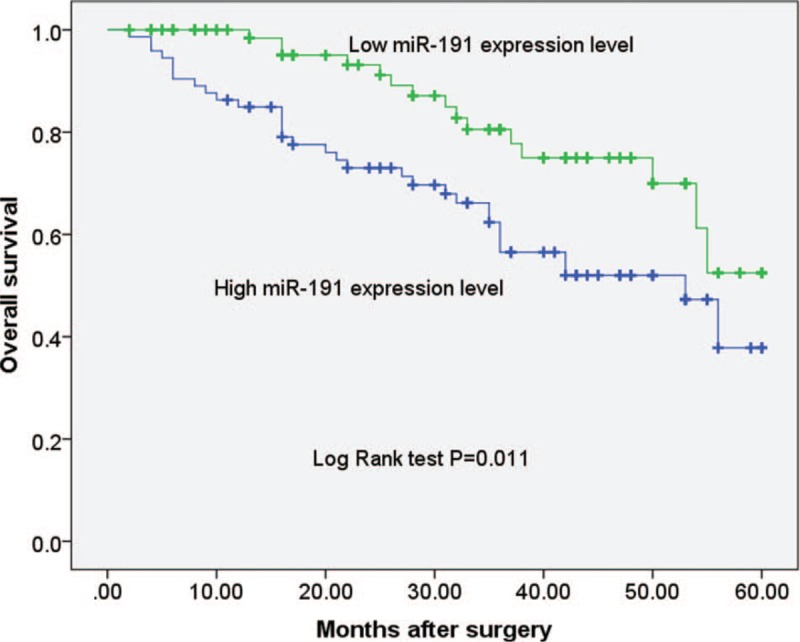
MicroRNA-191 (miR-191) has been identified as being upregulated in several types of cancers, and plays the role of oncogene. The expression of miR-191 has been found to be upregulated in prostate cancer tissues as well as cell lines. In this study, we analyzed the correlation of miR-191 expression with clinicopathologic factors and prognosis in prostate cancer.Prostate cancer tissue samples and adjacent normal prostate tissue samples were collected from 146 patients who underwent laparoscopic radical prostatectomy between April 2013 and March 2018. Student two-tailed t-test was used for comparisons of 2 independent groups. The relationships between miR-191 expression and different clinicopathological characteristics were evaluated using the Chi-squared test. Kaplan-Meier survival plots and log-rank tests were used to assess the differences in overall survival of the different subgroups of prostate cancer patients.miR-191 expression was significantly higher in prostate cancer tissues compared with normal adjacent prostate tissues (P < .001). miR-191 expression was observed to be significantly correlated with Gleason score (P < .001), pelvic lymph node metastasis (P = .006), bone metastases (P < .001), and T stage (P = .005). Kaplan-Meier analysis showed that patients with higher levels of miR-191 had significantly poorer survival than those with lower expression of this miRNA in prostate cancer patients (log rank test, P = .011). Multivariate analysis revealed that miR-191 expression (hazard ratio [HR] = 2.311, 95% confidence interval, [CI]: 1.666-9.006; P = .027) was independently associated with the overall survival of prostate cancer patients.Our results demonstrated that miR-191 might serve as an independent prognostic indicator for prostate cancer patients.
微小RNA-191(miR-191)已被确定在多种癌症中表达上调,并发挥癌基因的作用。研究发现,miR-191在前列腺癌组织以及细胞系中表达上调。在本研究中,我们分析了miR-191表达与前列腺癌临床病理因素及预后的相关性。收集了2013年4月至2018年3月期间接受腹腔镜前列腺癌根治术的146例患者的前列腺癌组织样本和相邻正常前列腺组织样本。采用双侧学生t检验对两个独立组进行比较。使用卡方检验评估miR-191表达与不同临床病理特征之间的关系。采用Kaplan-Meier生存曲线和对数秩检验评估前列腺癌患者不同亚组总生存的差异。与相邻正常前列腺组织相比,miR-191在前列腺癌组织中的表达显著更高(P<0.001)。观察到miR-191表达与 Gleason评分(P<0.001)、盆腔淋巴结转移(P=0.006)、骨转移(P<0.001)和T分期(P=0.005)显著相关。Kaplan-Meier分析显示,在前列腺癌患者中,miR-191水平较高的患者生存率明显低于该miRNA表达较低的患者(对数秩检验,P=0.011)。多因素分析显示,miR-191表达(风险比[HR]=2.311,95%置信区间[CI]:1.666-9.006;P=0.027)与前列腺癌患者的总生存独立相关。我们的结果表明,miR-191可能作为前列腺癌患者的独立预后指标。