Melbø-Jørgensen Christian, Ness Nora, Andersen Sigve, Valkov Andrej, Dønnem Tom, Al-Saad Samer, Kiselev Yury, Berg Thomas, Nordby Yngve, Bremnes Roy M, Busund Lill-Tove, Richardsen Elin
Department of Medical Biology, UIT The Arctic University of Norway, Tromsø, Norway.
Department of Clinical Medicine, UIT The Arctic University of Norway, Tromsø, Norway; Department Oncology, University Hospital of North Norway, Tromsø, Norway.
PLoS One. 2014 Nov 17;9(11):e113039. doi: 10.1371/journal.pone.0113039. eCollection 2014.
microRNAs (miRNAs) are involved in various neoplastic diseases, including prostate cancer (PCs). The aim of this study was to investigate the miRNA profile in PC tissue, to assess their association with clinicopathologic data, and to evaluate the potential of miRNAs as diagnostic and prognostic markers.
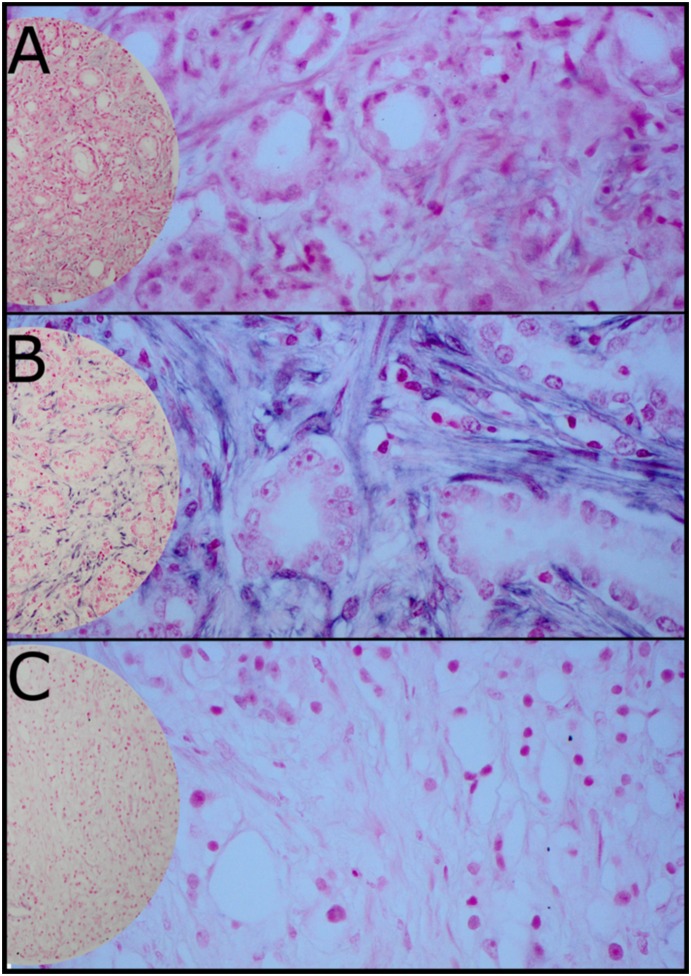
From a cohort of 535 patients submitted to radical prostatectomy (RP), a sample of 30 patients (14 patients with rapid biochemical failure (BF) and 16 patients without BF) with Gleason score 7 were analyzed. A total of 1435 miRNAs were quantified by microarray hybridization, and selected miRNAs with the highest Standard deviation (n = 50) were validated by real-time quantitative PCR (qRT-PCR). In situ hybridization (ISH) was used to evaluate the expression of miR-21.
miR-21 was the only miR that was significantly up-regulated in the BF group (p = 0.045) miR-21 was up-regulated in patients with BF compared with non-BF group (p = 0.05). In univariate analyses, high stromal expression of miR-21 had predictive impact on biochemical failure-free survival (BFFS) and clinical failure-free survival (CFFS) (p = 0.006 and p = 0.04, respectively). In the multivariate analysis, high stromal expression of miR-21 expression was found to be an independent prognostic factor for BFFS in patients with Gleason score 6 (HR 2.41, CI 95% 1.06-5.49, p = 0.037).
High stromal expression of miR-21 was associated with poor biochemical recurrence-free survival after RP. For patients with Gleason score 6, miR-21 may help predict the risk of future disease progression and thereby help select patients for potential adjuvant treatment or a more stringent follow-up.
微小RNA(miRNA)参与包括前列腺癌(PC)在内的多种肿瘤性疾病。本研究旨在调查PC组织中的miRNA谱,评估它们与临床病理数据的关联,并评估miRNA作为诊断和预后标志物的潜力。
从535例行根治性前列腺切除术(RP)的患者队列中,分析了30例Gleason评分为7分的患者样本(14例生化快速失败(BF)患者和16例无BF患者)。通过微阵列杂交对总共1435种miRNA进行定量,并通过实时定量PCR(qRT-PCR)验证选择的标准差最高的miRNA(n = 50)。原位杂交(ISH)用于评估miR-21的表达。
miR-21是BF组中唯一显著上调的miR(p = 0.045)。与非BF组相比,BF患者中miR-21上调(p = 0.05)。在单变量分析中,miR-21的高基质表达对无生化失败生存期(BFFS)和无临床失败生存期(CFFS)有预测影响(分别为p = 0.006和p = 0.04)。在多变量分析中,发现miR-21表达的高基质表达是Gleason评分为6分患者BFFS的独立预后因素(HR 2.41,CI 95% 1.06 - 5.49,p = 0.037)。
miR-21的高基质表达与RP后不良的无生化复发生存相关。对于Gleason评分为6分的患者,miR-21可能有助于预测未来疾病进展的风险,从而有助于选择可能接受辅助治疗或更严格随访的患者。