Yu Ji Hee, Han Kyungdo, Park Sanghyun, Lee Da Young, Nam Ga Eun, Seo Ji A, Kim Sin Gon, Baik Sei Hyun, Park Yong Gyu, Kim Seon Mee, Kim Nan Hee, Choi Kyung Mook
Department of Internal Medicine, Division of Endocrinology and Metabolism, College of Medicine, Korea University.
Department of Biostatistics, College of Medicine, The Catholic University of Korea.
Medicine (Baltimore). 2019 Jul;98(29):e16317. doi: 10.1097/MD.0000000000016317.
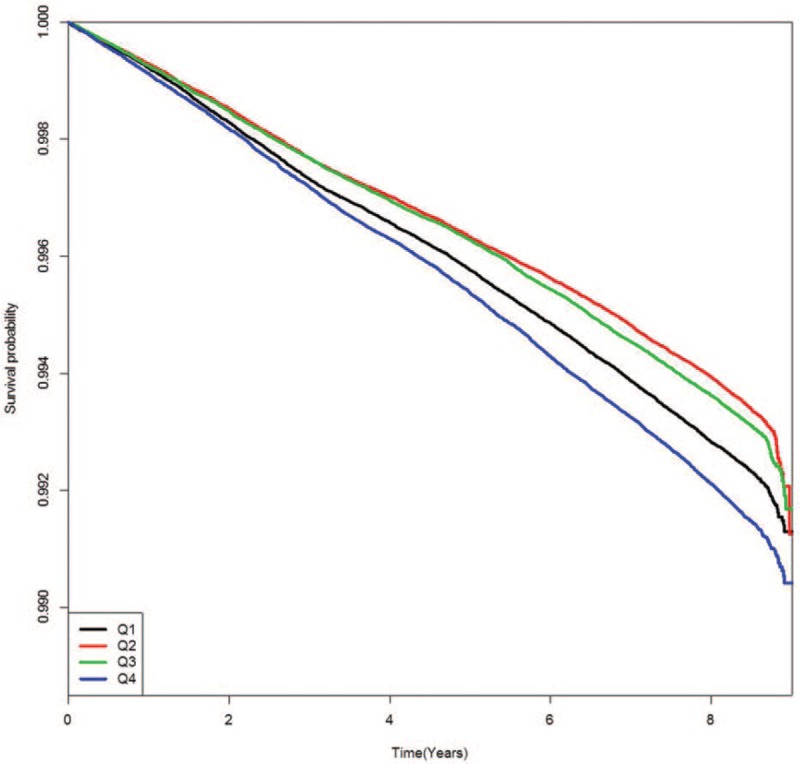
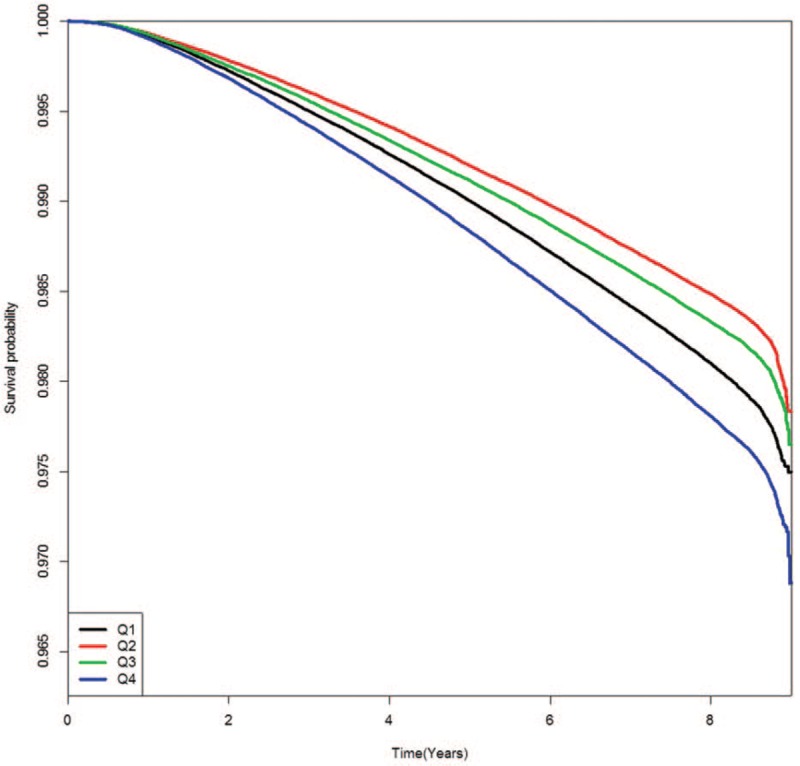
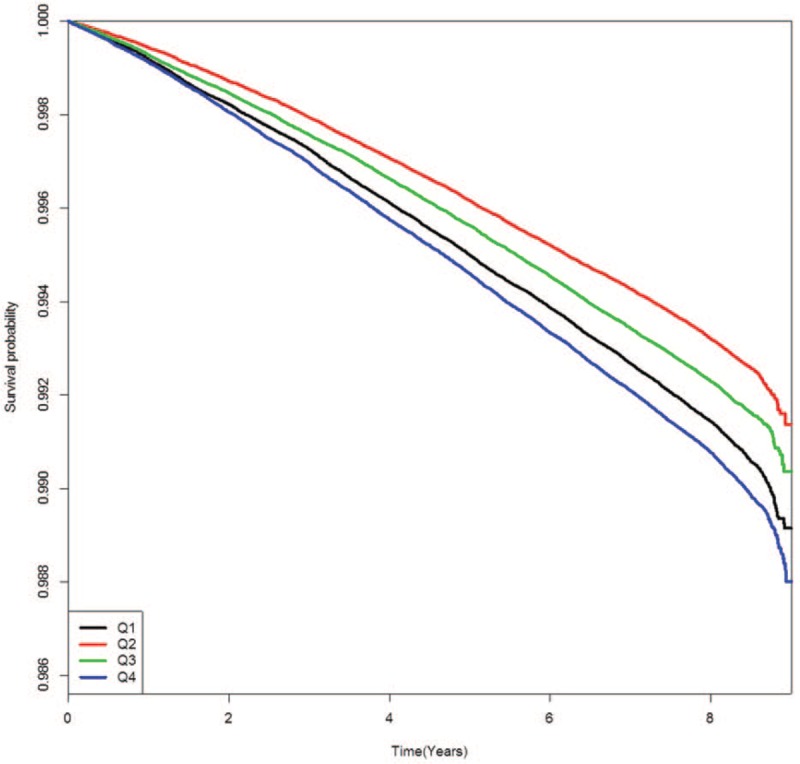
Increased glycemic variability (GV) is an independent risk factor for cardiovascular complications in patients with diabetes. We evaluated the risk of future development of cardiovascular disease (CVD) and death according to GV in a general population without diabetes.We used the National Health Insurance Service, providing a population-based, nationwide database of Koreans. We included individuals without diabetes who underwent glucose measurement at least 3 times during 2002 to 2006. GV was calculated as standard deviation (SD) of fasting plasma glucose (FPG) levels. We observed development of CVD or all-cause death from 2007 to 2015, and also evaluated the mortality within 1 year after CVD.Among 3,211,319 people, we found 23,374 incident cases of myocardial infarction (MI), 27,705 cases of stroke, and 63,275 deaths during 8.3 years of follow-up. After multivariate adjustment, GV was found to be a significant predictor of MI, stroke and all-cause death for their highest quartile, with corresponding hazard ratios (HR) of 1.08 (95% confidence interval, CI 1.04-1.11), 1.09 (95% CI 1.06-1.13), and 1.12 (95% CI 1.10-1.15), respectively. The risk of death increased more in those who had both impaired fasting glucose and the highest quartile of GV (HR 1.24 [95% CI 1.21-1.28]). Moreover, early death rate after 1 year of CVD was higher in the highest quartile of GV compared to the lowest quartile (HR 1.21 [95% CI 1.03-1.41]).Long-term FPG variation was independently associated with CVD and mortality in a general population without diabetes.
血糖变异性(GV)增加是糖尿病患者心血管并发症的独立危险因素。我们根据血糖变异性评估了无糖尿病的普通人群未来发生心血管疾病(CVD)和死亡的风险。我们使用了国民健康保险服务机构提供的以韩国人群为基础的全国性数据库。我们纳入了在2002年至2006年期间至少进行过3次血糖测量的无糖尿病个体。血糖变异性通过空腹血糖(FPG)水平的标准差(SD)来计算。我们观察了2007年至2015年期间心血管疾病的发生或全因死亡情况,并评估了心血管疾病发生后1年内的死亡率。在3211319人中,我们在8.3年的随访期间发现了23374例心肌梗死(MI)事件、27705例中风事件和63275例死亡。经过多变量调整后,发现血糖变异性处于最高四分位数时是心肌梗死、中风和全因死亡的显著预测因素,相应的风险比(HR)分别为1.08(95%置信区间,CI 1.04 - 1.11)、1.09(95% CI 1.06 - 1.13)和1.12(95% CI 1.10 - 1.15)。空腹血糖受损且血糖变异性处于最高四分位数的人群死亡风险增加得更多(HR 1.24 [95% CI 1.21 - 1.28])。此外,血糖变异性最高四分位数组的心血管疾病发生后1年内的早期死亡率高于最低四分位数组(HR 1.21 [95% CI 1.03 - 1.41])。在无糖尿病的普通人群中,长期空腹血糖变化与心血管疾病和死亡率独立相关。