Luo Qianqian, Huang Xiaojie, Li Lingling, Ding Yingying, Mi Guodong, Scott Sarah Robbins, Zhao Yan, Rou Keming, He Na, Wu Hao, Wu Zunyou
The National Center for Acquired Immunodeficiency Syndromes and Sexually Transmitted Diseases Control and Prevention, Chinese Center for Disease Control and Prevention, Beijing.
School of Nursing, Binzhou Medical University, Yantai, Shandong.
Medicine (Baltimore). 2019 Jul;98(29):e16375. doi: 10.1097/MD.0000000000016375.
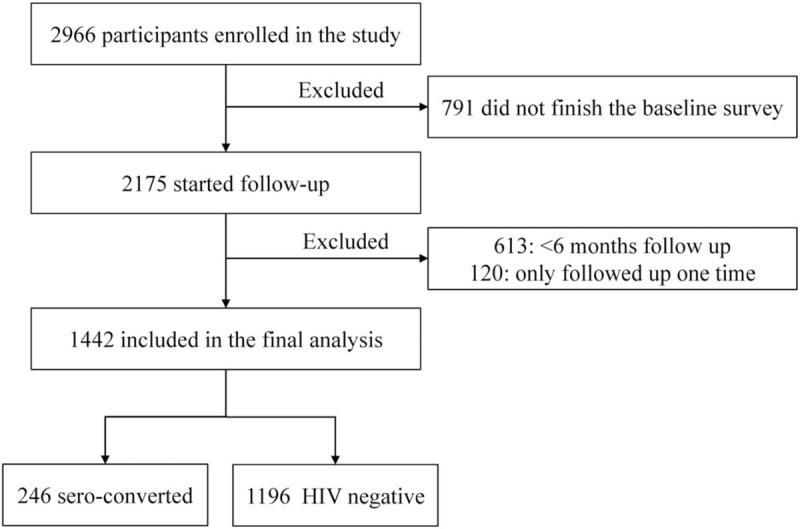
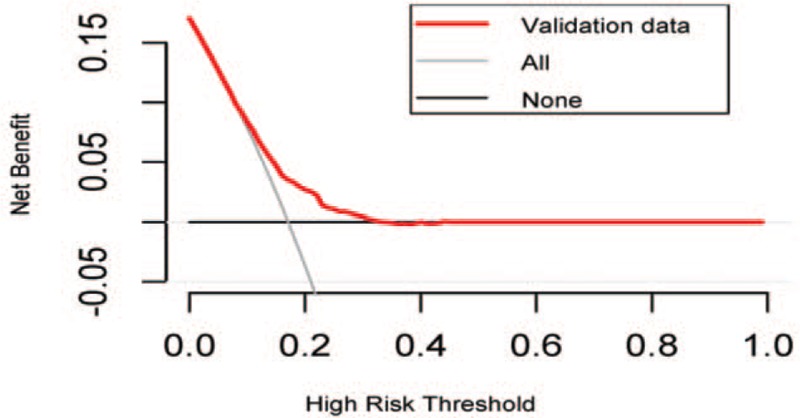
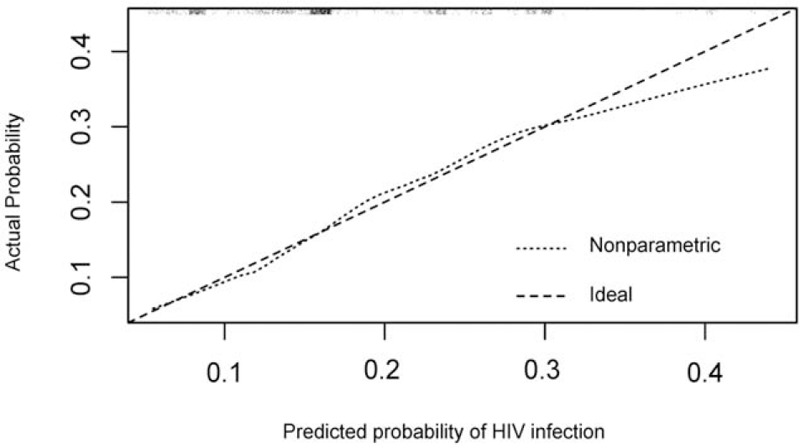
A human immunodeficiency virus (HIV) risk assessment tool was previously developed for predicting HIV infection among men who have sex with men (MSM), but was not externally validated. We evaluated the tool's validity for predicting HIV infection in an independent cohort.The tool was assessed using data from a retrospective cohort study of HIV-negative adult MSM who were recruited in Beijing, China between January 2009 and December 2016.High-risk behaviors occurring within 6 months before the survey were evaluated. Area under curve (AUC) of the receiver operating character curve (ROC) was used to quantify discrimination performance; calibration curve and Hosmer-Lemeshow statistic were used for calibration performance valuation; and decision curve analysis (DCA) was used to evaluate clinical usage.One thousand four hundred forty two participants from the cohort were included in the analysis; 246 (17.1%) sero-converted during follow-up. External validation of the tool showed good calibration, the Hosmer-Lemeshow test showed no statistical difference between observed probability and tool-based predictive probability of HIV infection (X = 4.55, P = .80). The tool had modest discrimination ability (AUC = 0.63, 95% confidence interval [CI]: 0.61-0.66). The decision curve analysis indicated that implementing treatment measures based on the tool's predicative risk thresholds ranging from 10% to 30% might increase the net benefit of treatment when compared with treating all or no MSM.The HIV risk assessment tool can predict the actual risk of HIV infection well amongst MSM in China, but it has a moderate ability to discriminate those at high risk of HIV infection.
先前开发了一种人类免疫缺陷病毒(HIV)风险评估工具,用于预测男男性行为者(MSM)中的HIV感染情况,但未进行外部验证。我们在一个独立队列中评估了该工具预测HIV感染的有效性。该工具是使用一项针对2009年1月至2016年12月在中国北京招募的HIV阴性成年男男性行为者的回顾性队列研究数据进行评估的。评估了调查前6个月内发生的高危行为。采用受试者操作特征曲线(ROC)的曲线下面积(AUC)来量化区分性能;校准曲线和Hosmer-Lemeshow统计量用于校准性能评估;决策曲线分析(DCA)用于评估临床实用性。该队列中的1442名参与者纳入了分析;246人(17.1%)在随访期间血清转化。该工具的外部验证显示校准良好,Hosmer-Lemeshow检验显示HIV感染的观察概率与基于工具的预测概率之间无统计学差异(X = 4.55,P = 0.80)。该工具具有适度的区分能力(AUC = 0.63,95%置信区间[CI]:0.61 - 0.66)。决策曲线分析表明,与治疗所有男男性行为者或不治疗相比,基于该工具10%至30%的预测风险阈值实施治疗措施可能会增加治疗的净效益。该HIV风险评估工具能够很好地预测中国男男性行为者中HIV感染的实际风险,但在区分HIV感染高危人群方面能力中等。