Department of Ophthalmology and Vision Sciences, University of Toronto, Toronto, Canada.
Division of Health Care and Outcomes Research, Toronto Western Research Institute, University Health Network, Toronto, Canada.
PLoS One. 2019 Jul 23;14(7):e0218540. doi: 10.1371/journal.pone.0218540. eCollection 2019.
Social participation benefits health. We assessed the relationship between self-reported visual impairment (VI) and glaucoma versus seniors' social participation.
Data from individuals aged ≥65 years responding to the Canadian Community Health Survey Healthy Aging 2008/2009 (n = 16,369) was analyzed. Participation in eight social activities by seniors with and without self-reported VI or glaucoma was compared.
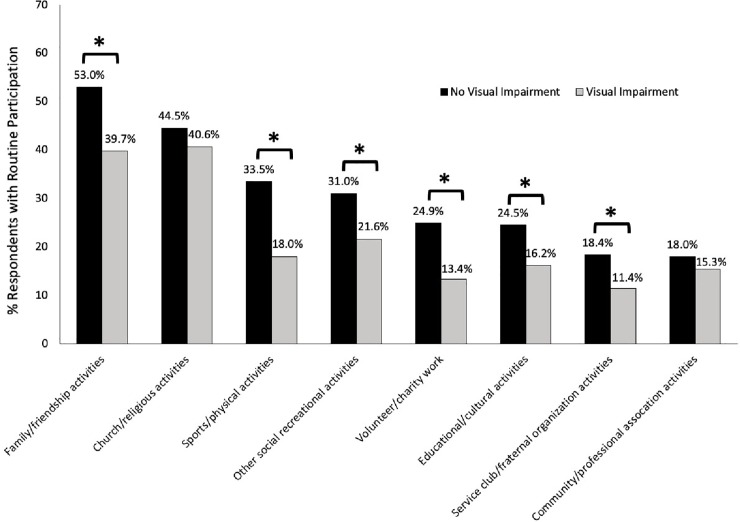
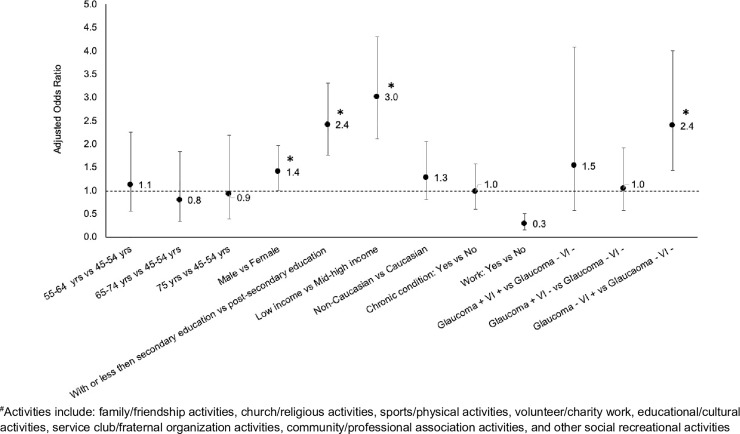
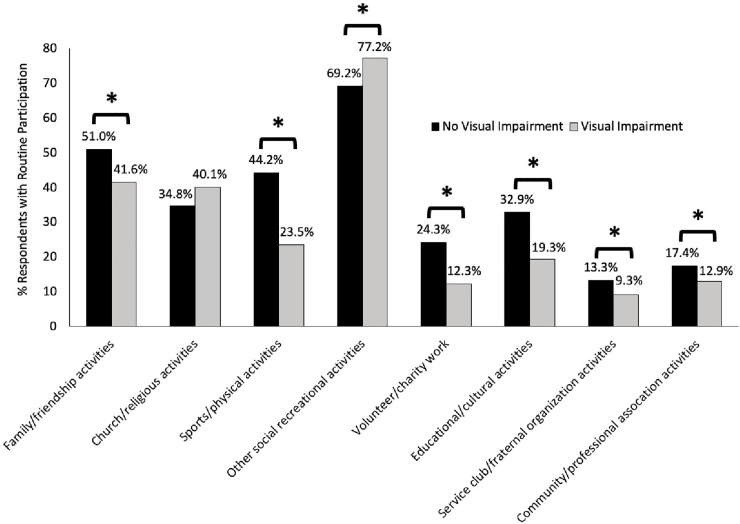
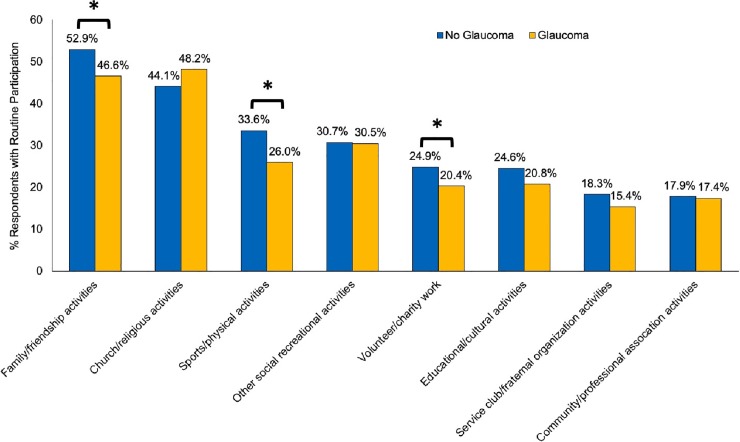
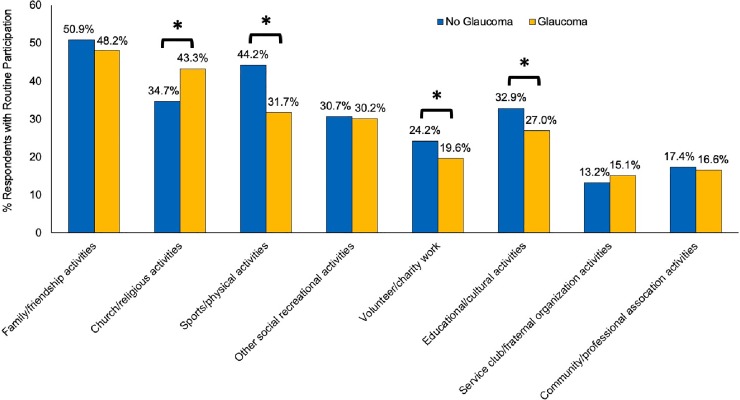
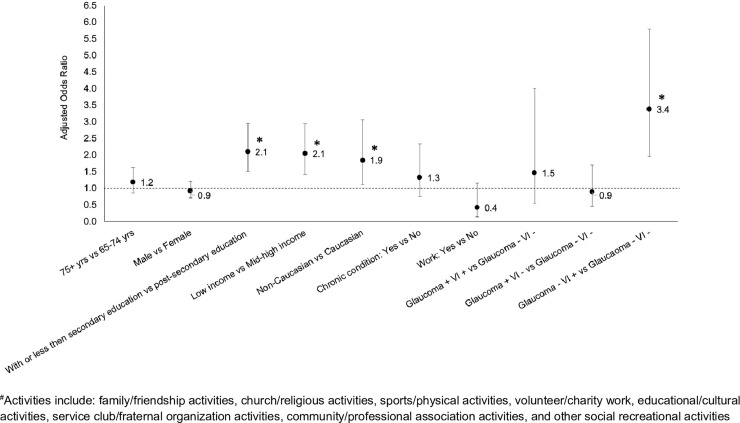
Seniors with VI had significantly reduced participation (p<0.05) in sports/physical activities (18.0% vs. 33.6%), family/friendship activities outside the household (39.7% vs. 53.0%), service club/fraternal organization activities (11.4% vs. 18.4%), volunteer/charity work (13.4% vs. 24.9%), educational/cultural activities (16.2% vs. 24.5%), and other social recreational activities (21.6% vs. 31.0%) compared to those without VI. Differences in participation in church/religious activities (40.6% vs. 44.5%) and community/professional association activities (15.3% vs. 18.0%) were non-significant between seniors with and without VI. Seniors with glaucoma versus those without had significantly reduced participation (p<0.05) in family/friendship activities (46.6% vs. 52.9%), sports/physical activities (26.0% vs. 33.6%) and volunteer/charity work (20.4% vs. 24.9%). No participation in any social activity was significantly higher among seniors with VI versus those without (10.1% vs. 2.9%, p<0.05), but was similar among seniors with and without glaucoma (3.9% vs. 3.1%, p>0.05). After adjusting for the effects of age, sex, education, household income, ethnicity, job status and chronic diseases (adjusted odds ratio, aOR = 3.4 (95% confidence interval (CI) 2.0-5.8), seniors with VI but no glaucoma were more likely not to engage in any social activities compared to seniors without VI and no glaucoma. Seniors with glaucoma but without VI had a similar level of non-participation (aOR = 0.9, 95%% CI 0.5-1.7).
Significantly reduced social participation was found across six community activities among seniors with self-reported VI and in three activities among those with self-reported glaucoma. Policies and programs that help seniors with VI or glaucoma engage in social activities are needed.
社会参与有益于健康。我们评估了自我报告的视力障碍(VI)和青光眼与老年人社会参与之间的关系。
分析了对加拿大社区健康调查健康老龄化 2008/2009 年(n=16369)中年龄≥65 岁的个体的数据。比较了有和没有自我报告的 VI 或青光眼的老年人参与八项社会活动的情况。
VI 老年人的参与度明显下降(p<0.05),包括体育/体育活动(18.0% vs. 33.6%)、家庭/友谊活动(39.7% vs. 53.0%)、服务俱乐部/兄弟组织活动(11.4% vs. 18.4%)、志愿/慈善工作(13.4% vs. 24.9%)、教育/文化活动(16.2% vs. 24.5%)和其他社会娱乐活动(21.6% vs. 31.0%)。与没有 VI 的老年人相比,VI 老年人在教堂/宗教活动(40.6% vs. 44.5%)和社区/专业协会活动(15.3% vs. 18.0%)中的参与差异无统计学意义。与没有青光眼的老年人相比,青光眼老年人的家庭/友谊活动(46.6% vs. 52.9%)、体育/体育活动(26.0% vs. 33.6%)和志愿/慈善工作(20.4% vs. 24.9%)的参与度明显下降。VI 老年人不参与任何社会活动的比例明显高于没有 VI 的老年人(10.1% vs. 2.9%,p<0.05),但与有和没有青光眼的老年人相似(3.9% vs. 3.1%,p>0.05)。在校正了年龄、性别、教育程度、家庭收入、种族、工作状况和慢性病的影响后(调整后的优势比,aOR=3.4(95%置信区间(CI)2.0-5.8)),与没有 VI 和没有青光眼的老年人相比,有 VI 但没有青光眼的老年人更不可能参与任何社会活动。没有 VI 但有青光眼的老年人的非参与度相似(aOR=0.9,95%CI 0.5-1.7)。
报告有 VI 的老年人在六项社区活动中的参与度显著下降,报告有青光眼的老年人在三项活动中的参与度显著下降。需要制定政策和方案,帮助有 VI 或青光眼的老年人参与社会活动。