Zhao Shanshan, Li Zhenghui, Zhang Muxian, Zhang Lingliang, Zheng Honghua, Ning Jinhuan, Wang Yanyan, Wang Fengpeng, Zhang Xiaobin, Gan Hexia, Wang Yuanqing, Zhang Xian, Luo Hong, Bu Guojun, Xu Huaxi, Yao Yi, Zhang Yun-Wu
Fujian Provincial Key Laboratory of Neurodegenerative Disease and Aging Research, Institute of Neuroscience, School of Medicine, Xiamen University, Xiamen, 361102, Fujian, China.
Neuromedicine Center, the 174th Hospital of Chinese People's Liberation Army, Affiliated Chenggong Hospital, Xiamen University, Xiamen, 361003, Fujian, China.
Exp Mol Med. 2019 Jul 23;51(7):1-11. doi: 10.1038/s12276-019-0277-4.
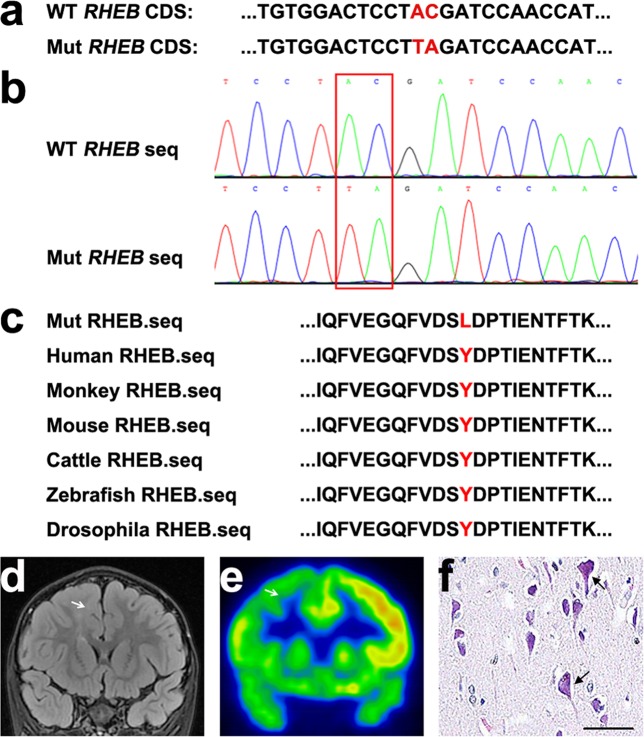
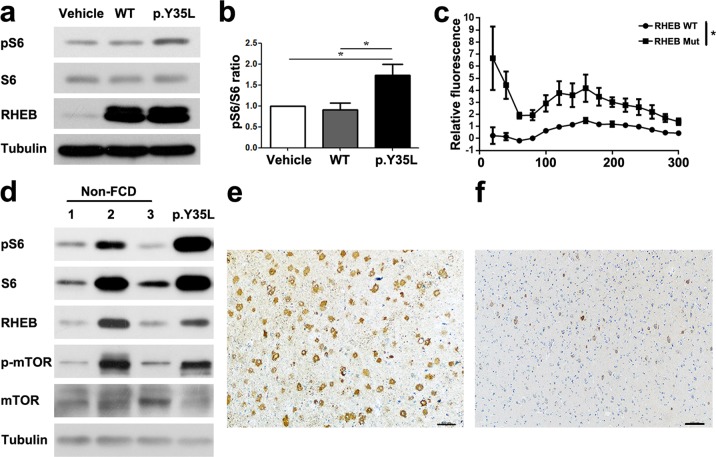
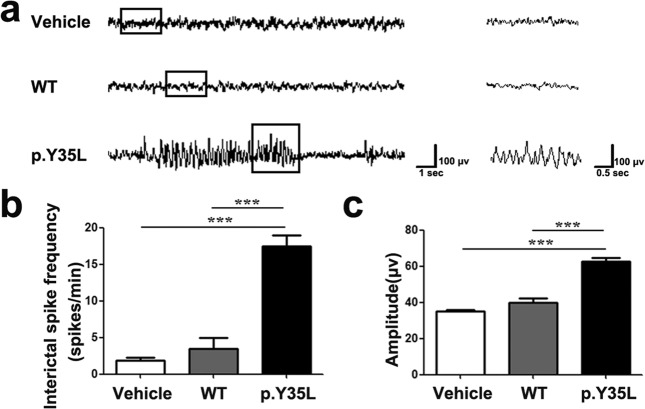
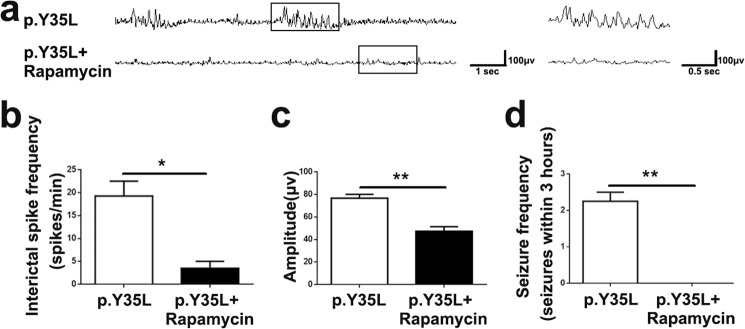
Focal cortical dysplasia type II (FCDII) is a cerebral cortex malformation characterized by local cortical structure disorganization, neuronal dysmorphology, and refractory epilepsy. Brain somatic mutations in several genes involved in the PI3K/AKT/mTOR pathway are associated with FCDII, but they are only found in a proportion of patients with FCDII. The genetic causes underlying the development FCDII in other patients remain unclear. Here, we carried out whole exome sequencing and targeted sequencing in paired brain-blood DNA from patients with FCDII and identified a brain somatic doublet mutation c.(A104T, C105A) in the Ras homolog, mTORC1 binding (RHEB) gene, which led to the RHEB p.Y35L mutation in one patient with FCDII. This RHEB mutation carrier had a dramatic increase of ribosomal protein S6 phosphorylation, indicating mTOR activation in the region of the brain lesion. The RHEB p.Y35L mutant protein had increased GTPλS-binding activity compared with wild-type RHEB. Overexpression of the RHEB p.Y35L variant in cultured cells also resulted in elevated S6 phosphorylation compared to wild-type RHEB. Importantly, in utero electroporation of the RHEB p.Y35L variant in mice induced S6 phosphorylation, cytomegalic neurons, dysregulated neuron migration, abnormal electroencephalogram, and seizures, all of which are found in patients with FCDII. Rapamycin treatment rescued abnormal electroencephalograms and alleviated seizures in these mice. These results demonstrate that brain somatic mutations in RHEB are also responsible for the pathogenesis of FCDII, indicating that aberrant activation of mTOR signaling is a primary driver and potential drug target for FCDII.
II型局灶性皮质发育不良(FCDII)是一种大脑皮质畸形,其特征为局部皮质结构紊乱、神经元形态异常以及难治性癫痫。参与PI3K/AKT/mTOR信号通路的多个基因中的脑体细胞突变与FCDII相关,但仅在一部分FCDII患者中发现。其他FCDII患者发病的遗传原因仍不清楚。在此,我们对FCDII患者的配对脑血DNA进行了全外显子组测序和靶向测序,并在Ras同源物、mTORC1结合蛋白(RHEB)基因中鉴定出一个脑体细胞双突变c.(A104T,C105A),该突变导致一名FCDII患者出现RHEB p.Y35L突变。该RHEB突变携带者的核糖体蛋白S6磷酸化显著增加,表明脑损伤区域的mTOR被激活。与野生型RHEB相比,RHEB p.Y35L突变蛋白的GTPλS结合活性增加。在培养细胞中过表达RHEB p.Y35L变体也导致与野生型RHEB相比S6磷酸化升高。重要的是,在小鼠子宫内电穿孔导入RHEB p.Y35L变体可诱导S6磷酸化、巨细胞神经元、神经元迁移失调、异常脑电图和癫痫发作,这些都是FCDII患者中出现的症状。雷帕霉素治疗可挽救这些小鼠的异常脑电图并减轻癫痫发作。这些结果表明,RHEB基因的脑体细胞突变也参与了FCDII的发病机制,表明mTOR信号通路的异常激活是FCDII的主要驱动因素和潜在药物靶点。