Martinez-Rios Veronica, Gkogka Elissavet, Dalgaard Paw
National Food Institute (DTU Food), Technical University of Denmark, Lyngby, Denmark.
Arla Innovation Centre, Arla Foods Amba, Aarhus, Denmark.
Front Microbiol. 2019 Jul 3;10:1510. doi: 10.3389/fmicb.2019.01510. eCollection 2019.
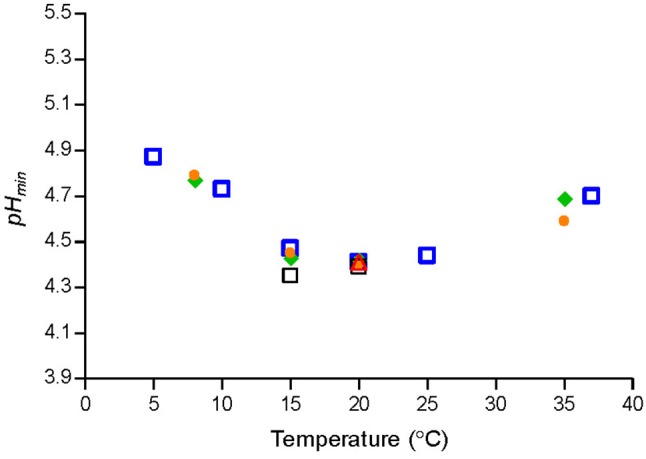
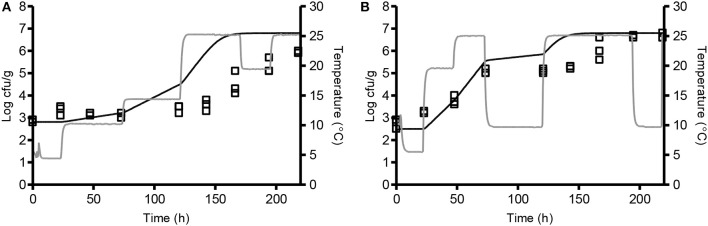
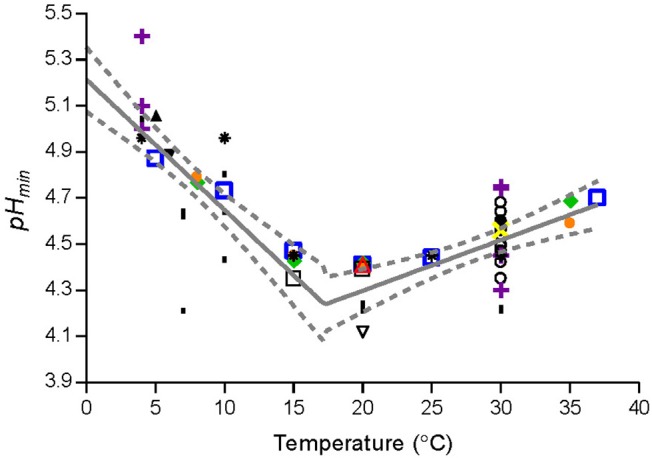
The aim of this study was to quantify the influence of temperature on H -values of as used in cardinal parameter growth models and thereby improve the prediction of growth for this pathogen in food with low pH. Experimental data for growth in broth at different pH-values and at different constant temperatures were generated and used to determined H -values. Additionally, H -values for available from literature were collected. A new H -function was developed to describe the effect of temperatures on H -values obtained experimentally and from literature data. A growth and growth boundary model was developed by substituting the constant H -value present in the Mejlholm and Dalgaard (2009) model (J. Food. Prot. 72, 2132-2143) by the new H -function. To obtain data for low pH food, challenge tests were performed with in commercial and laboratory-produced chemically acidified cheese including glucono-delta-lactone (GDL) and in commercial cream cheese. Furthermore, literature data for growth of in products with or without GDL were collected. Evaluation of the new and expanded model by comparison of observed and predicted μ -values resulted in a bias factor of 1.01 and an accuracy factor of 1.48 for a total of 1,129 growth responses from challenge tests and literature data. Growth and no-growth responses of in seafood, meat, non-fermented dairy products, and fermented cream cheese were 90.3% correctly predicted with incorrect predictions being 5.3% fail-safe and 4.4% fail-dangerous. The new H -function markedly extended the range of applicability of the Mejlholm and Dalgaard (2009) model from pH 5.4 to pH 4.6 and therefore the model can now support product development, reformulation or risk assessment of food with low pH including chemically acidified cheese and cream cheese.
本研究的目的是量化温度对用于基本参数生长模型的H值的影响,从而改进对这种低pH值食品中病原体生长的预测。生成了在不同pH值和不同恒定温度下肉汤中生长的实验数据,并用于确定H值。此外,还收集了文献中可得的H值。开发了一个新的H函数来描述温度对通过实验和文献数据获得的H值的影响。通过用新的H函数替代Mejlholm和Dalgaard(2009年)模型(《食品保护杂志》72,2132 - 2143)中存在的恒定H值,开发了一个生长和生长边界模型。为了获得低pH值食品的数据,在含有葡萄糖酸 - δ - 内酯(GDL)的商业和实验室生产的化学酸化奶酪以及商业奶油奶酪中对进行了挑战试验。此外,还收集了在含有或不含有GDL的产品中生长的文献数据。通过比较观察到的和预测的μ值对新的扩展模型进行评估,对于来自挑战试验和文献数据的总共1129个生长响应,偏差因子为1.01,准确因子为1.48。在海鲜、肉类、非发酵乳制品和发酵奶油奶酪中的生长和不生长响应有90.3%被正确预测,错误预测中有5.3%为安全失败型,4.4%为危险失败型。新的H函数显著扩展了Mejlholm和Dalgaard(2009年)模型的适用范围,从pH 5.4扩展到pH 4.6,因此该模型现在可以支持低pH值食品的产品开发、重新配方或风险评估,包括化学酸化奶酪和奶油奶酪。