Institute for Applied Computing, National Research Council of Italy, Rome, Italy.
School of Interdisciplinary Informatics, College of Information Science and Technology, University of Nebraska at Omaha, Omaha, NE, United States.
Front Immunol. 2019 Jul 3;10:1513. doi: 10.3389/fimmu.2019.01513. eCollection 2019.
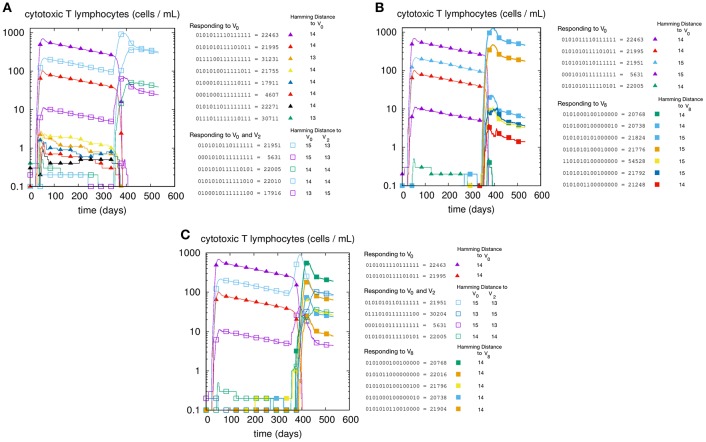
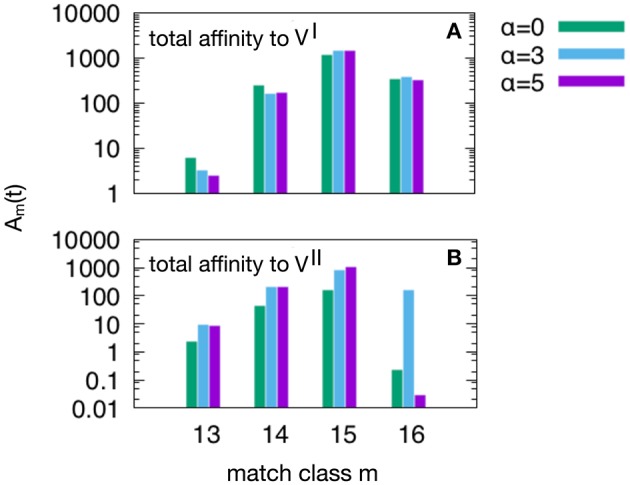
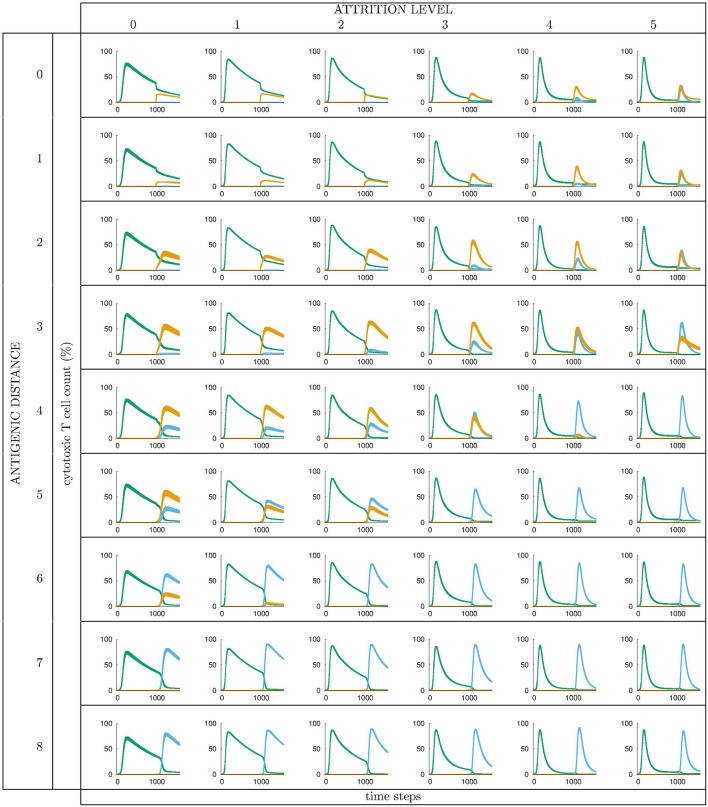
Experimental and computational studies have revealed that T-cell cross-reactivity is a widespread phenomenon that can either be advantageous or detrimental to the host. In particular, detrimental effects can occur whenever the clonal dominance of memory cells is not justified by their infection-clearing capacity. Using an agent-based model of the immune system, we recently predicted the "memory anti-naïve" phenomenon, which occurs when the secondary challenge is similar but not identical to the primary stimulation. In this case, the pre-existing memory cells formed during the primary infection may be rapidly deployed in spite of their low affinity and can actually prevent a potentially higher affinity naïve response from emerging, resulting in impaired viral clearance. This finding allowed us to propose a mechanistic explanation for the concept of "antigenic sin" originally described in the context of the humoral response. However, the fact that antigenic sin is a relatively rare occurrence suggests the existence of evolutionary mechanisms that can mitigate the effect of the memory anti-naïve phenomenon. In this study we use computer modeling to further elucidate clonal dominance and the memory anti-naïve phenomenon, and to investigate a possible mitigating factor called attrition. Attrition has been described in the experimental and computational literature as a combination of competition for space and apoptosis of lymphocytes via type-I interferon in the early stages of a viral infection. This study systematically explores the relationship between clonal dominance and the mechanism of attrition. Our results suggest that attrition can indeed mitigate the memory anti-naïve effect by enabling the emergence of a diverse, higher affinity naïve response against the secondary challenge. In conclusion, modeling attrition allows us to shed light on the nature of clonal interaction and dominance.
实验和计算研究表明,T 细胞交叉反应是一种普遍现象,它可能对宿主有利也可能有害。特别是,当记忆细胞的克隆优势与其清除感染的能力不成比例时,就会出现有害影响。我们最近使用免疫系统的基于代理的模型预测了“记忆抗幼稚”现象,这种现象发生在二次挑战与初次刺激相似但不完全相同时。在这种情况下,尽管记忆细胞的亲和力较低,但在初次感染期间形成的预先存在的记忆细胞可能会迅速被部署,实际上可以防止潜在的更高亲和力的幼稚反应出现,从而导致病毒清除受损。这一发现使我们能够对最初在体液免疫反应背景下描述的“抗原原罪”概念提出一种机制解释。然而,抗原原罪是一种相对罕见的现象,这表明存在进化机制可以减轻记忆抗幼稚现象的影响。在这项研究中,我们使用计算机建模进一步阐明了克隆优势和记忆抗幼稚现象,并研究了一种可能的缓解因素,称为损耗。在实验和计算文献中,损耗被描述为病毒感染早期通过 I 型干扰素竞争空间和淋巴细胞凋亡的组合。本研究系统地探讨了克隆优势与损耗机制之间的关系。我们的研究结果表明,损耗确实可以通过允许针对二次挑战出现多样化、更高亲和力的幼稚反应来减轻记忆抗幼稚效应。总之,对损耗的建模使我们能够揭示克隆相互作用和优势的本质。