Fundacion INFANT, Buenos Aires, Argentina.
Nat Med. 2011 Feb;17(2):195-9. doi: 10.1038/nm.2262. Epub 2010 Dec 5.
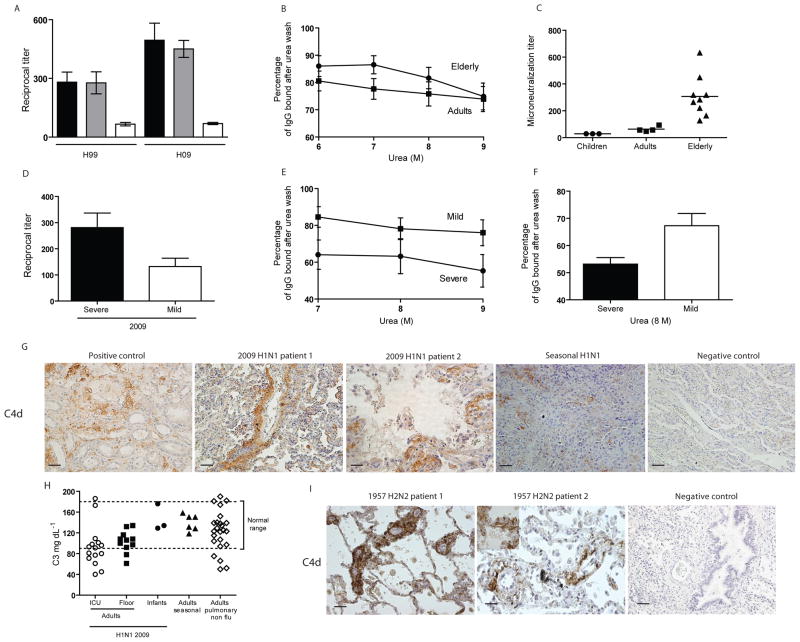
Pandemic influenza viruses often cause severe disease in middle-aged adults without preexisting comorbidities. The mechanism of illness associated with severe disease in this age group is not well understood. Here we find preexisting serum antibodies that cross-react with, but do not protect against, 2009 H1N1 influenza virus in middle-aged adults. Nonprotective antibody is associated with immune complex-mediated disease after infection. We detected high titers of serum antibody of low avidity for H1-2009 antigen, and low-avidity pulmonary immune complexes against the same protein, in severely ill individuals. Moreover, C4d deposition--a marker of complement activation mediated by immune complexes--was present in lung sections of fatal cases. Archived lung sections from middle-aged adults with confirmed fatal influenza 1957 H2N2 infection revealed a similar mechanism of illness. These observations provide a previously unknown biological mechanism for the unusual age distribution of severe cases during influenza pandemics.
大流行性流感病毒常导致无潜在合并症的中年成年人发生严重疾病。对于该年龄组中与严重疾病相关的发病机制尚不清楚。在这里,我们发现中年成年人中预先存在的血清抗体与 2009 年 H1N1 流感病毒发生交叉反应,但不能预防该病毒。非保护性抗体与感染后免疫复合物介导的疾病有关。我们在重症患者中检测到针对 H1-2009 抗原的低亲和力血清抗体和针对同一蛋白的低亲和力肺免疫复合物的高滴度。此外,在致命病例的肺组织切片中存在 C4d 沉积——一种由免疫复合物介导的补体激活的标志物。从中年成年人确诊的致死性流感 1957 年 H2N2 感染的存档肺组织切片中揭示了一种类似的发病机制。这些观察结果为流感大流行期间严重病例的异常年龄分布提供了一个以前未知的生物学机制。