Oeda Satoshi, Takahashi Hirokazu, Isoda Hiroshi, Komukai Sho, Imajo Kento, Yoneda Masato, Ono Masafumi, Hyogo Hideyuki, Kawaguchi Takumi, Fujii Hideki, Kawanaka Miwa, Sumida Yoshio, Tanaka Saiyu, Kawamoto Hirofumi, Torimura Takuji, Saibara Toshiji, Kawaguchi Atsushi, Nakajima Atsushi, Eguchi Yuichiro
Liver Center, Saga University, Saga-Shi, Saga 849-8501, Japan.
Division of Metabolism and Endocrinology, Faculty of Medicine, Saga University, Saga-Shi, Saga 849-8501, Japan.
Biomed Rep. 2019 Aug;11(2):63-69. doi: 10.3892/br.2019.1224. Epub 2019 Jun 21.
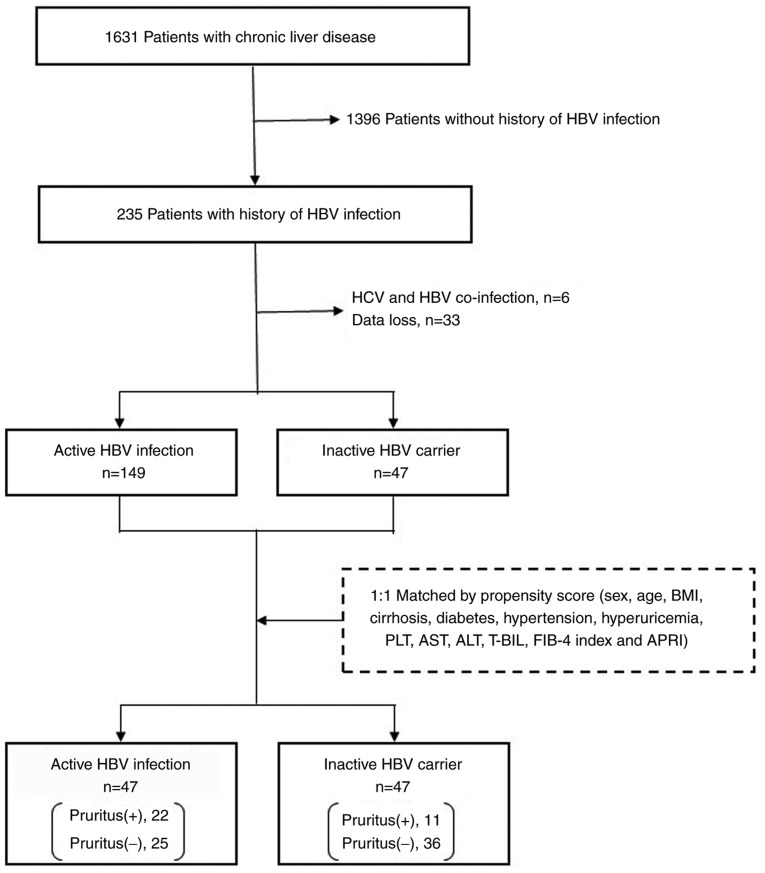
Pruritus is a common pathogenesis in liver diseases, including chronic hepatitis B (CHB). The phases of hepatitis B virus (HBV) infection are defined in the American Association for the Study of Liver Diseases guidelines. However, it still remains unclear whether the phase independently affects pruritus. The aim of this study was to clarify the effect of HBV infection phase on pruritus in patients with HBV. Of the 1,631 patients that attended the joint research facilities and were interviewed regarding their pruritus between January and June 2016, 196 patients with HBV infection were selected for the present analysis. One-to-one propensity score-matching using 13 variables was performed between participants in the hepatitis B e antigen (HBe-Ag)-positive/negative immune-active phase group and the inactive CHB phase group. Data from 47 patients per group were included in the final analysis. The prevalence of pruritus in the inactive CHB phase was significantly lower than in the HBe-Ag-positive/negative immune-active phase (23 vs. 47%; P=0.031). Being in the inactive CHB phase was determined to be an independent risk factor for pruritus (odds ratio, 0.35; 95% confidence interval, 0.143-0.842; P=0.019). The progression to inactive CHB phase may contribute to the amelioration of pruritus in patients with HBV infection.
瘙痒是肝病(包括慢性乙型肝炎)常见的发病机制。美国肝病研究协会指南对乙型肝炎病毒(HBV)感染阶段进行了定义。然而,尚不清楚该阶段是否独立影响瘙痒。本研究旨在阐明HBV感染阶段对HBV患者瘙痒的影响。在2016年1月至6月期间到联合研究机构就诊并接受瘙痒相关访谈的1631名患者中,选取196例HBV感染患者进行本分析。在乙肝e抗原(HBe-Ag)阳性/阴性免疫活跃期组和非活动性慢性乙肝期组的参与者之间,使用13个变量进行一对一倾向评分匹配。每组47例患者的数据纳入最终分析。非活动性慢性乙肝期瘙痒的患病率显著低于HBe-Ag阳性/阴性免疫活跃期(23%对47%;P=0.031)。处于非活动性慢性乙肝期被确定为瘙痒的独立危险因素(比值比,0.35;95%置信区间,0.143 - 0.842;P=0.019)。进展至非活动性慢性乙肝期可能有助于改善HBV感染患者的瘙痒症状。