Mita Tomoya, Katakami Naoto, Okada Yosuke, Yoshii Hidenori, Osonoi Takeshi, Nishida Keiko, Shiraiwa Toshihiko, Torimoto Keiichi, Kurozumi Akira, Wakasugi Satomi, Gosho Masahiko, Shimomura Iichiro, Watada Hirotaka
Department of Metabolism and Endocrinology, Juntendo University Graduate School of Medicine, 2-1-1 Bunkyo-ku, Tokyo, Japan.
Department of Metabolic Medicine, Osaka University Graduate School of Medicine, 2-2,Yamadaoka, Suita, Osaka, Japan.
Diabetes Ther. 2019 Oct;10(5):1565-1575. doi: 10.1007/s13300-019-0665-8. Epub 2019 Jul 23.
A recent study demonstrated that large glucose fluctuations were associated with an increased incidence of cardiovascular disease (CVD) in patients with type 2 diabetes mellitus (T2DM) and acute myocardial infarction. However, it is unknown whether glucose fluctuations are related to the incidence of CVD or the progression of atherosclerosis in patients with T2DM with no apparent history of CVD. In this protocol, we will be investigating the relationships of glucose fluctuations evaluated by continuous glucose monitoring (CGM) to the incidence of composite cardiovascular events and the progression of atherosclerosis in patients with T2DM who had no apparent history of CVD.
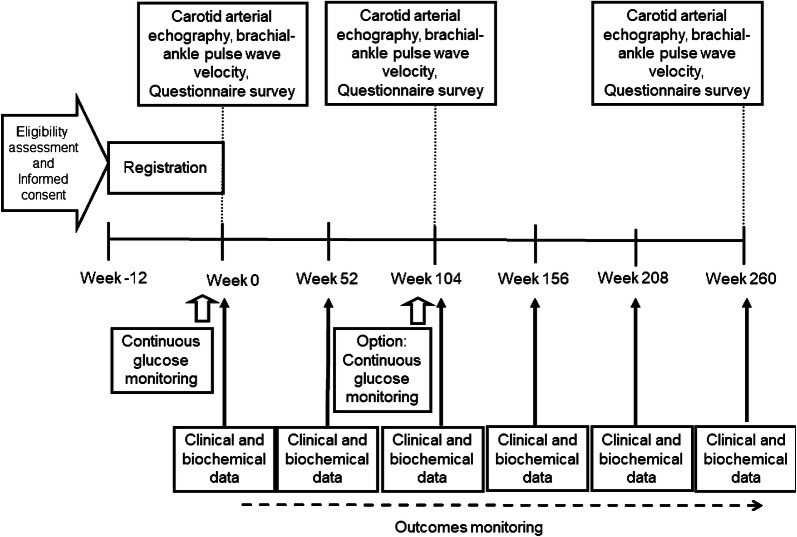
This is a prospective, multicenter, 5-year follow-up observational study. Between April 2018 and October 2019, 1000 participants are expected to be recruited at 34 medical institutions. CGM using FreeStyle Libre Pro is useful for evaluating glucose fluctuations by continuously monitoring glucose levels in interstitial fluid for up to 14 days. The primary study outcome is the relationship between fluctuations in glucose levels evaluated by CGM and the incidence of composite cardiovascular events. Secondary outcomes include the relationships of fluctuations in glucose levels evaluated by CGM to changes in carotid intima media thickness evaluated by echography or grayscale median (an index of tissue characteristics of the carotid wall), brachial-ankle pulse wave velocity, development or progression of diabetic retinopathy or nephropathy, quality-of-life-related diabetes therapy, quality of sleep, development of dementia, and autonomic nerve function.
This protocol is designed to investigate the relationship between glucose fluctuations and the incidence of composite cardiovascular events. We completed the registration of 1000 participants in March 2019. Thus, results will be available in 2024. We expect that evaluating glucose fluctuations will aid the identification of patients with a high probability of developing CVD.
ClinicalTrials.gov identifier, UMIN000032325.
最近一项研究表明,在2型糖尿病(T2DM)合并急性心肌梗死患者中,较大的血糖波动与心血管疾病(CVD)发病率增加相关。然而,对于无明显CVD病史的T2DM患者,血糖波动是否与CVD发病率或动脉粥样硬化进展相关尚不清楚。在本研究方案中,我们将调查通过持续葡萄糖监测(CGM)评估的血糖波动与无明显CVD病史的T2DM患者复合心血管事件发病率及动脉粥样硬化进展之间的关系。
这是一项前瞻性、多中心、为期5年的随访观察性研究。预计在2018年4月至2019年10月期间,在34家医疗机构招募1000名参与者。使用FreeStyle Libre Pro进行的CGM可通过连续监测组织间液中的血糖水平长达14天来评估血糖波动。主要研究结局是CGM评估的血糖水平波动与复合心血管事件发病率之间的关系。次要结局包括CGM评估的血糖水平波动与超声心动图或灰度中位数(颈动脉壁组织特征指标)评估的颈动脉内膜中层厚度变化、臂踝脉搏波速度、糖尿病视网膜病变或肾病的发生或进展、与生活质量相关的糖尿病治疗、睡眠质量、痴呆症的发生以及自主神经功能之间的关系。
本研究方案旨在调查血糖波动与复合心血管事件发病率之间的关系。我们于2019年3月完成了1000名参与者的登记。因此,结果将于2024年公布。我们预计评估血糖波动将有助于识别发生CVD可能性高的患者。
ClinicalTrials.gov标识符,UMIN000032325。