Department of Cardiology, Beijing An Zhen Hospital, Capital Medical University, Beijing, China.
Diabetes Care. 2013 Apr;36(4):1026-32. doi: 10.2337/dc12-0925. Epub 2013 Jan 24.
Dysglycemia is associated with poorer prognosis in patients with acute myocardial infarction (AMI). Whether admission glycemic variability (GV) has important value in prognosis of AMI patients is still unknown. The aim of the study is to investigate the prognostic value of admission GV, glucose, and glycosylated hemoglobin (HbA(1c)) in AMI patients.
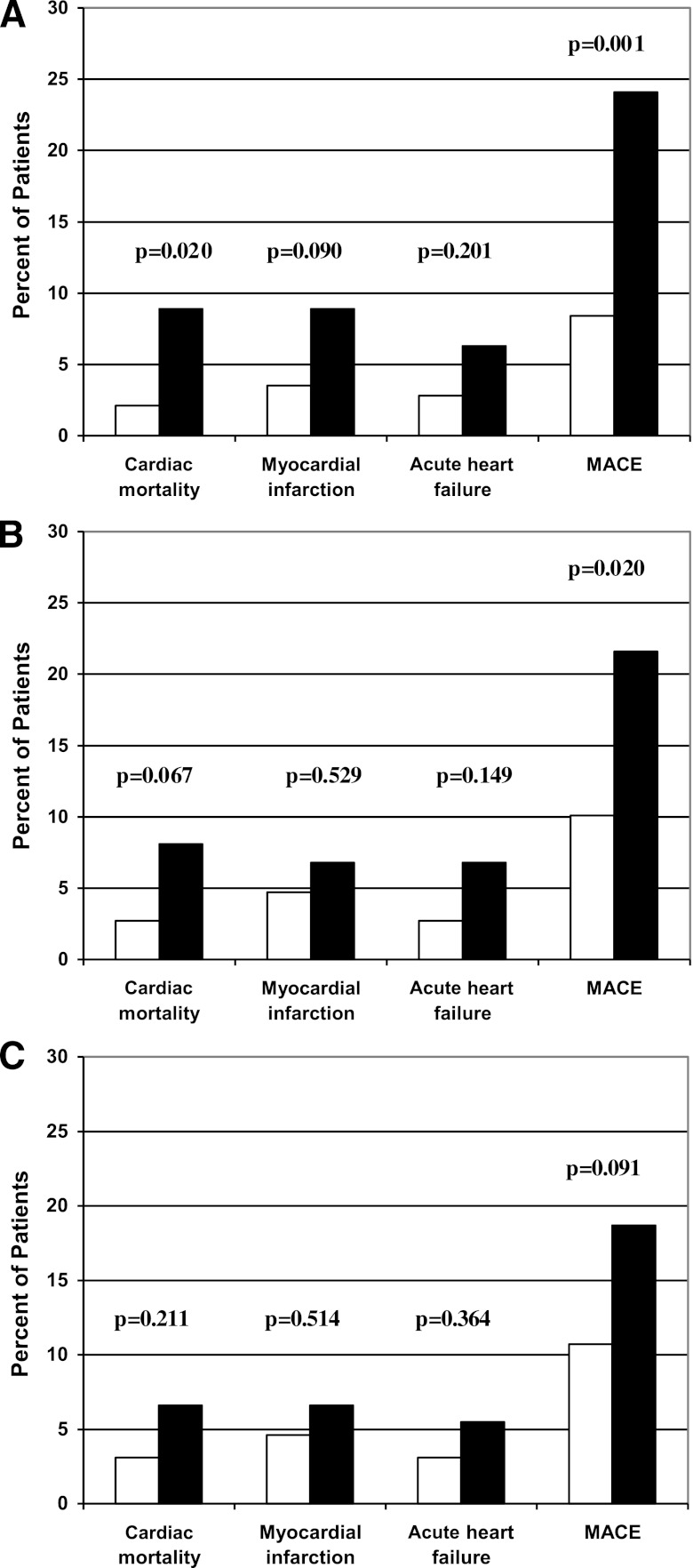
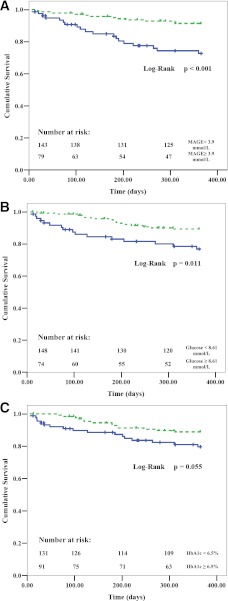
We measured blood glucose, HbA(1c), and GV on admission in 222 consecutive patients with diagnosed AMI. GV, indicated as the mean amplitude of glycemic excursions (MAGE), was determined by a continuous glucose monitoring system. MAGE was categorized as ≥3.9 or <3.9 mmol/L, admission glucose as ≥8.61 or <8.61 mmol/L, and HbA(1c) as ≥6.5 or <6.5%. Participants were followed up prospectively for 12 months. The relationship of admission MAGE, glucose, and HbA(1c) to the major adverse cardiac event (MACE) of AMI patients was analyzed.
In 222 enrolled patients with AMI, the rate of MACE by MAGE category (<3.9 or ≥3.9 mmol/L) was 8.4 and 24.1%, respectively (P = 0.001), by admission glucose category (<8.61 or ≥8.61 mmol/L) was 10.1 and 21.6%, respectively (P = 0.020), and by HbA(1c) category (<6.5 vs. ≥6.5%) was 10.7 versus 18.7%, respectively (P = 0.091). In multivariate analysis, high MAGE level was significantly associated with incidence of MACE (hazard ratio 2.419 [95% CI 1.273-9.100]; P = 0.017) even after adjusting for Global Registry of Acute Coronary Events risk score, but admission glucose and HbA(1c) was not.
Elevated admission GV appears more important than admission glucose and prior long-term abnormal glycometabolic status in predicting 1-year MACE in patients with AMI.
血糖异常与急性心肌梗死(AMI)患者的预后不良相关。入院时血糖变异性(GV)对 AMI 患者的预后是否具有重要价值尚不清楚。本研究旨在探讨 AMI 患者入院时的 GV、血糖和糖化血红蛋白(HbA(1c))的预后价值。
我们连续测量了 222 例确诊 AMI 患者入院时的血糖、HbA(1c)和 GV。通过连续血糖监测系统(CGMS)测定 GV,以平均血糖波动幅度(MAGE)表示。MAGE 分为≥3.9 或<3.9mmol/L,入院时血糖分为≥8.61 或<8.61mmol/L,HbA(1c)分为≥6.5 或<6.5%。对患者进行前瞻性随访 12 个月。分析入院时 MAGE、血糖和 HbA(1c)与 AMI 患者主要不良心脏事件(MACE)的关系。
在 222 例 AMI 患者中,MAGE 分类(<3.9 或≥3.9mmol/L)的 MACE 发生率分别为 8.4%和 24.1%(P=0.001),入院时血糖分类(<8.61 或≥8.61mmol/L)的 MACE 发生率分别为 10.1%和 21.6%(P=0.020),HbA(1c)分类(<6.5%或≥6.5%)的 MACE 发生率分别为 10.7%和 18.7%(P=0.091)。多因素分析显示,高 MAGE 水平与 MACE 的发生显著相关(危险比 2.419[95%CI 1.273-9.100];P=0.017),即使在校正全球急性冠状动脉事件注册风险评分后也是如此,但入院时血糖和 HbA(1c)则不然。
与入院时血糖和既往长期异常糖代谢状态相比,升高的入院 GV 似乎更能预测 AMI 患者 1 年时的 MACE。