Department of Prosthodontics, Poznań University of Medical Sciences, Poznan, Poland.
Department of Clinical Psychology, Poznań University of Medical Sciences, Poznan, Poland.
Brain Behav. 2019 Sep;9(9):e01360. doi: 10.1002/brb3.1360. Epub 2019 Jul 24.
Medical students are in a very demanding environment and are affected by high degree of stress. High levels of anxiety can affect a student's academic performance and also increase the risk of other health-related problems. This study aims to evaluate, thanks to the intensity of stress manifestations (4DSQ) together with the sense of coherence (SOC), the prevalence of TMD and oral parafunctions in students enrolled in the University of Medical Sciences. Moreover, it aims to evaluate the relationship between the psychosocial manifestations of stress and sense of coherence in relation to gender.
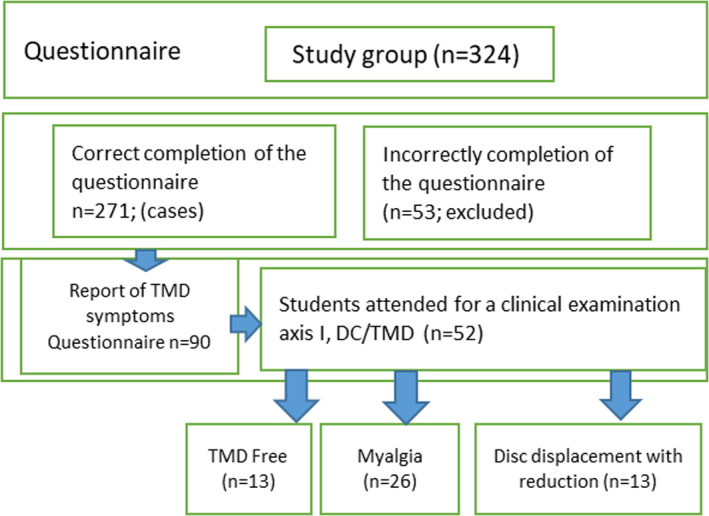
A total of 324 students of Poznań University of Medical Sciences participated in this study. Students were assessed using a three-part questionnaire: one was to assess symptoms of TMD, the second part was 4DSQ, and the third was a SOC Questionnaire.
About one-third of the students in this study presented symptoms of TMD and perceived more intensively symptoms of distress, anxiety, somatization, and depression. They presented a higher level of somatic symptoms and a lower level of Sense of Coherence than students without TMD symptoms.
There is a strong negative relationship between the sense of coherence and the level of perceived distress, anxiety, somatization, and depression. Female students attending Medical School showed a higher level of somatization of stress but with a higher capacity to overcome challenges as compared to men.
医学生所处的环境要求很高,且压力很大。高度的焦虑会影响学生的学业成绩,也会增加其他与健康相关问题的风险。本研究旨在通过压力表现强度(4DSQ)和心理韧性(SOC)评估,评估在医学科学大学注册的学生的 TMD 和口腔功能障碍的患病率。此外,还评估了压力的心理社会表现与社会认知度与性别之间的关系。
共有 324 名波兹南医科大学的学生参加了这项研究。学生们使用三部分问卷进行评估:第一部分评估 TMD 症状,第二部分是 4DSQ,第三部分是 SOC 问卷。
研究中的约三分之一的学生出现了 TMD 症状,并且更强烈地感受到了困扰、焦虑、躯体化和抑郁的症状。他们表现出更高的躯体症状水平和更低的心理韧性水平,而没有 TMD 症状的学生则表现出更低的躯体症状水平和更高的心理韧性水平。
心理韧性与感知到的困扰、焦虑、躯体化和抑郁水平之间存在强烈的负相关关系。与男性相比,女医学生表现出更高的躯体化压力水平,但她们克服挑战的能力更高。