Rijnstate Ziekenhuis, Department of Orthopedics, Arnhem.
Radboud University Medical Center, Department of Operating Rooms, Nijmegen.
Acta Orthop. 2019 Dec;90(6):554-558. doi: 10.1080/17453674.2019.1644069. Epub 2019 Jul 24.
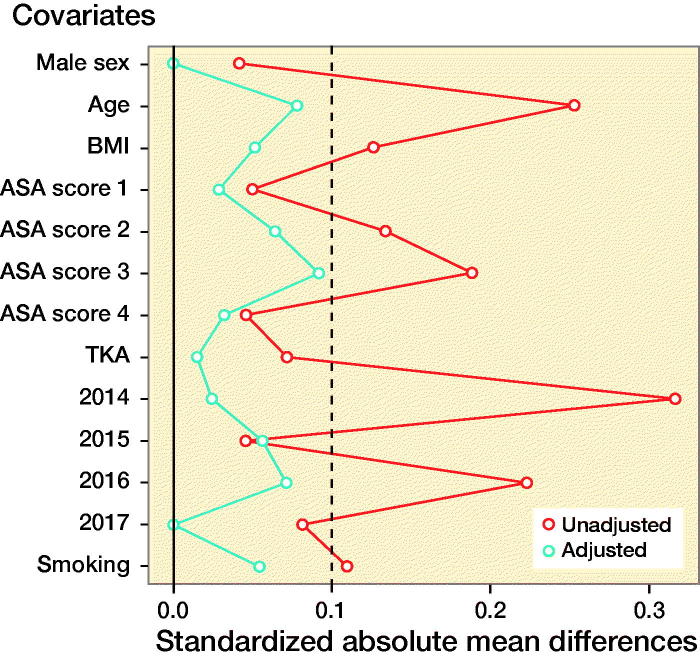
Background and purpose - Periprosthetic joint infection (PJI) remains a devastating complication following total knee or total hip arthroplasty (TKA/THA). Nowadays, many studies focus on preventive strategies regarding PJI; however, the potential role of anesthesia in the development of PJI remains unclear.Patients and methods - All consecutive patients undergoing elective primary unilateral TKA or THA from January 2014 through December 2017 were included. Exclusion criteria included femoral fractures as the indication for surgery and previously performed osteosynthesis or hardware removal on the affected joint. Age, sex, BMI, ASA classification, type of arthroplasty surgery, type of anesthesia, duration of surgery, smoking status, and intraoperative hypothermia were recorded. Propensity score-matched univariable logistic regression analysis was used to control for allocation bias.Results - 3,909 procedures consisting of 54% THAs and 46% TKAs were available for analysis. 42% arthroplasties were performed under general anesthesia and 58% under spinal anesthesia. Early PJIs were observed in 1.7% of the general anesthesia group and in 0.8% in the spinal anesthesia group. The multivariable logistic regression model demonstrated an odds ratio for PJI of 2.0 (95% CI 1.0-3.7) after general anesthesia relative to the propensity score-matched patients who received spinal anesthesia.Interpretation - These results suggest a potential association between general anesthesia and early PJI. Future research using large-scale data is required to further elucidate this clinically relevant association.
背景与目的-全膝关节或全髋关节置换术(TKA/THA)后,假体周围关节感染(PJI)仍然是一种破坏性的并发症。如今,许多研究都集中在 PJI 的预防策略上;然而,麻醉在 PJI 发展中的潜在作用尚不清楚。
患者与方法-纳入 2014 年 1 月至 2017 年 12 月期间接受择期单侧初次 TKA 或 THA 的所有连续患者。排除标准包括手术指征为股骨骨折以及受影响关节已行内固定或内固定取出术。记录年龄、性别、BMI、ASA 分级、关节置换手术类型、麻醉类型、手术时间、吸烟状况和术中低体温。采用倾向评分匹配单变量逻辑回归分析来控制分配偏倚。
结果-共有 3909 例手术,包括 54%的 THA 和 46%的 TKA,可用于分析。42%的关节置换术采用全身麻醉,58%采用椎管内麻醉。全身麻醉组早期 PJI 发生率为 1.7%,椎管内麻醉组为 0.8%。多变量逻辑回归模型显示,全身麻醉的 PJI 比值比(OR)为 2.0(95%CI 1.0-3.7),与接受椎管内麻醉的倾向评分匹配患者相比。
结论-这些结果表明全身麻醉与早期 PJI 之间存在潜在关联。需要使用大规模数据进行进一步研究,以阐明这一具有临床意义的关联。