Department of Pharmacy Services, University of Virginia Health System, Charlottesville, Virginia, USA.
Division of Infectious Diseases and International Health, Department of Medicine, University of Virginia Health System, Charlottesville, Virginia, USA.
J Clin Microbiol. 2019 Sep 24;57(10). doi: 10.1128/JCM.00634-19. Print 2019 Oct.
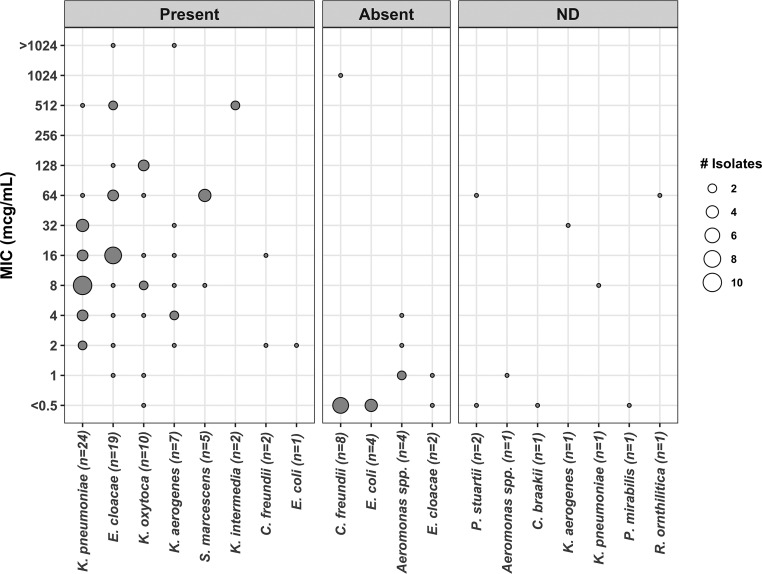
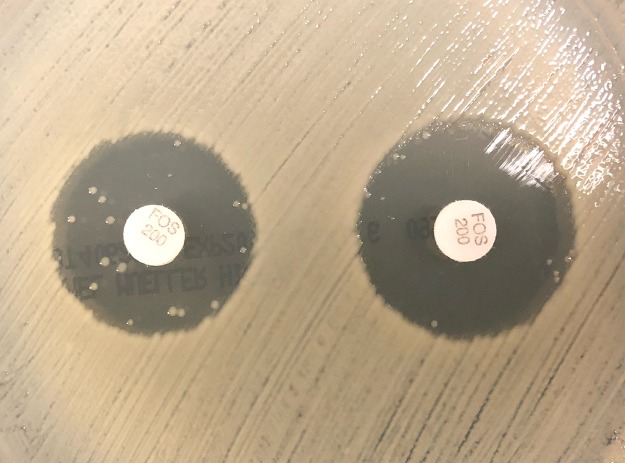
With multidrug-resistant (MDR) on the rise, a nontoxic antimicrobial agent with a unique mechanism of action such as fosfomycin seems attractive. However, establishing accurate fosfomycin susceptibility testing for non- isolates in a clinical microbiology laboratory remains problematic. We evaluated fosfomycin susceptibility by multiple methods with 96 KPC-producing clinical isolates of multiple strains and species collected at a single center between 2008 and 2016. In addition, we assessed the presence of fosfomycin resistance genes from whole-genome sequencing (WGS) data using NCBI's AMRFinder and custom HMM search. Susceptibility testing was performed using a glucose-6-phosphate-supplemented fosfomycin Etest and Kirby-Bauer disk diffusion (DD) assays, and the results were compared to those obtained by agar dilution. Clinical Laboratory and Standards Institute (CLSI) breakpoints for were applied for interpretation. Overall, 63% (60/96) of isolates were susceptible by Etest, 70% (67/96) by DD, and 88% (84/96) by agar dilution. was detected in 80% (70/88) of previously sequenced isolates, with species-specific associations and alleles, and -positive isolates were associated with higher MIC distributions. Disk potentiation testing was performed using sodium phosphonoformate to inhibit and showed significant increases in the zone diameter of DD testing for isolates that were positive compared to those that were negative. The addition of sodium phosphonoformate (PPF) corrected 10/14 (71%) major errors in categorical agreement with agar dilution. Our results indicate that influences the inaccuracy of susceptibility testing by methods readily available in a clinical laboratory compared to agar dilution. Further research is needed to determine the impact of on clinical outcomes.
由于多药耐药(MDR)的上升,具有独特作用机制的非毒性抗菌剂,如磷霉素似乎很有吸引力。然而,在临床微生物学实验室中,对于非分离株建立准确的磷霉素药敏试验仍然存在问题。我们评估了 2008 年至 2016 年间在单一中心收集的多种菌株和种属的 96 株产 KPC 的临床分离株的多种方法的磷霉素药敏性。此外,我们还使用 NCBI 的 AMRFinder 和自定义 HMM 搜索从全基因组测序(WGS)数据评估了磷霉素耐药基因的存在。使用葡萄糖-6-磷酸补充的磷霉素 Etest 和 Kirby-Bauer 纸片扩散(DD)测定法进行药敏试验,并将结果与琼脂稀释法的结果进行比较。应用临床实验室和标准化协会(CLSI)的 折点进行解释。总体而言,63%(60/96)的分离株在 Etest 中敏感,70%(67/96)在 DD 中敏感,88%(84/96)在琼脂稀释中敏感。在 80%(70/88)先前测序的分离株中检测到 ,具有种特异性关联和等位基因,且 -阳性分离株与更高的 MIC 分布相关。使用磷苯甲酸钠抑制 进行了磁盘增效测试,与 -阴性分离株相比,-阳性分离株的 DD 测试的环直径显著增加。添加磷苯甲酸钠(PPF)纠正了与琼脂稀释相比,14 个中的 10 个(71%)主要错误的分类学一致性。我们的结果表明,与琼脂稀释相比, 影响了临床实验室中常用方法的药敏试验的准确性。需要进一步研究以确定 对临床结果的影响。