Africa Health Research Institute, KwaZulu-Natal, South Africa.
KwaZulu-Natal Research Innovation and Sequencing (KRISP), College of Health Sciences, University of KwaZulu-Natal, Durban, South Africa.
Sci Rep. 2019 Jul 24;9(1):10724. doi: 10.1038/s41598-019-46455-7.
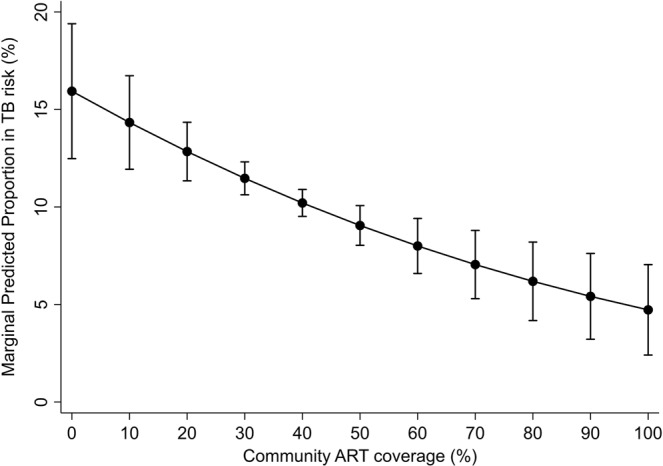
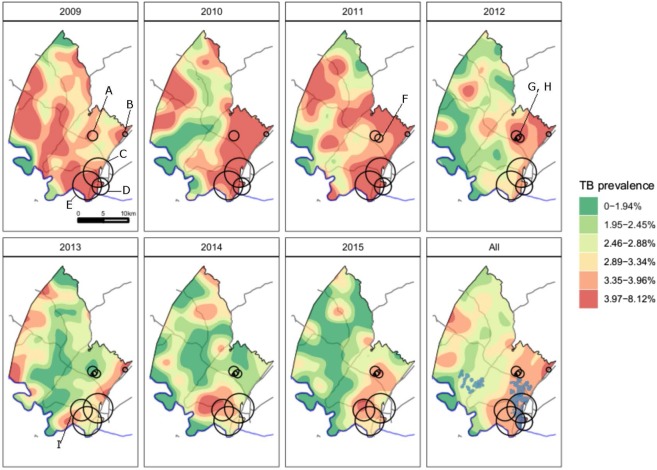
In HIV hyperendemic sub-Saharan African communities, particularly in southern Africa, the likelihood of achieving the Sustainable Development Goal of ending the tuberculosis (TB) epidemic by 2030 is low, due to lack of cost-effective and practical interventions in population settings. We used one of Africa's largest population-based prospective cohorts from rural KwaZulu-Natal Province, South Africa, to measure the spatial variations in the prevalence of recently-diagnosed TB disease, and to quantify the impact of community coverage of antiretroviral therapy (ART) on recently-diagnosed TB disease. We collected data on TB disease episodes from a population-based sample of 41,812 adult individuals between 2009 and 2015. Spatial clusters ('hotspots') of recently-diagnosed TB were identified using a space-time scan statistic. Multilevel logistic regression models were fitted to investigate the relationship between community ART coverage and recently-diagnosed TB. Spatial clusters of recently-diagnosed TB were identified in a region characterized by a high prevalence of HIV and population movement. Every percentage increase in ART coverage was associated with a 2% decrease in the odds of recently-diagnosed TB (aOR = 0.98, 95% CI:0.97-0.99). We identified for the first time the clear occurrence of recently-diagnosed TB hotspots, and quantified potential benefit of increased community ART coverage in lowering tuberculosis, highlighting the need to prioritize the expansion of such effective population interventions targeting high-risk areas.
在艾滋病毒高度流行的撒哈拉以南非洲社区,特别是在南部非洲,由于缺乏在人群环境中具有成本效益和实用性的干预措施,实现 2030 年终结结核病(TB)流行的可持续发展目标的可能性很低。我们利用来自南非夸祖鲁-纳塔尔省农村地区的非洲最大的人群前瞻性队列之一,来衡量最近确诊的结核病疾病的流行率的空间差异,并量化社区内抗逆转录病毒疗法(ART)覆盖率对最近确诊的结核病疾病的影响。我们从 2009 年至 2015 年期间的人群基础样本中收集了关于结核病疾病发作的数据。使用时空扫描统计数据识别了最近确诊的结核病的空间聚类(“热点”)。使用多水平逻辑回归模型来研究社区 ART 覆盖率与最近确诊的结核病之间的关系。在 HIV 流行率和人口流动率高的地区发现了最近确诊的结核病的空间聚类。ART 覆盖率每增加一个百分点,最近确诊的结核病的几率就会降低 2%(优势比[OR] = 0.98,95%置信区间[CI]:0.97-0.99)。我们首次明确发现了最近确诊的结核病热点的发生,并量化了增加社区 ART 覆盖率降低结核病的潜在益处,突出了需要优先扩大针对高风险地区的这种有效的人群干预措施。