Dreher Dorothée, Baldermann Susanne, Schreiner Monika, Hause Bettina
Leibniz Institute of Plant Biochemistry, Weinberg 3, D-06120 Halle/Saale, Germany.
Leibniz Institute of Vegetable and Ornamental Crops, Theodor-Echtermeyer-Weg 1, D-14979 Großbeeren, Germany.
J Adv Res. 2019 Mar 14;19:85-90. doi: 10.1016/j.jare.2019.03.002. eCollection 2019 Sep.
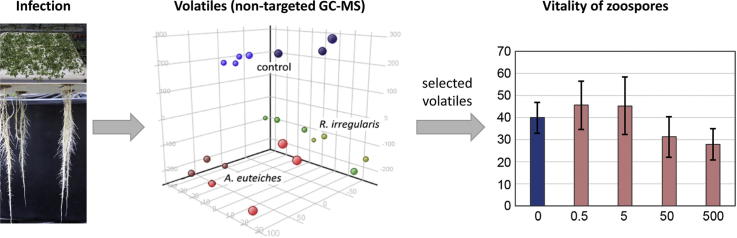
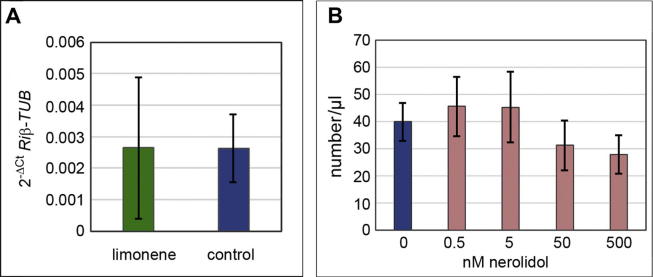
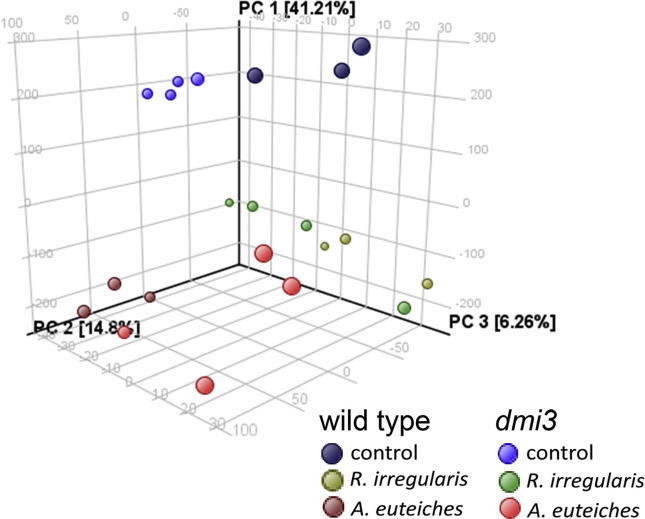
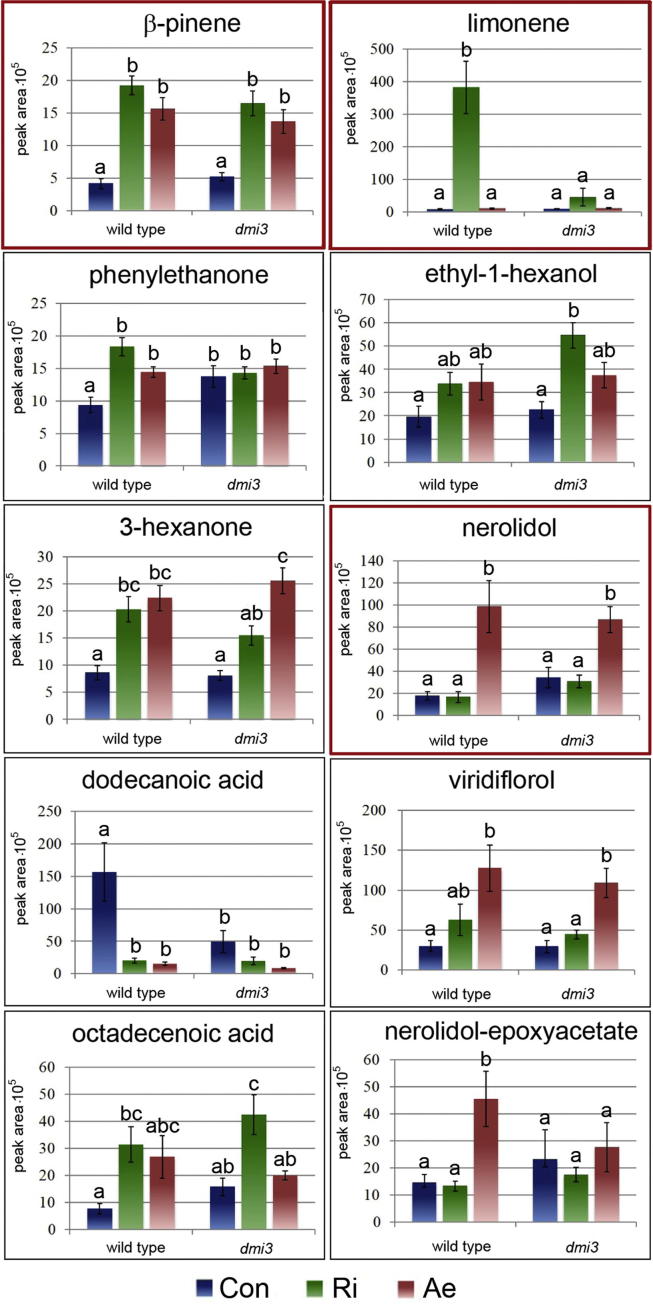
Plants are in permanent contact with various microorganisms and are always impacted by them. To better understand the first steps of a plant's recognition of soil-borne microorganisms, the early release of volatile organic compounds (VOCs) emitted from roots of in response to the symbiont or the pathogenic oomycete was analysed. More than 90 compounds were released from roots as detected by an untargeted gas chromatography-mass spectrometry approach. Principal component analyses clearly distinguished untreated roots from roots treated with either or . Several VOCs were found to be emitted specifically in response to each of the microorganisms. Limonene was specifically emitted from wild-type roots after contact with spores but not from roots of the mycorrhiza-deficient mutant . The application of limonene to mycorrhizal roots, however, did not affect the mycorrhization rate. Inoculation of roots with zoospores resulted in the specific emission of several sesquiterpenes, such as nerolidol, viridiflorol and nerolidol-epoxyacetate but application of nerolidol to zoospores of did not affect their vitality. Therefore, plants discriminate between different microorganisms at early stages of their interaction and respond differently to the level of root-emitted volatiles.
植物与各种微生物持续接触,并始终受到它们的影响。为了更好地理解植物识别土壤传播微生物的最初步骤,分析了植物根系在响应共生菌或致病卵菌时早期释放的挥发性有机化合物(VOCs)。通过非靶向气相色谱-质谱法检测到根系释放出90多种化合物。主成分分析清楚地将未处理的根系与用共生菌或致病卵菌处理过的根系区分开来。发现几种VOCs是针对每种微生物特异性释放的。野生型根系在接触共生菌孢子后会特异性释放柠檬烯,但菌根缺陷型突变体的根系不会释放。然而,将柠檬烯应用于菌根根系并不会影响菌根形成率。用致病卵菌游动孢子接种根系会导致几种倍半萜烯的特异性释放,如橙花叔醇、绿花白千层醇和橙花叔醇环氧乙酸酯,但将橙花叔醇应用于致病卵菌游动孢子不会影响其活力。因此,植物在与微生物相互作用的早期阶段就能区分不同的微生物,并对根系释放的挥发物水平做出不同反应。