Clin Transl Radiat Oncol. 2019 Jun 15;18:16-22. doi: 10.1016/j.ctro.2019.06.005. eCollection 2019 Sep.
We sought to model chronic radiation-associated dysphagia (RAD) in patients given intensity-modulated radiation therapy (IMRT) for oropharyngeal squamous cell cancer (OPSCC) as a function of age and dose to non-target swallowing muscles.
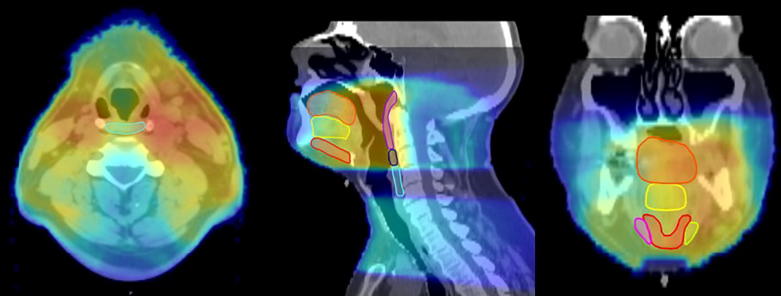
We reviewed 300 patients with T1-T4 N0-3 M0 OPSCC given definitive IMRT with concurrent chemotherapy. Chronic RAD was defined as aspiration or stricture on videoflouroscopy/endoscopy, gastrostomy tube, or aspiration pneumonia at ≥12 months after IMRT. Doses to autosegmented regions of interest (ROIs; inferior, middle and superior constrictors, anterior and posterior digastrics, mylo/geniohyoid complex, intrinsic tongue, and gengioglossus) were obtained from DICOM-RT plans and dose-volume histograms. The probability of chronic RAD as a function of mean ROI dose, stratified by age (<50, 50-59, 60-69, or ≥70 years), was estimated with logistic probability models and subsequent unsupervised nonlinear curves.
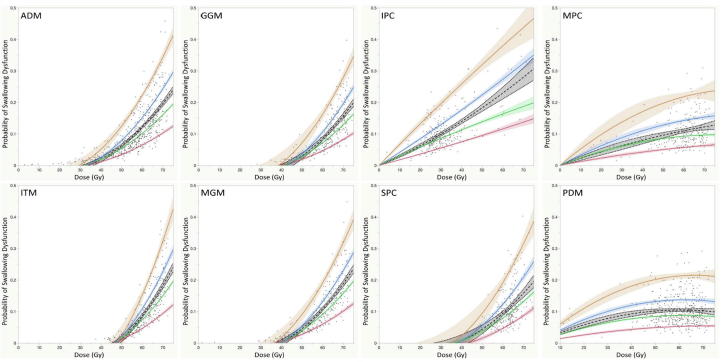
Chronic RAD was observed in 34 patients (11%). Age was a significant correlate of chronic RAD, both independently and with dose for all muscle groups examined. Distinct muscle-specific dose-response profiles were observed as a function of age (e.g., 5% of patients in their 50 s [but 20% of those 70 + ] who received 60 Gy to the superior constrictor had chronic RAD). This effect was stable across all observed muscle ROIs, with a false discovery rate-corrected < 0.05, for all dose/muscle/age models, suggesting that including age as a covariate improves modeling of chronic RAD.
Age at treatment moderates the probability of chronic RAD after chemo-IMRT for OPSCC, with aging muscles showing lower dose thresholds. Uniform dose constraints may not predict toxicity in older patients.
我们试图建立接受调强放射治疗(IMRT)的口咽鳞状细胞癌(OPSCC)患者慢性放射性吞咽困难(RAD)的模型,该模型是年龄和非靶吞咽肌肉剂量的函数。
我们回顾了300例接受确定性IMRT联合同步化疗的T1-T4 N0-3 M0 OPSCC患者。慢性RAD定义为IMRT后≥12个月时视频透视/内镜检查发现的误吸或狭窄、胃造瘘管置入或吸入性肺炎。从DICOM-RT计划和剂量体积直方图中获取自动分割的感兴趣区域(ROI;下咽缩肌、中咽缩肌和上咽缩肌、二腹肌前腹和后腹、下颌舌骨肌/颏舌骨肌复合体、舌固有肌和颏舌肌)的剂量。采用逻辑概率模型和随后的无监督非线性曲线估计慢性RAD的概率,该概率是平均ROI剂量的函数,并按年龄(<50岁、50-59岁、60-69岁或≥70岁)分层。{
34例患者(11%)出现慢性RAD。年龄是慢性RAD的一个显著相关因素,在所有检查的肌肉组中,年龄与剂量均独立相关。观察到不同肌肉特异性的剂量反应曲线随年龄变化(例如,50多岁接受上咽缩肌60 Gy照射的患者中有5%出现慢性RAD,但70岁及以上患者中有20%出现慢性RAD)。在所有观察到的肌肉ROI中,这种效应都是稳定的,所有剂量/肌肉/年龄模型的错误发现率校正后<0.05表明,将年龄作为协变量可改善慢性RAD的模型。
治疗时的年龄会影响OPSCC患者接受化疗IMRT后发生慢性RAD的概率,随着肌肉老化,剂量阈值降低。统一的剂量限制可能无法预测老年患者的毒性。}