Horton Christelene Jack, Weng Hsin-Yi, Wells Ellen M
School of Health Sciences, Purdue University, West Lafayette, Indiana.
Department of Comparative Pathobiology, Purdue University, West Lafayette, Indiana.
Environ Epidemiol. 2019 May;3(3):e045. doi: 10.1097/EE9.0000000000000045. Epub 2019 Jun 12.
Previous studies suggest that cumulative lead exposure is associated with cognitive decline, but its relation with Alzheimer's disease (AD) remains unclear. Therefore, this study investigated the longitudinal association between blood lead level (BLL) and AD mortality.
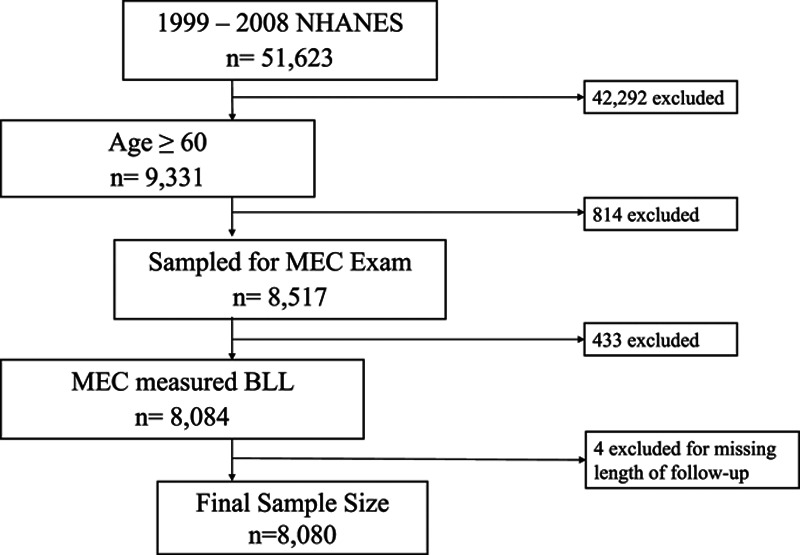
This study included 8,080 elders (60 years or older) with BLL data from the 1999 to 2008 US National Health and Nutrition Examination Survey. Mortality was determined from linked 1999-2014 National Death Index data. A causal diagram presented causal assumptions and identified a sufficient set of confounders: age, sex, poverty, race/ethnicity, and smoking. Cox proportional hazard models were used to determine the association between BLL and subsequent AD mortality. Impacts of competing risks and design effect were also assessed. Adjusted hazard rate ratio (HRR) and 95% confidence interval (CI) were reported.
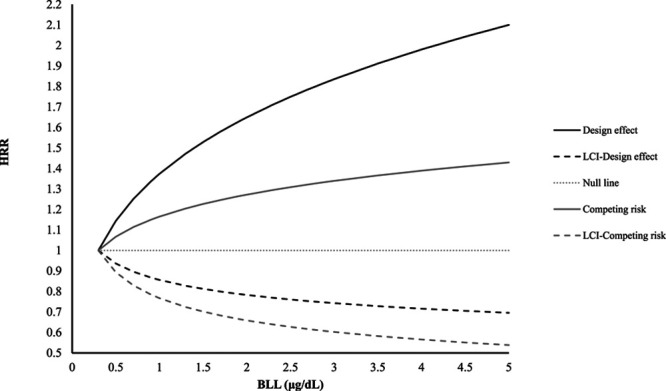
Follow-up ranged from <1 to 152 months (median, 74). Eighty-one participants died from AD over 632,075 total person-months at risk. An increase in BLL was associated with an increase in AD mortality after adjusting for identified confounders. We estimated that those with BLL of 1.5 and 5 μg/dl had 1.2 (95% CI = 0.70, 2.1) and 1.4 (95% CI = 0.54, 3.8) times the rate of AD mortality compared to those with BLL of 0.3 μg/dl, respectively, after accounting for competing risks. Adjusted HRRs were 1.5 (95% CI = 0.81, 2.9) and 2.1 (95% CI = 0.70, 6.3), respectively, after considering design effect.
This longitudinal study demonstrated a positive, albeit not statistically significant, association between BLL and AD mortality after adjustment for competing risks or design effect.
既往研究表明,累积铅暴露与认知功能下降有关,但其与阿尔茨海默病(AD)的关系仍不明确。因此,本研究调查了血铅水平(BLL)与AD死亡率之间的纵向关联。
本研究纳入了8080名年龄在60岁及以上的老年人,其BLL数据来自1999年至2008年美国国家健康与营养检查调查。死亡率通过1999 - 2014年国家死亡指数数据的关联确定。因果图展示了因果假设并确定了一组充分的混杂因素:年龄、性别、贫困、种族/民族和吸烟。采用Cox比例风险模型来确定BLL与随后AD死亡率之间的关联。还评估了竞争风险和设计效应的影响。报告了调整后的风险率比(HRR)和95%置信区间(CI)。
随访时间从不足1个月至152个月(中位数为74个月)。在总计632,075人月的风险期内,81名参与者死于AD。在调整了已确定的混杂因素后,BLL的升高与AD死亡率的增加相关。在考虑竞争风险后,我们估计血铅水平为1.5μg/dl和5μg/dl的人群与血铅水平为0.3μg/dl的人群相比,AD死亡率分别为其1.2倍(95%CI = 0.70, 2.1)和1.4倍(95%CI = 0.54, 3.8)。在考虑设计效应后,调整后的HRR分别为1.5(95%CI = 0.81, 2.9)和2.1(95%CI = 0.70, 6.3)。
这项纵向研究表明,在调整竞争风险或设计效应后,BLL与AD死亡率之间存在正相关关系,尽管在统计学上不显著。