From the Institute of Anatomy, Department of Imaging and Functional Musculoskeletal Research, Paracelsus Medical University Salzburg & Nuremberg, Salzburg, Austria (AR, WW, AGC, FE); Department of Orthopedic Surgery and Traumatology, Landesklinik Tamsweg, Tamsweg, Austria (AR); and La Trobe Sport and Exercise Medicine Research Centre, La Trobe University, School of Allied Health, Bundoora, Melbourne, Victoria, Australia (AGC).
Am J Phys Med Rehabil. 2020 Jan;99(1):33-40. doi: 10.1097/PHM.0000000000001271.
The aim of the study was to investigate whether muscle strength declines before or concurrent with incident knee pain in subjects with and without radiographic knee osteoarthritis.
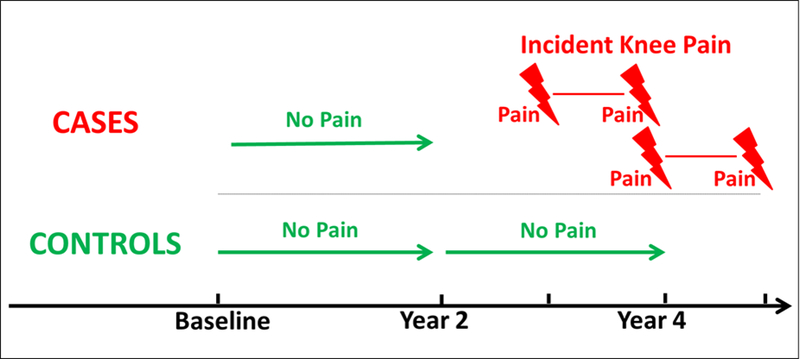
Osteoarthritis initiative participants with incident knee pain (occurrence of infrequent/frequent knee pain during the past 12 mos at two consecutive follow-up time points (either years Y3 + Y4 or Y4 + Y5) were compared with controls (no incident knee pain) with 2-yr changes in knee extensor strength during BL➔Y2 (before) and Y2➔Y4 (concurrent).
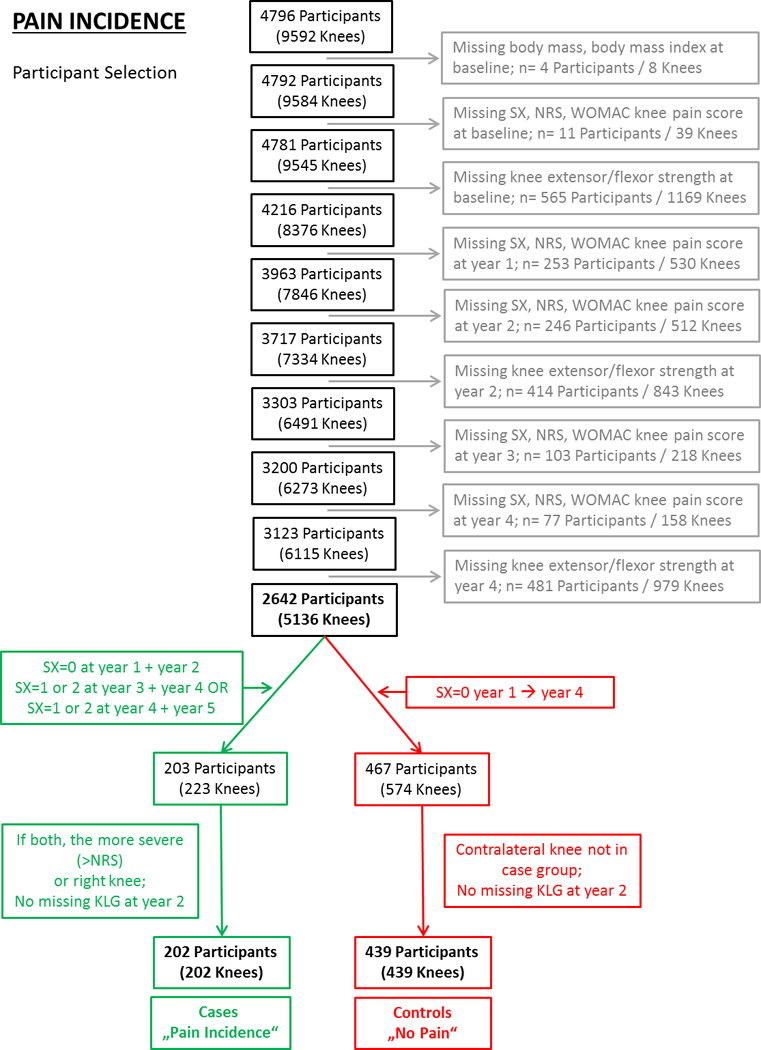
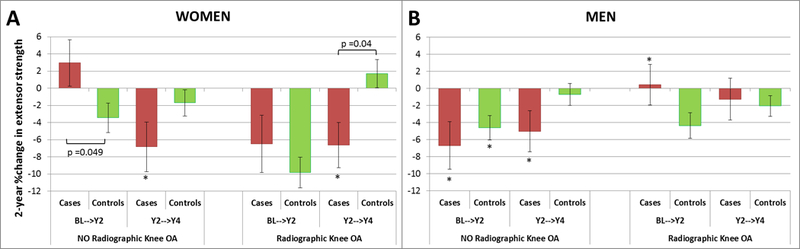
Two hundred two knees (49% women, 40% radiographic knee osteoarthritis) displayed incident pain, and 439 did not (46% women, 23% radiographic knee osteoarthritis). Women with radiographic knee osteoarthritis displayed a significantly greater (P = 0.04) reduction in knee extensor strength concurrent with incident pain compared with controls (mean = -17.6 N vs. +4.5 N), but men did not. A similar trend was observed in women without radiographic knee osteoarthritis, but this was not statistically significant (P = 0.08). There was no significant relationship with change in extensor strength before incident pain (P ≥ 0.43).
These results suggest that in women, incident knee pain is accompanied by a concurrent reduction in knee extensor strength, whereas loss in strength does not precede incident knee pain. The findings encourage interventional studies that attempt to attenuate a decline in extensor strength once knee symptoms occur.
本研究旨在探究有无放射学膝关节骨关节炎的受试者中,膝关节疼痛新发时肌肉力量是先下降还是与疼痛同时下降。
将膝关节骨关节炎倡议参与者中膝关节疼痛新发者(在过去 12 个月的两次连续随访时间点(第 3 年+第 4 年或第 4 年+第 5 年)中经常/偶尔出现膝关节疼痛)与对照组(无膝关节疼痛新发)进行比较,在基线➔第 2 年(之前)和第 2 年➔第 4 年(同时)期间比较膝关节伸肌力量的 2 年变化。
202 个膝关节(49%为女性,40%为放射学膝关节骨关节炎)出现疼痛新发,439 个膝关节未出现疼痛新发(46%为女性,23%为放射学膝关节骨关节炎)。与对照组相比(均值=-17.6 N 对+4.5 N),患有放射学膝关节骨关节炎的女性在膝关节疼痛新发的同时,膝关节伸肌力量显著下降(P=0.04),但男性没有。在没有放射学膝关节骨关节炎的女性中也观察到类似的趋势,但无统计学意义(P=0.08)。与疼痛新发前伸肌力量的变化无显著相关性(P≥0.43)。
这些结果表明,在女性中,膝关节疼痛新发时伴有膝关节伸肌力量的同时下降,而力量丧失并不先于膝关节疼痛新发。这些发现鼓励进行干预性研究,试图在膝关节症状出现后减缓伸肌力量的下降。