Ruhdorfer A, Wirth W, Dannhauer T, Eckstein F
Institute of Anatomy, Paracelsus Medical University Salzburg and Nuremberg, Salzburg, Austria.
Institute of Anatomy, Paracelsus Medical University Salzburg and Nuremberg, Salzburg, Austria.
Osteoarthritis Cartilage. 2015 Aug;23(8):1348-56. doi: 10.1016/j.joca.2015.04.004. Epub 2015 Apr 14.
To evaluate 4-year longitudinal change in thigh muscle and adipose tissue content in chronically painful vs painless knees.
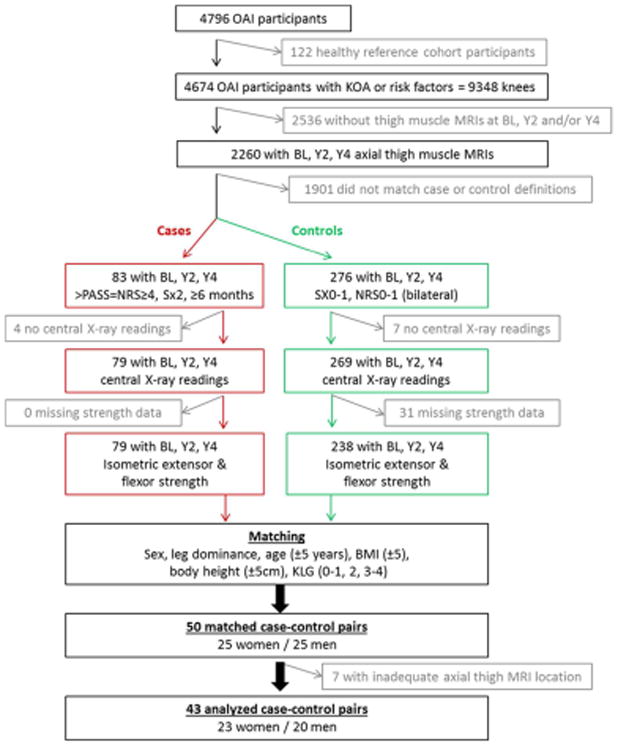
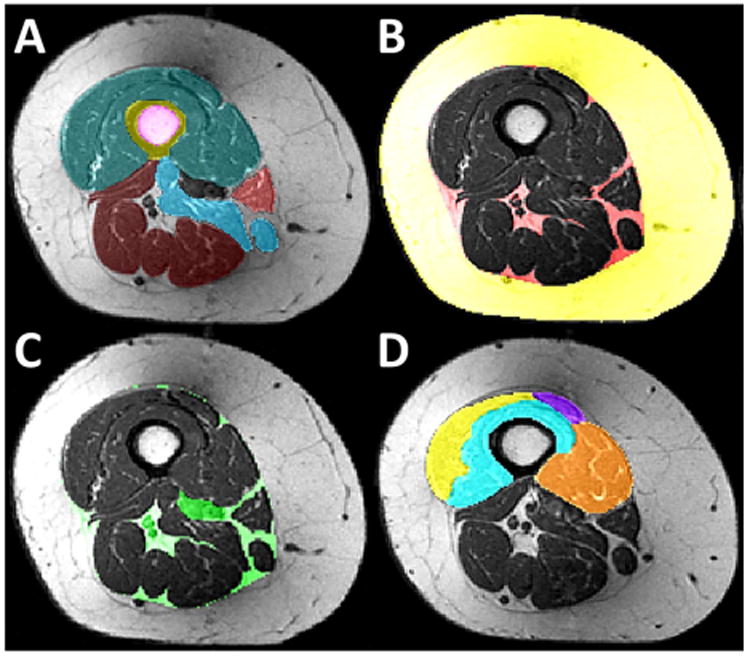
Knees from Osteoarthritis Initiative (OAI) participants with non-acceptable symptom status (numerical rating scale (NRS) ≥4) and frequent pain (≥6 months at baseline, year 2 and year 4 follow-up) were studied. These were matched with painless controls (bilateral NRS pain intensity ≤1 and ≤infrequent pain at all 3 timepoints). 4-year longitudinal changes in thigh muscle anatomical cross-sectional areas (CSAs), isometric muscle strength, and in subcutaneous (SCF) and intermuscular fat (IMF) CSAs were obtained from magnetic resonance images (MRI) and were compared between groups (paired t-tests).
43 participants fulfilled the inclusion criteria of chronic pain, had complete thigh muscle MRI acquisitions and strength measurements, and a matched control. Quadriceps CSAs, but not extensor strength, showed a significant longitudinal decrease in chronically painful knees (-3.9%; 95% confidence interval [95 CI] -6.3%, -1.5%) and in painless controls (-2.4%; 95% CI -4.1%, -0.7%); the difference in change was not statistically significant (P = 0.33). There was a significant 4-year gain in SCF in painful knees (8.1%; 95% CI 3.1%, 13%) but not in controls (0.0%; 95% CI -4.4%, +4.4%) with the difference in change being significant (P = 0.03). The gain in IMF (∼5.2%) was similar between painful and painless knees.
This is the first paper to show a significant impact of (chronic) knee pain on longitudinal change in local subcutaneous adipose tissue. The effect of pain on subcutaneous fat appeared stronger than that on intermuscular adipose tissue and on muscle status.
评估慢性疼痛膝关节与无痛膝关节大腿肌肉和脂肪组织含量的4年纵向变化。
对骨关节炎倡议(OAI)参与者中症状状态不可接受(数字评分量表(NRS)≥4)且频繁疼痛(基线、第2年和第4年随访时≥6个月)的膝关节进行研究。将这些膝关节与无痛对照组(双侧NRS疼痛强度≤1且在所有3个时间点疼痛不频繁)进行匹配。从磁共振成像(MRI)中获取大腿肌肉解剖横截面积(CSA)、等长肌力以及皮下(SCF)和肌间脂肪(IMF)CSA的4年纵向变化,并在组间进行比较(配对t检验)。
43名参与者符合慢性疼痛的纳入标准,有完整的大腿肌肉MRI采集和力量测量数据,且有匹配的对照组。股四头肌CSA在慢性疼痛膝关节中显示出显著的纵向下降(-3.9%;95%置信区间[95CI]-6.3%,-1.5%),在无痛对照组中也有下降(-2.4%;95%CI-4.1%,-0.7%);变化差异无统计学意义(P=0.33)。疼痛膝关节的SCF有显著的4年增加(8.1%;95%CI3.1%,13%),而对照组没有增加(0.0%;95%CI-4.4%,+4.4%),变化差异有统计学意义(P=0.03)。疼痛膝关节和无痛膝关节的IMF增加(约5.2%)相似。
本文首次表明(慢性)膝关节疼痛对局部皮下脂肪组织的纵向变化有显著影响。疼痛对皮下脂肪的影响似乎比对肌间脂肪组织和肌肉状态的影响更强。