Department of Psychiatry, Yale University School of Medicine, New Haven, Connecticut, United States of America.
Department of Neuroscience, Yale University School of Medicine, New Haven, Connecticut, United States of America.
PLoS One. 2019 Jul 25;14(7):e0219147. doi: 10.1371/journal.pone.0219147. eCollection 2019.
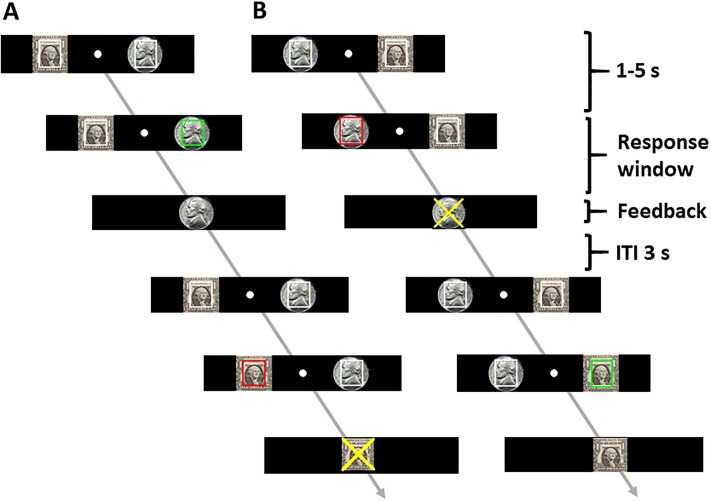
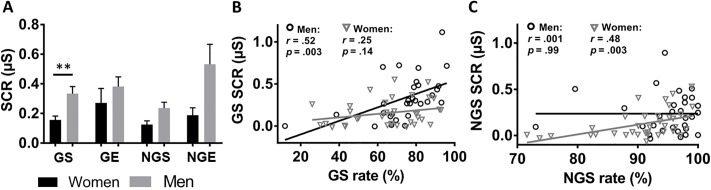
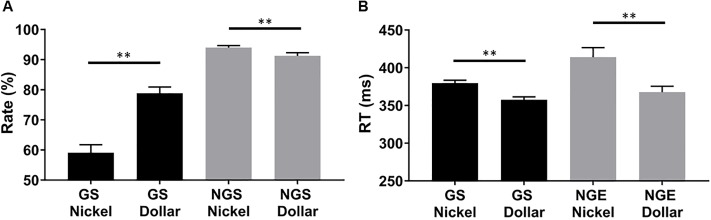
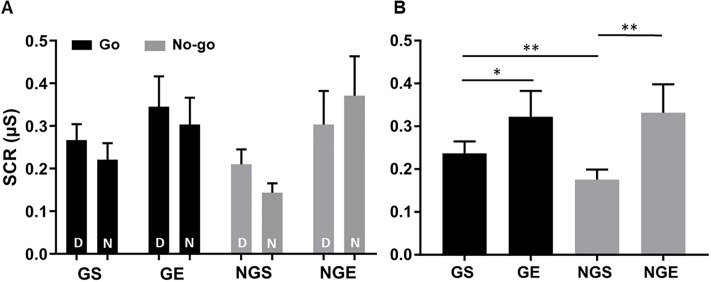
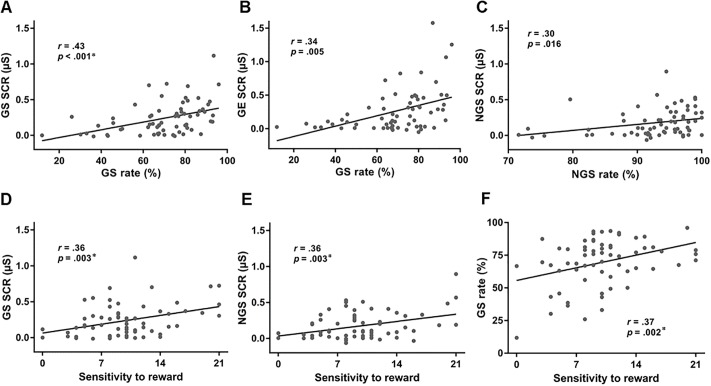
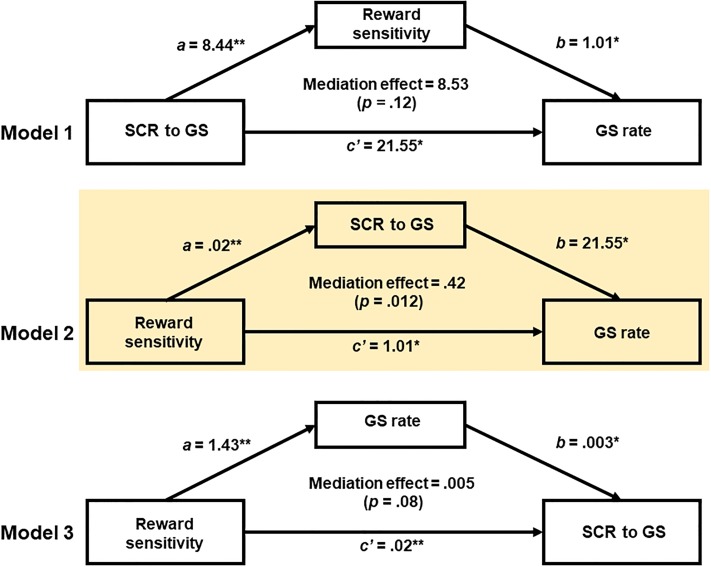
Skin conductance response (SCR) is used in psychophysiological research to measure the reactions of the autonomic nervous system to reward and punishment. While there is consistent evidence that SCR increases to both aversive and appetitive stimuli, it remains unclear whether SCR simply represents a general index of arousal to motivationally significant outcomes or may also differentiate action or inhibition of action that lead to such outcomes. Furthermore, individual differences in trait sensitivity to reward and punishment can influence physiological arousal during approach and avoidance behaviors. Yet, their inter-relationships have not been examined. To address these gaps, we employed a reward go/no-go task with ⅔ go and ⅓ no-go trials and an individually titrated go response window. Correct go and no-go responses were rewarded while incorrect responses were penalized. We examined whether SCR varied with outcome (win vs. loss), action (go vs. no-go), and individual differences in reward sensitivity (SR) and sex. The results showed greater SCRs to loss vs. win, to go vs. no-go success, and to go success in positive correlation with SR. Further, SCR mediated the relationship between SR and go success rate. In sex differences, men exhibited greater SCR which was more predictive of go success rate relative to women. In contrast, SCR was more predictive of no-go success rate in women. Thus, SCR varies according to behavioral contingency, outcome, sex, and reward sensitivity. These findings add to the literature by characterizing the individual and behavioral factors that may influence physiological arousal in response to salient events.
皮肤电反应(SCR)在心理生理学研究中用于测量自主神经系统对奖励和惩罚的反应。虽然有一致的证据表明 SCR 会对厌恶和喜好刺激增加,但尚不清楚 SCR 是否仅仅代表对动机重要结果的一般唤醒指标,或者是否也可以区分导致这些结果的行动或抑制行动。此外,个体对奖励和惩罚的特质敏感性差异会影响接近和回避行为期间的生理唤醒。然而,它们之间的相互关系尚未得到检验。为了解决这些差距,我们采用了奖励 Go/No-Go 任务,其中 2/3 的 Go 试验和 1/3 的 No-Go 试验,以及个体滴定的 Go 反应窗口。正确的 Go 和 No-Go 反应会得到奖励,而错误的反应会受到惩罚。我们研究了 SCR 是否随结果(赢 vs. 输)、行动(Go vs. No-Go)以及奖励敏感性(SR)和性别个体差异而变化。结果表明,与结果(赢 vs. 输)相比,SCR 对 Go 更敏感;与 No-Go 成功相比,SCR 对 Go 更敏感;与 SR 呈正相关,SCR 对 Go 成功的预测性更高。此外,SCR 介导了 SR 与 Go 成功率之间的关系。在性别差异方面,男性表现出更大的 SCR,与女性相比,SCR 更能预测 Go 成功率。相反,SCR 对 No-Go 成功率的预测性更高。因此,SCR 根据行为偶然性、结果、性别和奖励敏感性而变化。这些发现通过描述可能影响对突出事件的生理唤醒的个体和行为因素,为文献增添了新的内容。