Department of Psychiatry, Yale University School of Medicine, New Haven, Connecticut, USA.
Department of Statistical and Data Sciences, Smith College, Northampton, Massachusetts, USA.
Hum Brain Mapp. 2022 Jun 1;43(8):2634-2652. doi: 10.1002/hbm.25810. Epub 2022 Feb 25.
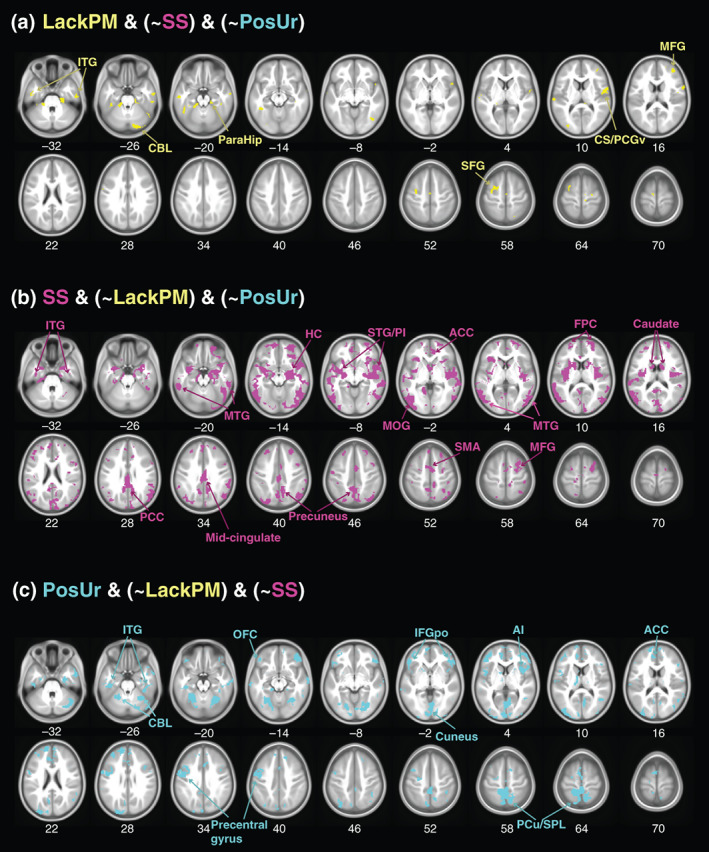
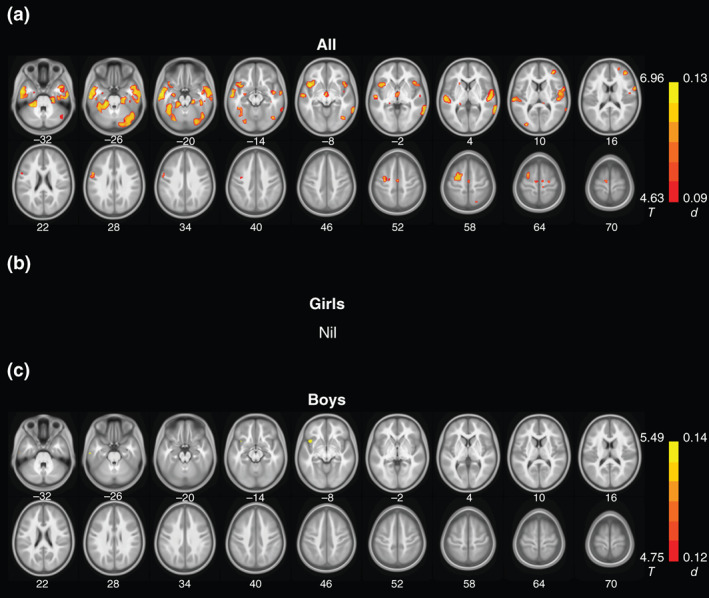
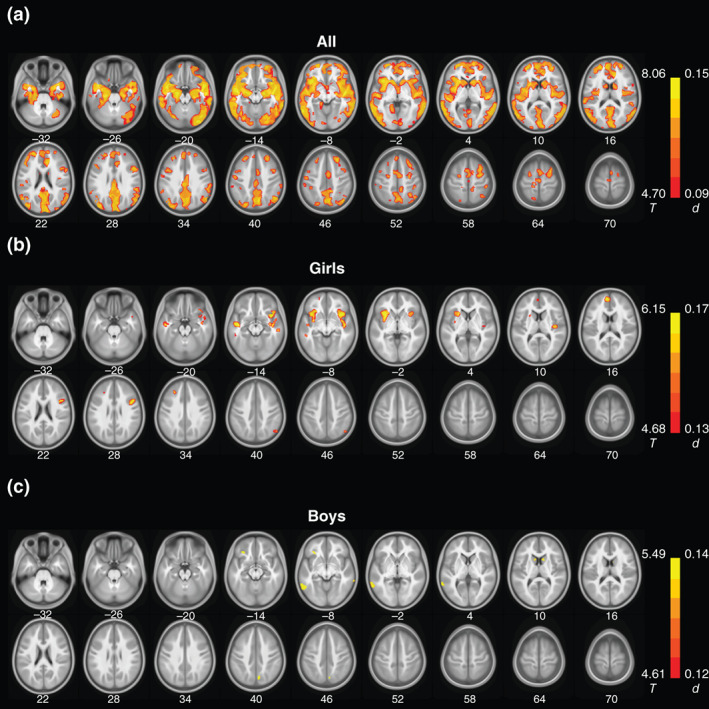
Previous research investigated the cerebral volumetric correlates of impulsivity largely in moderate-sized samples and few have examined the distinct correlates of dimensions of impulsivity, sex differences, or heritability of the correlates. Here, we performed voxel-based morphometry analysis of data (n = 11,474; 5,452 girls, 9-10 years) curated from the Adolescent Brain Cognition Development project. In a linear regression with all five UPPS-P subscores as regressors and age in months, total intracranial volume, study site, and scanner model as covariates, higher levels of lack of premeditation, and sensation seeking were correlated with larger cortical and subcortical gray matter volumes (GMVs). In contrast, higher positive urgency was correlated with smaller GMVs in many of the same regions. The dimensional impulsivity traits also involved distinct volumetric correlates, with, for instance, sensation seeking and positive urgency specifically implicating bilateral caudate head/mid-cingulate cortex and bilateral lateral orbitofrontal cortex/left precentral gyrus, respectively. Boys relative to girls scored higher in all impulsivity dimensions. Girls relative to boys showed significantly stronger positive and negative correlations between sensation seeking and insula, putamen, and inferior frontal gyrus (IFG) GMVs and between positive urgency and cingulate cortex, insula, and IFG GMVs, respectively. With a subsample of twins, the dimensional impulsivity traits were weakly to moderately heritable in both girls and boys, and the GMV correlates were highly heritable in girls and boys combined. These findings collectively suggest shared and nonshared as well as sex differences in the cerebral volumetric bases of dimensional impulsivity traits and may facilitate research of externalizing psychopathology in children.
先前的研究主要在中等规模的样本中调查了冲动的脑容量相关性,很少有研究检查冲动维度的不同相关性、性别差异或相关性的遗传性。在这里,我们对来自青少年大脑认知发展项目的数据(n=11474;5452 名女孩,9-10 岁)进行了基于体素的形态测量分析。在一个线性回归中,将五个 UPPS-P 子量表的总分作为回归量,以年龄(月)、总颅内体积、研究地点和扫描仪模型作为协变量,缺乏预谋和感觉寻求的水平越高,与皮质和皮质下灰质体积(GMV)越大相关。相比之下,更高的积极紧迫感与许多相同区域的 GMV 更小相关。维度冲动特质也涉及到不同的体积相关性,例如,感觉寻求和积极紧迫感分别特别涉及双侧尾状核头部/中扣带皮层和双侧外侧眶额皮层/左侧中央前回。男孩在所有冲动维度上的得分均高于女孩。与男孩相比,女孩的感觉寻求和岛叶、壳核和下额回(IFG)GMV 之间以及积极紧迫感和扣带皮层、岛叶和 IFG GMV 之间的相关性明显更强。对于双胞胎的一个子样本,维度冲动特质在女孩和男孩中均具有弱至中度的遗传性,GMV 相关性在女孩和男孩中均具有高度遗传性。这些发现共同表明,在维度冲动特质的大脑体积基础上存在共享和非共享以及性别差异,并可能促进儿童外化性精神病理学的研究。