Entomology Program, Department of Agricultural Biotechnology, Seoul National University, Seoul, Republic of Korea.
Research Institute of Agriculture and Life Sciences, Seoul National University, Seoul, Republic of Korea.
PLoS One. 2019 Jul 25;14(7):e0220327. doi: 10.1371/journal.pone.0220327. eCollection 2019.
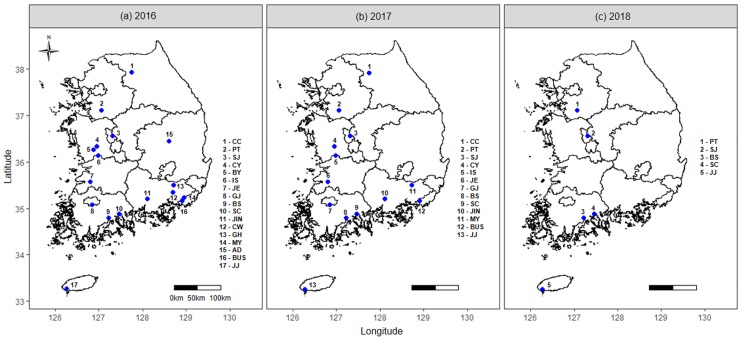
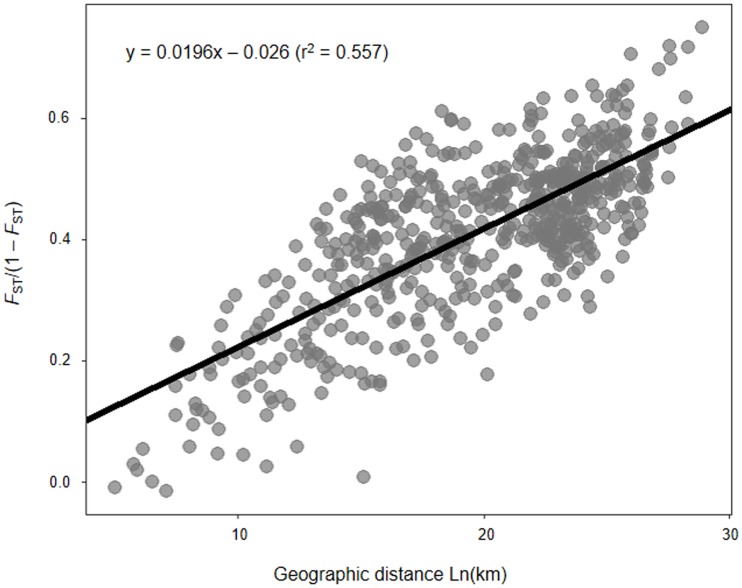
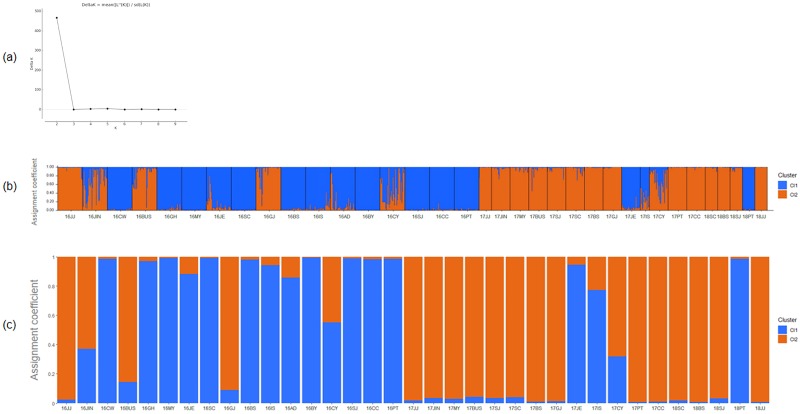
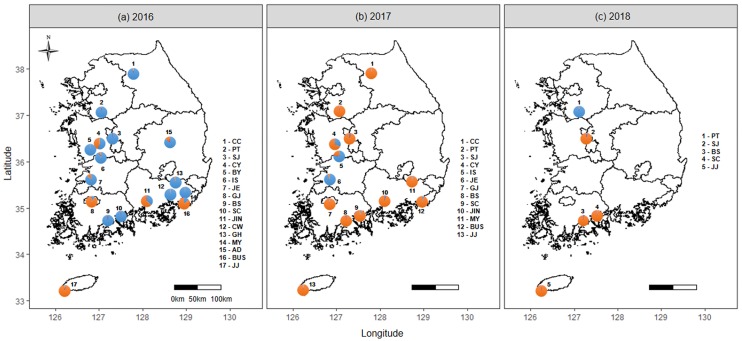
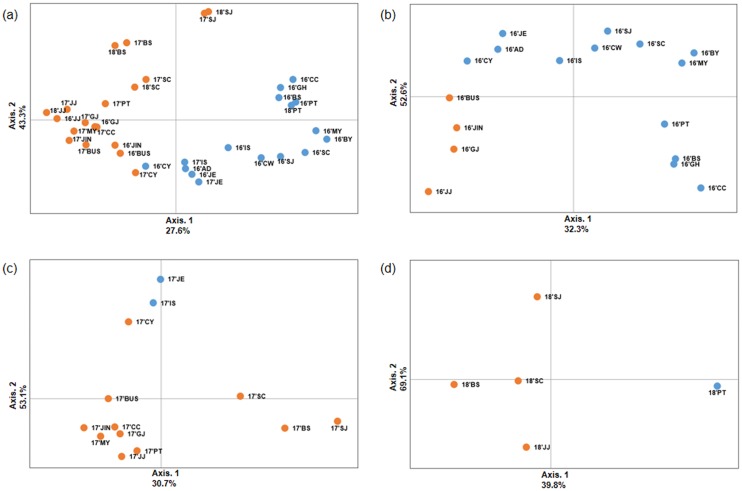
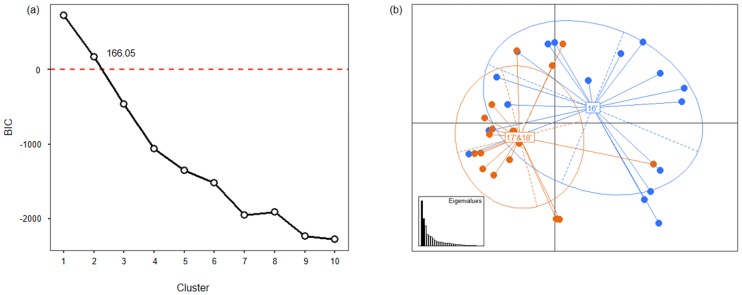
The sweet potato whitefly, Bemisia tabaci (Gennadius) (Hemiptera: Aleyrodidae) is a major agricultural pest that causes economic damages worldwide. In particular, B. tabaci MED (Mediterranean) has resulted in serious economic losses in tomato production of Korea. In this study, 1,145 B. tabaci MED females from 35 tomato greenhouses in different geographic regions were collected from 2016 to 2018 (17 populations in 2016, 13 in 2017, and five in 2018) and analyzed to investigate their population genetic structures using eight microsatellite markers. The average number of alleles per population (NA) ranged from 2.000 to 5.875, the expected heterozygosity (HE) ranged from 0.218 to 0.600, the observed heterozygosity (HO) ranged from 0.061 to 0.580, and the fixation index inbreeding coefficient (FIS) ranged from -0.391 to 0.872 over the three years of the study. Some significant correlation (p < 0.05) was present between genetic differentiations (FST) and geographical distance, and a comparatively high proportion of variation was found among the B. tabaci MED populations. The B. tabaci MED populations were divided into two well-differentiated genetic clusters within different geographic regions. Interestingly, its genetic structures converged into one genetic cluster during just one year. The reasons for this genetic change were speculated to arise from different fitness, insecticide resistance, and insect movement by human activities.
甘薯粉虱,烟粉虱(Bemisia tabaci)(半翅目:粉虱科)是一种重要的农业害虫,在全球范围内造成了经济损失。特别是 B. tabaci MED(地中海)在韩国番茄生产中造成了严重的经济损失。在这项研究中,从 2016 年至 2018 年,从不同地理区域的 35 个番茄温室中采集了 1145 只 B. tabaci MED 雌性(2016 年 17 个种群,2017 年 13 个,2018 年 5 个),并使用 8 个微卫星标记分析了它们的种群遗传结构。每个种群的平均等位基因数(NA)范围从 2.000 到 5.875,预期杂合度(HE)范围从 0.218 到 0.600,观察杂合度(HO)范围从 0.061 到 0.580,固定指数近亲繁殖系数(FIS)范围从-0.391 到 0.872,这是研究的三年期间。遗传分化(FST)与地理距离之间存在一些显著相关性(p <0.05),并且 B. tabaci MED 种群之间存在较高比例的变异。B. tabaci MED 种群在不同地理区域内分为两个分化良好的遗传聚类。有趣的是,在短短一年的时间里,它的遗传结构就汇聚成一个遗传聚类。这种遗传变化的原因推测是由于不同的适应性、抗药性和昆虫通过人类活动的移动。