Gautam Saurabh, Crossley Michael S, Dutta Bhabesh, Coolong Timothy, Simmons Alvin M, da Silva Andre, Snyder William E, Srinivasan Rajagopalbabu
Department of Entomology, University of Georgia, 1109 Experiment Street, Griffin, GA 30223, USA.
Department of Entomology, University of Georgia, 120 Cedar St., 413 Bioscience Bldg., Athens, GA 30602, USA.
Insects. 2020 Nov 26;11(12):834. doi: 10.3390/insects11120834.
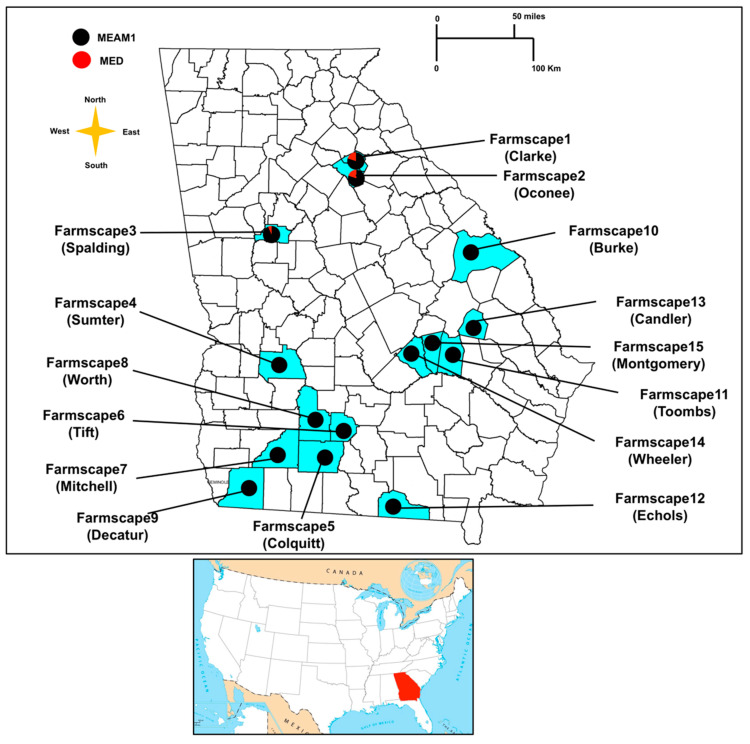
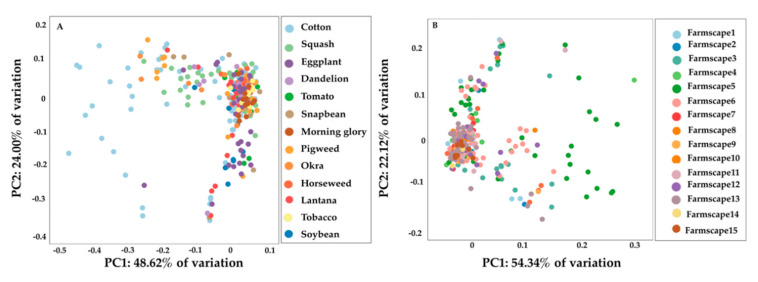
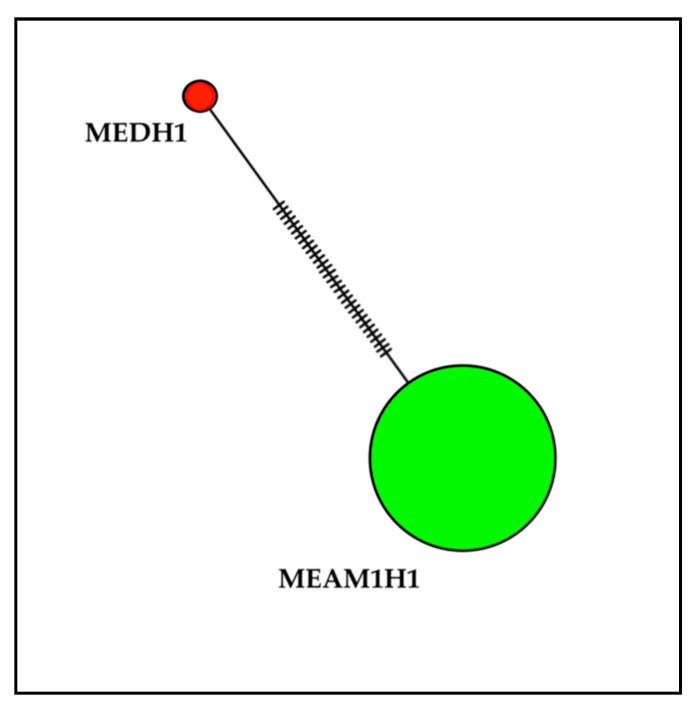
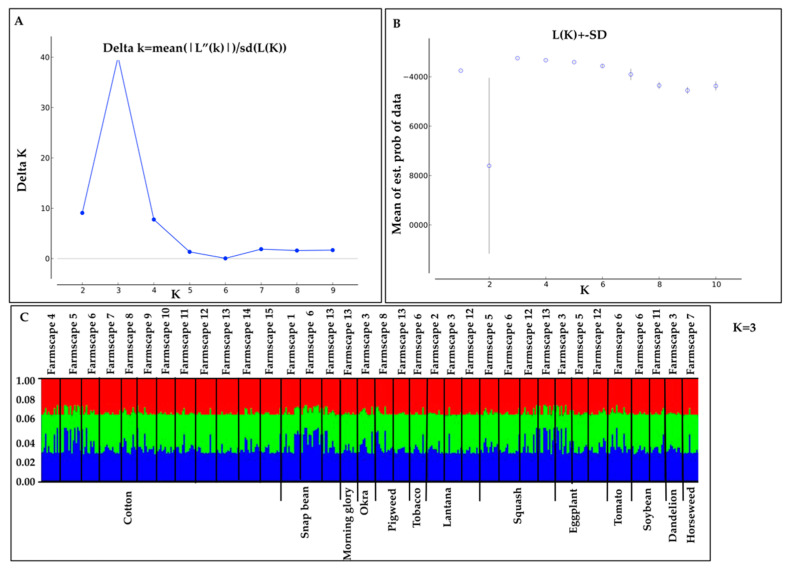
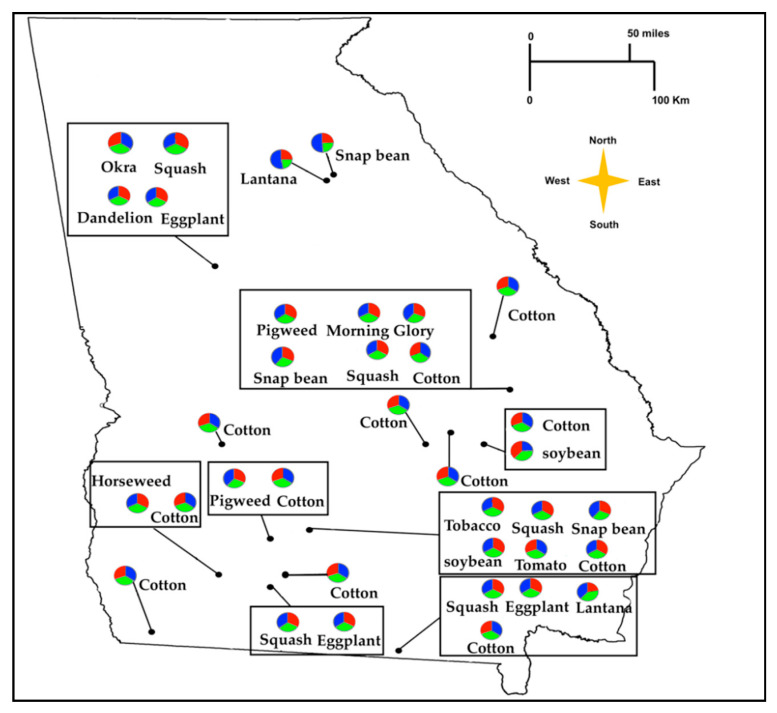
is a whitefly species complex comprising important phloem feeding insect pests and plant virus vectors of many agricultural crops. Middle East-Asia Minor 1 (MEAM1) and Mediterranean (MED) are the two most invasive members of the species complex worldwide. The diversity of agroecosystems invaded by could potentially influence their population structure, but this has not been assessed at a farmscape level. A farmscape in this study is defined as heterogenous habitat with crop and non-crop areas spanning ~8 square kilometers. In this study, mitochondrial COI gene (mtCOI) sequences and six microsatellite markers were used to examine the population structure of MEAM1 colonizing different plant species at a farmscape level in Georgia, United States. Thirty-five populations of adult whiteflies on row and vegetable crops and weeds across major agricultural regions of Georgia were collected from fifteen farmscapes. Based on morphological features and mtCOI sequences, five species/cryptic species of whiteflies ( MEAM1, MED, , , ) were found. Analysis of 102 mtCOI sequences revealed the presence of a single MEAM1 haplotype across farmscapes in Georgia. Population genetics analyses (AMOVA, PCA and STRUCTURE) of MEAM1 (microsatellite data) revealed only minimal genetic differences among collected populations within and among farmscapes. Overall, our results suggest that there is a high level of gene flow among MEAM1 populations among farmscapes in Georgia. Frequent whitefly population explosions driven by a single or a few major whitefly-suitable hosts planted on a wide spatial scale may be the key factor behind the persistence of a single panmictic population over Georgia's farmscapes. These population structuring effects are useful for delineating the spatial scale at which whiteflies must be managed and predicting the speed at which alleles associated with insecticide resistance might spread.
是一个粉虱物种复合体,包含许多重要的以韧皮部为食的害虫以及多种农作物的植物病毒传播媒介。中东 - 小亚细亚1型(MEAM1)和地中海型(MED)是该物种复合体在全球范围内最具入侵性的两个成员。被该复合体入侵的农业生态系统的多样性可能会影响其种群结构,但尚未在农田景观层面进行评估。本研究中的农田景观被定义为跨越约8平方公里的包含作物区和非作物区的异质栖息地。在本研究中,线粒体细胞色素氧化酶亚基I基因(mtCOI)序列和六个微卫星标记被用于在美国佐治亚州的农田景观层面研究定殖于不同植物物种上的MEAM1的种群结构。从佐治亚州主要农业区域的15个农田景观中收集了35个位于行栽作物、蔬菜作物和杂草上的成年粉虱种群。基于形态特征和mtCOI序列,发现了五种粉虱物种/隐存种(MEAM1、MED、、、)。对102个mtCOI序列的分析揭示在佐治亚州的农田景观中存在单一的MEAM1单倍型。对MEAM1(微卫星数据)的种群遗传学分析(方差分析、主成分分析和结构分析)显示,在收集的农田景观内和景观间的种群之间仅存在极小的遗传差异。总体而言,我们的结果表明在佐治亚州的农田景观中MEAM1种群之间存在高水平的基因流动。由在广泛空间尺度上种植的单一或少数几种主要适合粉虱生存的寄主所驱动的频繁粉虱种群爆发可能是在佐治亚州农田景观上单一随机交配种群持续存在的关键因素。这些种群结构效应对于划定必须管理粉虱的空间尺度以及预测与抗药性相关的等位基因可能传播的速度很有用。