Crowley Samuel T, Fukushima Yuta, Uchida Satoshi, Kataoka Kazunori, Itaka Keiji
Department of Biofunction Research, Institute of Biomaterials and Bioengineering, Tokyo Medical and Dental University (TMDU), 2-3-10 Kanda-Surugadai, Chiyoda-Ku, Tokyo 101-0062, Japan; Innovation Center of Nanomedicine (iCONM), Kawasaki Institute of Industrial Promotion, 3-25-14 Tonomachi, Kawasaki-Ku, Kawasaki-Shi 210-0821, Japan.
Department of Biofunction Research, Institute of Biomaterials and Bioengineering, Tokyo Medical and Dental University (TMDU), 2-3-10 Kanda-Surugadai, Chiyoda-Ku, Tokyo 101-0062, Japan.
Mol Ther Nucleic Acids. 2019 Sep 6;17:465-476. doi: 10.1016/j.omtn.2019.06.016. Epub 2019 Jun 29.
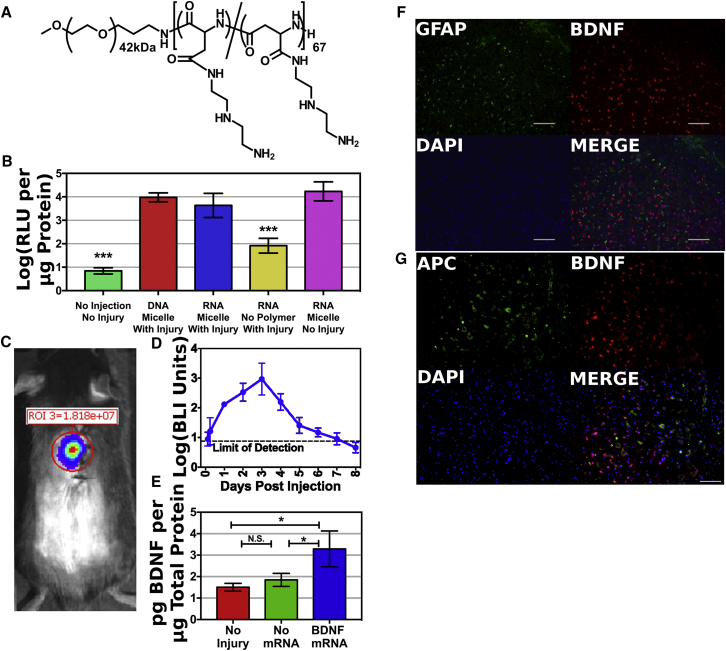
Spinal cord injury (SCI) is a debilitating condition that can cause impaired motor function or full paralysis. In the days to weeks following the initial mechanical injury to the spinal cord, inflammation and apoptosis can cause additional damage to the injured tissues. This secondary injury impairs recovery. Brain-derived neurotrophic factor is a secreted protein that has been shown to improve a variety of neurological conditions, including SCI, by promoting neuron survival and synaptic plasticity. This study treated a mouse model of contusion SCI using a single dose of brain-derived neurotrophic factor (BDNF) mRNA nanomicelles prepared with polyethylene glycol polyamino acid block copolymer directly injected into the injured tissue. BDNF levels in the injured spinal cord tissue were approximately doubled by mRNA treatment. Motor function was monitored using the Basso Mouse Scale and Noldus CatWalk Automated Gait Analysis System for 6 weeks post-injury. BDNF-treated mice showed improved motor function recovery, demonstrating the feasibility of mRNA delivery to treat SCI.
脊髓损伤(SCI)是一种使人衰弱的病症,可导致运动功能受损或完全瘫痪。在脊髓受到初始机械损伤后的数天至数周内,炎症和细胞凋亡会对受损组织造成额外损伤。这种继发性损伤会妨碍恢复。脑源性神经营养因子是一种分泌蛋白,已被证明可通过促进神经元存活和突触可塑性来改善包括脊髓损伤在内的多种神经病症。本研究使用由聚乙二醇聚氨基酸嵌段共聚物制备的单剂量脑源性神经营养因子(BDNF)mRNA纳米胶束直接注射到受伤组织中,对挫伤性脊髓损伤小鼠模型进行治疗。mRNA处理使受伤脊髓组织中的BDNF水平大约提高了一倍。在损伤后6周,使用巴索小鼠量表和诺达思CatWalk自动步态分析系统监测运动功能。接受BDNF治疗的小鼠运动功能恢复情况有所改善,证明了mRNA递送治疗脊髓损伤的可行性。