Ni Zhaohui, Jin Haijiao, Jiang Gengru, Wang Niansong, Peng Ai, Guo Zhiyong, Bai Shoujun, Zhou Rong, Lu Jianrao, Wang Yi, Li Ying, Zhuang Shougang, Yu Chen, Deng Yueyi, Jin Huimin, Xu Xudong, Zhang Junli, Zhao Junli, Yu Xiuzhi, Wang Xiaoxia, Zhang Liming, Niu Jianying, Liu Kun, Bao Xiaorong, Wang Qin, Ma Jun, Hu Chun, Zang Xiujuan, Yu Qing
Department of Nephrology, Renji Hospital, School of Medicine, Shanghai Jiao Tong University, Shanghai, China.
Clinical Research Center, Shanghai Jiao Tong University School of Medicine, Shanghai, China.
J Med Internet Res. 2019 May 8;21(5):e13168. doi: 10.2196/13168.
Renal anemia is one of the most important complications in patients on maintenance hemodialysis (MHD). Telehealth-based dialysis registration systems have the advantage of real-time monitoring and have gradually been applied to the management of chronic diseases.
The objective of our study was to evaluate the impact of a telehealth-based dialysis registration system on patients on MHD in terms of renal anemia control.
The Red China project aimed to develop a dialysis registration system based on the WeChat mobile platform. Demographic and baseline laboratory parameters such as age, gender, primary disease, dialysis age, and baseline creatinine levels were recorded using this system. In addition, the hemoglobin and hematocrit levels were recorded monthly. The platform then generated a hemoglobin and hematocrit statistics report for each hemodialysis center monthly, including the detection rate, target rate, and distribution of hemoglobin and released it to physicians via the WeChat mobile phone app. The physicians were then able to treat the individual's anemia appropriately by changing the doses of erythropoiesis-stimulating agents or iron use on the basis of this report. We analyzed the demographic and baseline laboratory parameters, detection rate, target rate, and average level and distribution of hemoglobin 28 months after the launch of the project.
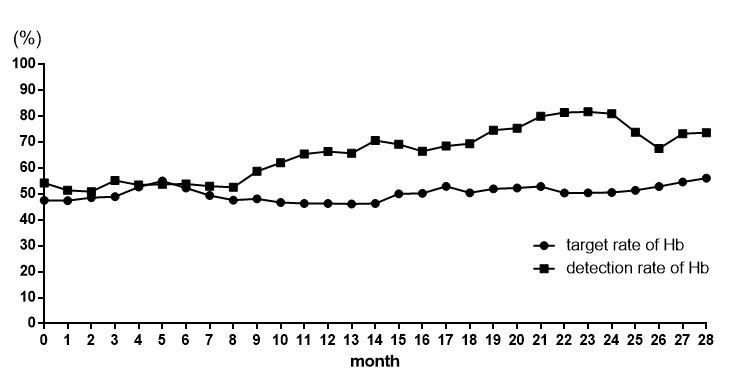
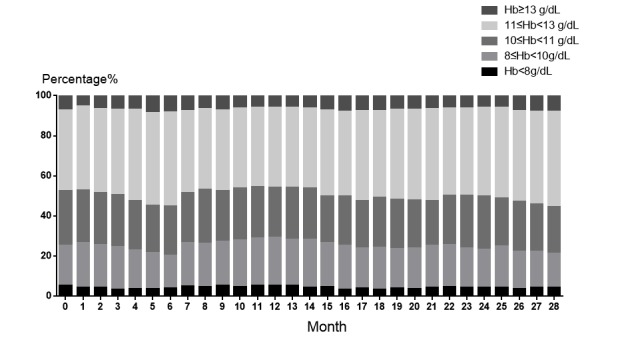
A total of 8392 patients on MHD from 28 hemodialysis centers in Shanghai were enrolled from June 2015 to October 2017. The detection rate of hemoglobin increased from 54.18% to 73.61% (P<.001), the target rate of hemoglobin increased from 47.55% to 56.07% (P<.001), and the mean level of hemoglobin increased from 10.83 (SD 1. 60) g/dL to 11.07 (SD 1.60) g/dL (P<.001). In addition, the proportion of patients with hemoglobin levels ≥11 g/dL but <13 g/dL increased from 40.40% to 47.48%.
This telehealth-based dialysis registration system can provide timely reporting of the anemia status in patients on MHD, which may improve the awareness of anemia and the attention to and compliance with anemia monitoring.
肾性贫血是维持性血液透析(MHD)患者最重要的并发症之一。基于远程医疗的透析登记系统具有实时监测的优势,并已逐渐应用于慢性病管理。
本研究旨在评估基于远程医疗的透析登记系统对MHD患者肾性贫血控制的影响。
“红色中国”项目旨在开发一个基于微信移动平台的透析登记系统。使用该系统记录人口统计学和基线实验室参数,如年龄、性别、原发疾病、透析龄和基线肌酐水平。此外,每月记录血红蛋白和血细胞比容水平。然后,该平台每月为每个血液透析中心生成一份血红蛋白和血细胞比容统计报告,包括检测率、达标率以及血红蛋白分布情况,并通过微信手机应用程序将报告发送给医生。医生随后能够根据该报告,通过调整促红细胞生成素或铁剂的使用剂量,对个体贫血进行适当治疗。我们分析了项目启动28个月后的人口统计学和基线实验室参数、检测率、达标率以及血红蛋白的平均水平和分布情况。
2015年6月至2017年10月,共纳入了上海28个血液透析中心的8392例MHD患者。血红蛋白检测率从54.18%提高到73.61%(P<0.001),血红蛋白达标率从47.55%提高到56.07%(P<0.001),血红蛋白平均水平从10.83(标准差1.60)g/dL提高到11.07(标准差1.60)g/dL(P<0.001)。此外,血红蛋白水平≥11 g/dL但<13 g/dL的患者比例从40.40%增加到47.48%。
这种基于远程医疗的透析登记系统可以及时报告MHD患者的贫血状况,这可能提高对贫血的认识以及对贫血监测的重视和依从性。