Valdez-Meza Eduardo Enrique, Raymundo Anabela, Figueroa-Salcido Oscar Gerardo, Ramírez-Torres Giovanni Isaí, Fradinho Patrícia, Oliveira Sonia, de Sousa Isabel, Suárez-Jiménez Miroslava, Cárdenas-Torres Feliznando Isidro, Islas-Rubio Alma Rosa, Rodríguez-Olibarría Guillermo, Ontiveros Noé, Cabrera-Chávez Francisco
Department of Research and Food Science, University of Sonora, Hermosillo, Sonora 1658, Mexico.
LEAF-Linking Landscape, Environment, Agriculture and Food, Instituto Superior de Agronomia, Universidade de Lisboa, Tapada da Ajuda, 1349-017 Lisboa, Portugal.
Foods. 2019 Jul 24;8(8):282. doi: 10.3390/foods8080282.
Alcalase-treated amaranth proteins generate angiotensin-1-converting enzyme (ACE-1) inhibitory peptides, which could be useful for functional foods development. Our aim was to evaluate the technological, sensory, and antihypertensive properties of pasta enriched with an amaranth hydrolysate.
Pasta with 11% (A; control), 15% (B), and 20% (C) of protein content were formulated. Pastas B and C were supplemented with an alcalase-treated amaranth protein concentrate. Cooking time, cooking lost, color, and texture were assessed. An untrained panel ( = 30) evaluated sensory attributes. The antihypertensive effect was evaluated in hypertensive rats.
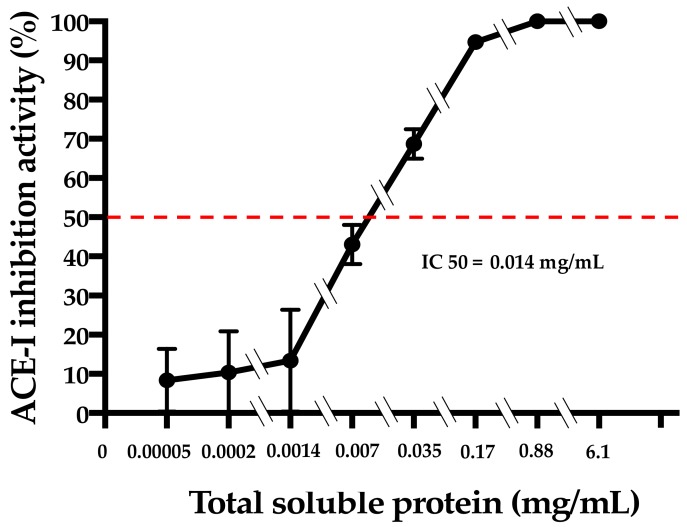
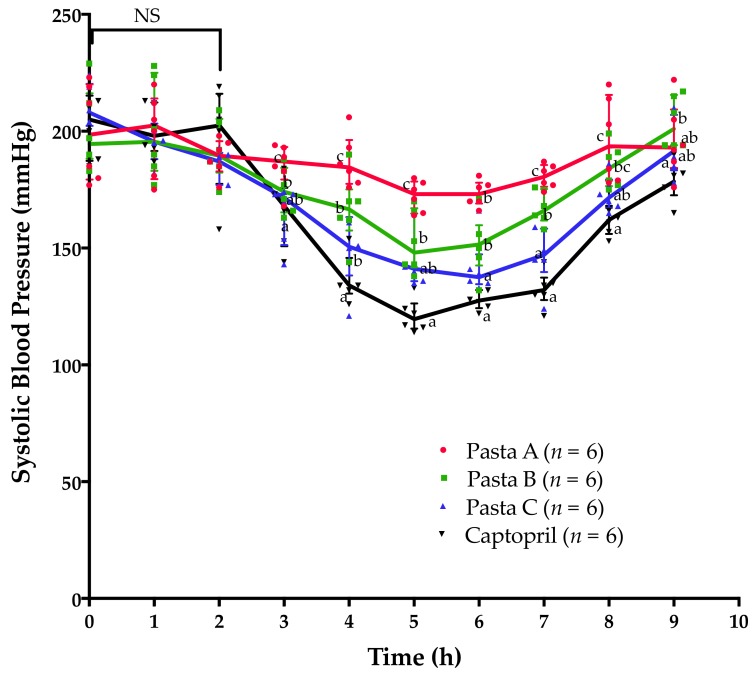
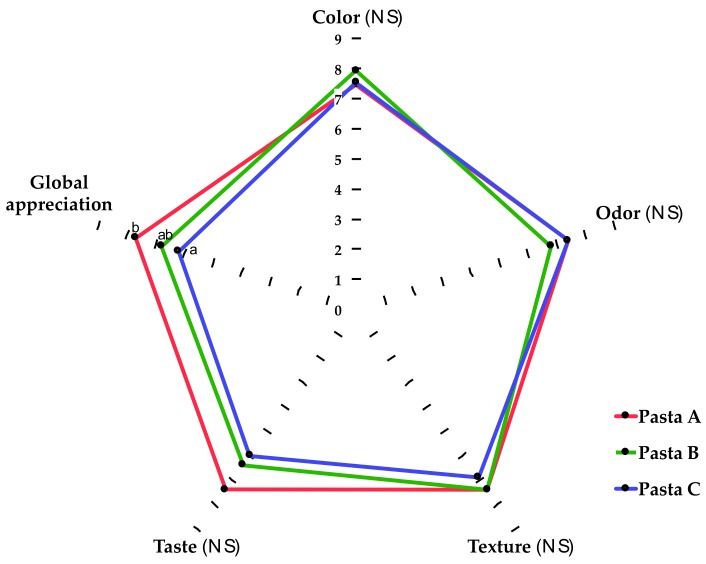
The hydrolysate IC50 was 0.014 mg/mL. Optimum cooking time and cooking loss decreased in products B and C vs. A ( < 0.05). The L* values decreased in pasta C. Firmness increased in pasta C vs. A ( < 0.05). Adhesiveness was different among groups ( < 0.05). Pasta A had the highest acceptability ( < 0.05). The products B and C, and captopril (positive control) showed antihypertensive properties after 3 h of supplementation ( < 0.05). This effect remained after 7 h, 8 h, or 9 h.
The addition of amaranth hydrolysates to pasta negatively impacts on the overall acceptability and, to a lesser extent, on pasta taste. However, it is possible to maintain the antihypertensive properties of the supplemented pasta under physiological conditions.
经碱性蛋白酶处理的苋菜籽蛋白可生成血管紧张素转换酶(ACE-1)抑制肽,这对功能性食品的开发可能有用。我们的目的是评估富含苋菜籽水解产物的意大利面的工艺、感官和降压特性。
制作了蛋白质含量分别为11%(A组,对照)、15%(B组)和20%(C组)的意大利面。B组和C组的意大利面添加了经碱性蛋白酶处理的苋菜籽浓缩蛋白。评估了烹饪时间、烹饪损失、颜色和质地。由30名未经训练的评价员评估感官特性。在高血压大鼠中评估降压效果。
水解产物的IC50为0.014mg/mL。与A组相比,B组和C组产品的最佳烹饪时间和烹饪损失降低(P<0.05)。C组意大利面的L*值降低。与A组相比,C组意大利面的硬度增加(P<0.05)。各组之间的粘附性不同(P<0.05)A组意大利面的可接受性最高(P<0.05)。补充3小时后,B组和C组产品以及卡托普利(阳性对照)显示出降压特性(P<0.05)。7小时、8小时或9小时后这种效果仍然存在。
在意大利面中添加苋菜籽水解产物对总体可接受性有负面影响,对意大利面的味道影响较小。然而,在生理条件下,可以保持添加了苋菜籽水解产物的意大利面的降压特性。