Genomic Unit for the Diagnosis of Human Pathologies, Division of Genetics and Cell Biology, IRCCS San Raffaele Scientific Institute, 20132 Milan, Italy.
Istituto di Chimica del Riconoscimento Molecolare, Consiglio Nazionale delle Ricerche, 20131 Milan, Italy.
Cells. 2019 Jul 24;8(8):769. doi: 10.3390/cells8080769.
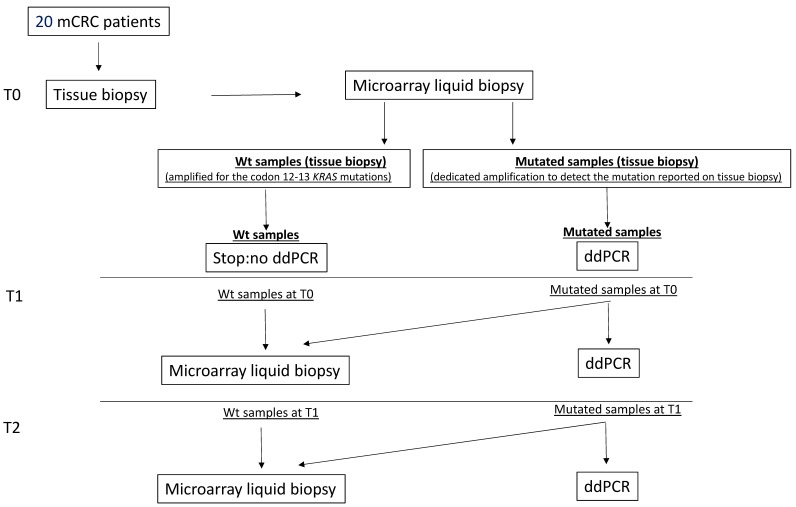
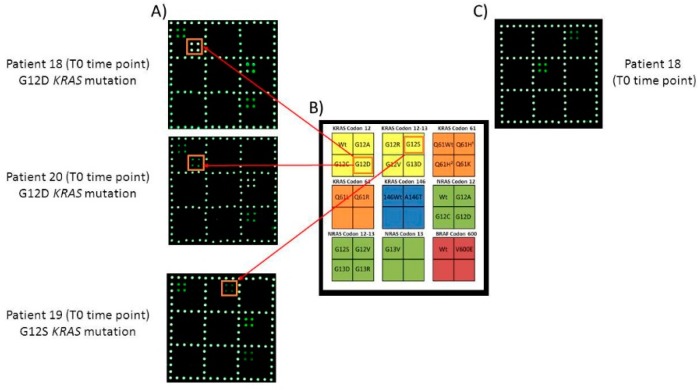
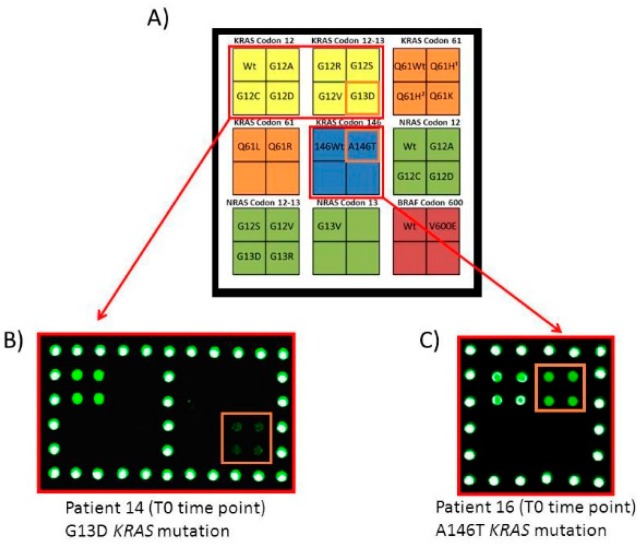
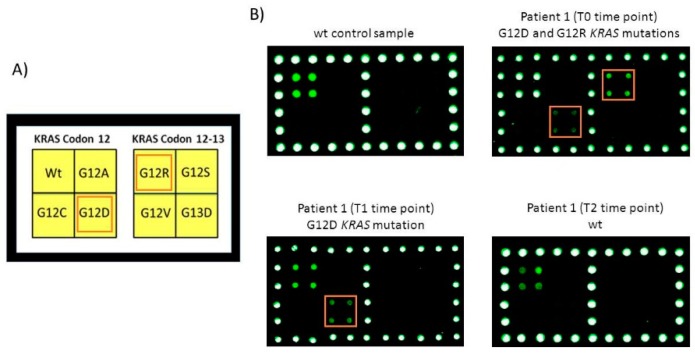
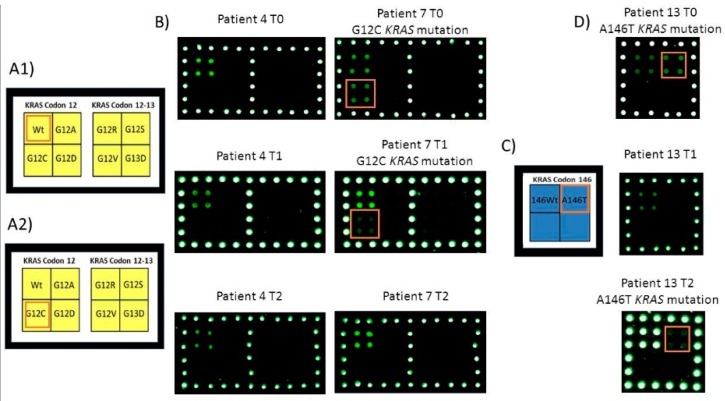
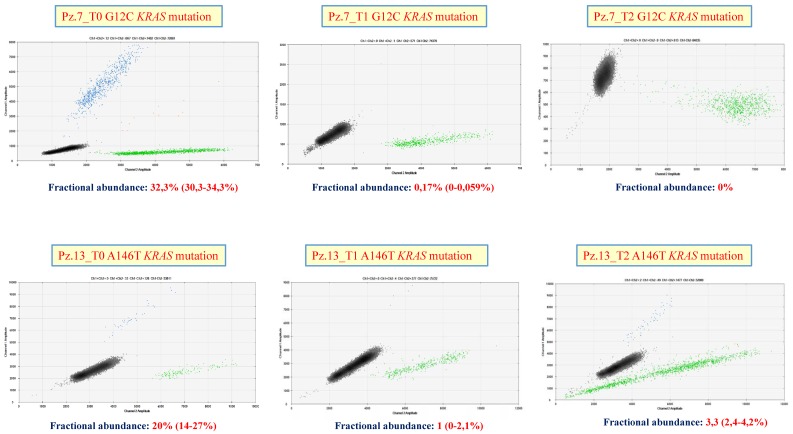
It has now been established that in biological fluids such as blood, it is possible to detect cancer causing genomic alterations by analysing circulating tumour DNA (ctDNA). Information derived from ctDNA offers a unique opportunity to enrich our understanding of cancer biology, tumour evolution and therapeutic efficacy and resistance. Here, we propose a workflow to identify targeted mutations by a customized microarray-based assay for the simultaneous detection of single point mutations in different oncogenes ( and ) followed by droplet digital PCR (ddPCR) to determine the fractional abundance of the mutated allele. Genetic variants were determined in the plasma of 20 metastatic colorectal cancer (mCRC) patients previously genotyped on tissue biopsy at the diagnosis for medication planning (T0) and following the tumour genetic evolution during treatment phase (T1 and T2) with the objective of allowing therapy response prediction and monitoring. Our preliminary results show that this combined approach is suitable for routine clinical practice. The microarray platform enables for a rapid, specific and sensitive detection of the most common mutations suitable for high-throughput analysis without costly instrumentation while, the ddPCR, consents an absolute quantification of the mutated allele in a longitudinal observational study on patients undergoing targeted therapy.
现在已经证实,在血液等生物体液中,可以通过分析循环肿瘤 DNA(ctDNA)来检测致癌的基因组改变。ctDNA 提供的信息为丰富我们对癌症生物学、肿瘤进化以及治疗效果和耐药性的理解提供了独特的机会。在这里,我们提出了一种工作流程,通过定制的基于微阵列的检测方法来识别靶向突变,该方法可同时检测不同致癌基因(和)中的单点突变,然后通过液滴数字 PCR(ddPCR)来确定突变等位基因的分数丰度。在 20 名转移性结直肠癌(mCRC)患者的血浆中确定了遗传变异,这些患者在诊断时(T0)已在组织活检中进行了基因分型,以便为药物规划提供依据,并且在治疗期间(T1 和 T2)随着肿瘤遗传进化进行了检测,目的是允许进行治疗反应预测和监测。我们的初步结果表明,这种联合方法适用于常规临床实践。微阵列平台可快速、特异性和敏感地检测最常见的突变,适用于高通量分析,而无需昂贵的仪器,而 ddPCR 则允许在接受靶向治疗的患者的纵向观察研究中对突变等位基因进行绝对定量。