Kidney Disease Center, The First Affiliated Hospital, College of Medicine, Zhejiang University, Hangzhou, China.
Key Laboratory of Kidney Disease Prevention and Control Technology, Zhejiang Province, China.
Biomed Res Int. 2019 Jun 27;2019:7298635. doi: 10.1155/2019/7298635. eCollection 2019.
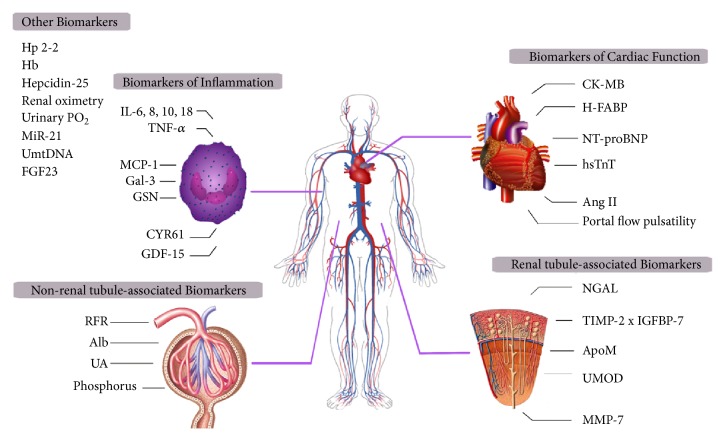
Cardiac surgery-associated acute kidney injury (CSA-AKI) is a major and serious complication in patients undergoing cardiac surgery and is independently associated with perioperative mortality and mortality. Therapeutic intervention aiming at reversing kidney dysfunction seems disappointing across multiple settings. Consequently, attention has shifted from treatment to prevention and early detection. The Kidney Disease: Improving Global Outcomes (KDIGO) guidelines have unified diagnostic standards mainly based on the serum creatinine (Scr) level or urine output, but neither marker is kidney specific. Efforts have been made to identify novel biomarkers with high sensitivity and specificity. The diagnostic capabilities of neutrophil gelatinase-associated lipocalin (NGAL) and G1 cell cycle arrest biomarker as biomarkers have been confirmed in a large number of clinical trials. The utility of biomarkers of cardiac function and inflammation has been validated in clinical studies. Aiming to offer valuable information for further research, we summarize the progress in defining current markers relevant to CSA-AKI in the last three years.
心脏手术相关急性肾损伤(CSA-AKI)是心脏手术患者的一种主要且严重的并发症,与围手术期死亡率和死亡率独立相关。针对肾脏功能障碍的治疗干预在多种情况下似乎令人失望。因此,人们的注意力已从治疗转向预防和早期发现。肾脏病:改善全球结局(KDIGO)指南主要基于血清肌酐(Scr)水平或尿量统一了诊断标准,但这两种标志物都不是肾脏特异性的。人们一直在努力寻找具有高灵敏度和特异性的新型生物标志物。大量临床试验已经证实中性粒细胞明胶酶相关脂质运载蛋白(NGAL)和 G1 细胞周期阻滞标志物作为生物标志物的诊断能力。心脏功能和炎症生物标志物的实用性已在临床研究中得到验证。为了为进一步的研究提供有价值的信息,我们总结了过去三年中与 CSA-AKI 相关的现有标志物的研究进展。